Kleros Live Stream, 5 August 2026: the first case where the evidence is not public
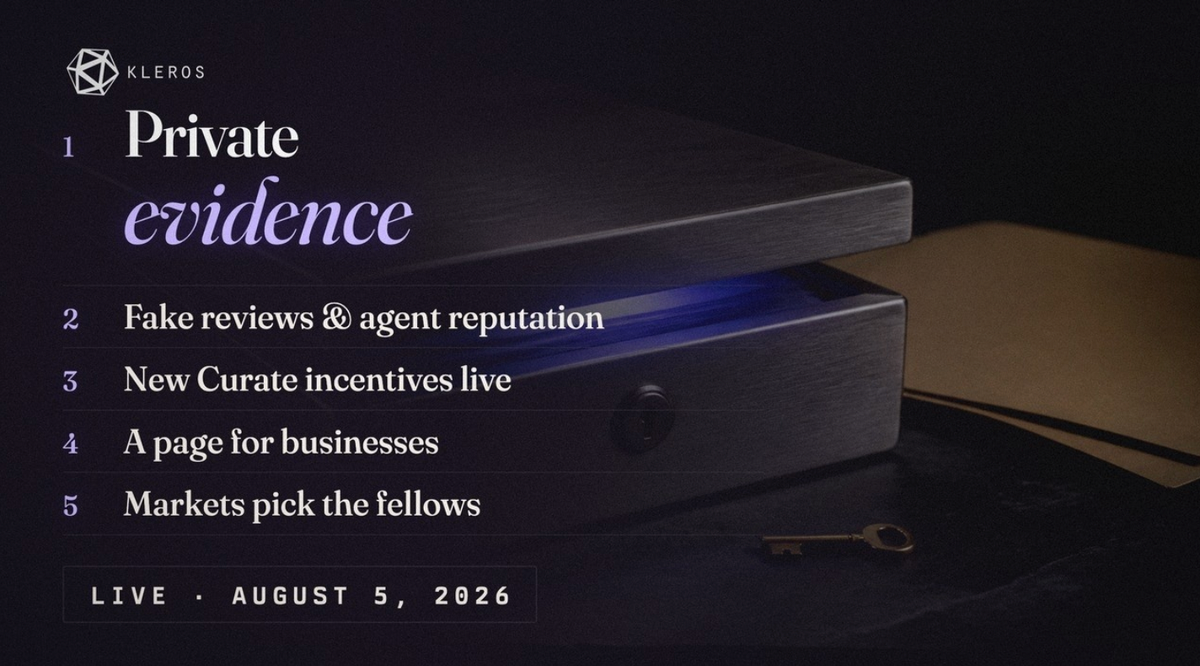
Case 146 came out of the Junín court and it was an airline no-show claim. The dispute is unremarkable. What is new is that the evidence never became public, which makes it the first Kleros case to run that way.
Confidentiality has been the standing objection to using a crowdsourced court for anything serious, so most of this call is about what it took: the research, the legal wrapper, and how the first case actually went. Then agent reputation, fake reviews, and a fellowship that picks its own fellows with a prediction market.
📋 The call at a glance
- Case 146 is the first Kleros case with confidential evidence. Evidence sat in a compliant data room instead of on IPFS, visible only to credentialed jurors.
- The hard problem is the crowd, not the chain. Jurors are strangers, and they have to read the evidence to rule on it.
- Curate: new incentives live, Robinhood Chain added, and challenges are down since submitters started using AI skills.
- A proof of concept for agent reputation under ERC-8004, which turns into the fake-review problem at agent scale.
- The Fellowship is open, with a privacy track and a decision-markets track whose fellows are chosen by a prediction market.

Chapters — jump to the moment
0:00Intro — POAP winds down, end of an era 3:25Case 146 — the first case with private evidence 7:33Handling confidential information in Kleros (William George) 8:45The catch: the evidence has to reach the crowd 11:32The Juror Misbehaviour Court 12:55Watermarking: which juror leaked? 17:59Vetting jurors with KYC, NDAs and credentials 22:22AI jurors inside trusted hardware 29:34GDPR and private courts (Facundo Trotz) 36:06Curate incentives, Robinhood Chain & Blockscout (Fortunato) 38:31Agent reputation, ERC-8004 and fake reviews 43:55The first case solved with private evidence (Lucía) 47:08A new Kleros for Business page 50:35The Decision Markets Fellowship 56:49Why academic mentions compound, and a book from IndiaThe call opened on POAP winding down, which Federico Ast took harder than a product sunset: born in Argentina, it became a fixture of every conference badge in the space, and his first encounter with it was Devcon Osaka in 2019.
Case 146, and the thing that has been blocking Kleros for years
Kleros handles a steady flow of government disputes: neighbourhood claims, consumer complaints, insurance, small construction. What it could not handle was a party who needed the file kept quiet. The reason is one property doing both jobs. A blockchain court is transparent, which is exactly what gives it rule of law, and that same transparency is what has kept an entire category of disputes away.
“One of the main value propositions of arbitration as a business is the fact that it is confidential.”
Federico Ast · 5:29
So Kleros started configuring courts with a different parameter set, where the evidence is not published. Case 146 is the first to run, and it is on chain like every other case: the court, the question the jurors answered and the ruling are all public. Only the evidence is not.
“It might look like a small thing now, but this is kind of a change in the trajectory of Kleros adoption.”
Federico Ast · 7:19
The problem is not the chain, it is the crowd
William George presented the research, and started by clearing away the obvious framing. Blockchains are transparent, but privacy coins have shown for years that you can put encryption on top of one. The real problem is structural, and specific to crowdsourced courts.
“Ultimately, if jurors drawn from the crowd are going to make a decision, they need to see that confidential evidence.”
William George · 9:01
What follows is a toolbox rather than a solution, and he said so himself. There are two places to intervene: before a juror ever sees the file, and after it leaks.
“Ultimately the security you have is economic. As is the case in most crypto-economic systems, you have resistance to attack up to some value.”
William George · 15:53
Fine for a crypto-native party who can price that risk. Not fine for an enterprise being asked how much economic security their trade secrets need, especially once you notice that a competitor who knows your case is coming can stake into the court they expect it to land in. That is what pushes you to the left-hand column.
When the juror is an AI
The newest section was about a jury of three models rather than three people. Kleros works fine that way, and the confidentiality problem gets a genuinely different answer: a trusted execution environment, hardware that holds encryption keys in a way that is not supposed to let them out and wipes itself if someone opens the box. The party encrypts the evidence to the enclave rather than to a juror. The model reads it and rules inside. A ruling comes out, encrypted so only the party can read the justification, and nothing else is ever visible to anyone, including the company running the model.
The elegant part is the second key. A juror running an LLM has secrets of their own, the prompts and the workflow that make their model rule well, and that is their edge over the other jurors. So they encrypt those to the same enclave. Neither side has to show the other anything. What you are trusting instead is whoever manufactured the hardware, and William did not dress that up: the mitigation is the same curated list, one level down.
The legal half of the answer
Facundo Trotz took the part no amount of mechanism design solves. IPFS is a hard place to comply with data protection law, which is survivable while your caseload is curation disputes about public smart contracts, and not survivable the moment you handle a citizen's consumer complaint on behalf of a municipality.
“Instead of posting evidence to IPFS, we keep it in a GDPR-compliant virtual data room.”
Facundo Trotz · 30:34
Each court sets its own bar for the credential. For the consumer ombudsman court a juror has to be a lawyer with consumer-protection experience or bring dispute-resolution experience, and accept terms that work as a code of conduct. Both he and William used the same phrase for all of it: a proof of concept, with trust assumptions and centralisation points, and a first step rather than a finished system.
Curate, and the fake review economy
New Curate incentives went live on August 1, Robinhood Chain joined with Blockscout as its reference explorer, and Gnosis and zkSync moved to Blockscout too. Scout now shows your full history, both what you earned through incentives and what you made challenging other people's items.
The most interesting number was a decline. Since submitters started using the AI skills, challenges have gone down, which sounds like less activity and is the opposite: submissions are simply right the first time.
“It is easier, faster, and you have less chance of being challenged, because AI are really, really good at spotting mistakes.”
Fortunato Cinquepalmi · 37:49
He also previewed a proof of concept, going to partners shortly, for curating agent reputation under ERC-8004. The problem is visible in the standard already: agents with tens of thousands of reviews and no way to tell which of them mean anything. It is the TripAdvisor problem with the volume turned up, since an agent can farm reviews faster than any human review farm.
Federico's contribution was the case that breaks every detection system built so far. A tour guide, at the end of the tour, still holding the keys to the van back into town, hands him a phone and watches him leave five stars.
“I mean, my review was under duress, you know.”
Federico Ast · 40:56
A real person, of their own hand, about a service they actually received. And worthless. Whatever gets built for agents has to survive that, not just the crude bot farms.
What the first case looked like
An airline dispute from Junín. A passenger booked a flight to Brazil, an airport strike was announced days before departure, and hours before the flight the check-in page returned an error. Unsure the flight would operate, she did not go to the airport. It operated, her ticket was marked a no-show, and the jury had to decide whether she should get her money back. Three jurors ruled: one against, two in favour of the passenger.
“It will allow us to solve cases even faster, because when we anonymised information it took us a long time to review.”
Lucía Bocalandro · 46:02
That operational half may matter as much as the legal half. The old process meant anonymising every document by hand, sometimes with three people checking the same file, and it took days. The new one removes that step and gives jurors the full context of a case rather than a redacted version of it.
She also walked through the new Kleros for Business page, the companion to the government-facing one from the week before. And the three-part walkthrough of how an Enterprise case actually runs is now published:

A fellowship that picks its fellows with a prediction market
The tenth generation of the Kleros Fellowship is open. The privacy track is the direct invitation from everything above, from either the crypto-economics or the legal side; Facu's ask was specific, data protection experts ideally paired with someone technical.
The decision-markets track does something recursive: fellows are selected by a prediction market. You apply with a research project, a market on Foresight prices its Impact Score over a four-week trading period, and the top-priced project is admitted, with the committee free to admit more. Payment follows realised impact rather than the forecast, at a thousand dollars per impact point up to a five thousand dollar cap. Jean named the failure mode out loud, which is why it is interesting. Any fellowship can be accused of picking the founder's favourites, and a market anyone can bet against is a strange and rather good answer.
Round two of the Foresight movie experiment is also open for trading. The premise sounds trivial, predicting how CTO Clément rates films, and the first round was not: the market beat both AI models and specialist recommendation algorithms.
Why the citations compound
The call closed on a video the team had just published: eighteen academic papers cited Kleros between March and June 2026, four of them featured, with more found since. Jean asked why now.
“This is a compounding effect. When we started there was nobody writing about Kleros, because Kleros didn't exist.”
Federico Ast · 57:30
Someone writes the first paper, someone reads it and writes the second, a doctoral student picks Kleros as their subject and now a piece of their career is tied to the project being interesting. Federico's argument for why this beats a marketing campaign is really an argument about a conservative industry: law does not switch providers because someone shipped a faster API, it moves when people it already trusts start talking about you. The illustration arrived at the end, from a fellowship candidate who mentioned during his interview that he had written a book about Kleros. He directs a large arbitration centre in India. Nobody at Kleros knew.
“He wrote a book about Kleros without telling us. I don't know how many people from other places are doing the same. This grows like plants.”
Federico Ast · 66:01
Mentioned in this call
- VideoPrivate Evidence, Public Court · William's full presentation, 28 min, chaptered
- VideoHow a Kleros Enterprise case works: intake and anonymisation · creating the case · evidence, voting and the ruling
- VideoAcademic Pulse Vol. II on X and LinkedIn · eighteen papers citing Kleros, March to June 2026
- CaseCase #146 on Kleros V2 · the dispute itself, closed and verifiable
- ArticleThe New Arbitrator Selection Problem in the Age of AI · Kluwer Arbitration Blog, the study with William and Rob
- ArticleThe Predictive Path of Justice · prediction markets and the arbitration efficiency crisis
- ArticleWhat the first Foresight experiment taught us
- ArticleAdvance Decision Markets: Kleros Fellowship Offers Up to $5,000 · the decision-markets track in full
- ApplyKleros Fellowship of Justice, 10th generation · privacy and decision-markets tracks
- ProductKleros for Business · Kleros for Governments · Scout · Foresight
- StandardERC-8004 · agent identity and reputation
- ToolsTresorit · the encrypted data room used for these cases
Full transcript · August 5, 2026
Auto-generated transcript, lightly processed and pending a final human edit. Speaker labels are approximate. Every timestamp is a deep link into the recording.
0:09Hello, hello, hello guys, how are you?
0:11Welcome everyone.
0:12Hello Jean, how are you?
0:14Hello, doing great.
0:15And you?
0:17Good, good.
0:18Uh today is uh Wednesday, 5th of August.
0:22Um I mean I'm kind of uh big also happy because we need to have a life happiness.
0:30Because of the news that happened this week about you know POAP winding down the project.
0:36You know like Pop was uh one of the big you know uh issuers uh the main issuer of the surround focus are um and it's like um I don't know, like seeing Patricio with his uh red suit everywhere, like promoting the project, uh also you know the fact that it was born in Argentina and got to
0:57regional global importance, I don't know.
1:01It made me a bit uh sad this this week.
1:04I mean this is like uh kind of an end of an era, right Jean?
1:08Yes, uh I remember the first uh live streams uh like the the computer we we used to distribute the POAPs And then when we went to the case.
1:29Looks looks like my connection dropped.
1:32Yeah, yeah, okay.
1:33But we're here.
1:34So yeah, you were saying about the about the first I'm I I I'm fi fix your thing and I will explain tell my first experience.
1:41I think my first experience with POAP was um in the Osaka 2019 Devcon conference.
1:51I think that was the first time I saw them.
1:53And um And it was the it was the conference where all of the Argentinians made the campaign to make the next uh DevCon in Argentina.
2:04Which didn't happen because we got COVID after that and then and then was not in Bogota, which it was maybe not a bad idea because also Colombia is also Latin America is also a place to when we want to bring more more users.
2:26And so like for me it's like a sad moment then in like a closing moment of um yeah it's sad.
2:34It's sad.
2:34I don't know.
2:35Um I'm also the I'm the worst POAP collector ever, you know, like uh people I know people who have like uh thousands of POAPs of all of the events.
2:45I've been to like lots of events like many countries I I never collected any POAP, you know.
2:51I always was like too lazy to to scan the code, you know, but I I yeah.
2:55Um One thing that uh was interesting is that they also had uh when when POAP Yeah, I think um I'm going to to continue myself.
3:12Uh Jean can tell us a bit later about the you know this live TEE is like this.
3:17Uh so what we have today um to move to another topic now is um so There is now in Kleros uh a case coming from the Junín Court called case 146.
3:31Uh as you know we are working uh with um different governments in order to have Kleros as a system to resolve disputes um coming in neighborhood claims, consumer claims, and we have like insurance disputes, we have uh like um construction, small construction disputes.
3:52credit card claims, all of the sort of things you could you could expect in neighborhoods, cities, municipalities, and we are really uh pushing a lot this type of use cases.
4:02And so historically, uh Kleros as a protocol had a big problem for adoption in the context of um traditional companies or traditional arbitration or traditional, you know cities um in order to well solve disputes that blockchains have a good advantage and a disadvantage.
4:23The advantage of blockchains is that they are transparent And the disadvantage of localist is that they are transparent in the sense that uh they are transparent in the sense that they provide rule of law and they provide certainty about how the process is going to work to all parties.
4:36So everyone knows that if the process of resolution of a pro of a of a dispute is encoded as a in a in a blockchain uh and in a system like Kleros.
4:47So you know that the process is going to be followed as it was coded and that nobody can tamper with it.
4:54So nobody can attack the system, nobody can put the rulers that they prefer, nobody can tamper with the evidence, nobody can tamper with the vote counting process and all that.
5:05However, um this advantage uh that blockchain has um for this type of use case or for this type of process becomes a disadvantage when you want to uh Have cases be confidential or private because of not everyone wants their disputes to go out in the public.
5:27Uh actually one of the main uh value propositions of arbitration as a business um is the fact that it is confidential.
5:37If you go to court against someone then those that information will end up being public.
5:42And so may many times you don't want that to be public because of trade secrets.
5:48You don't want people to see uh w how your business is operating or whatever.
5:54Uh so this is why um For lots of use cases of Kleros, uh you need information to be private.
6:02Also for regulatory reasons, uh there are, as you know, laws that protect privacy of people in different countries, and this is uh an important issue.
6:11So for us um it was always um because of being built on blockchain uh a problem that we could not give um the customers or partners the access to this uh confidentiality that they needed to adopt Kleros.
6:30And so this has always been a big friction point for us Um so for a long time we have known this and uh now we have been uh researching um way more the issues of privacy and confidentiality.
6:47Um And this means that we are starting to configure a number of curves with and different parameter set where the evidence is not public anymore Um and um this is going to remove we think a big friction point um from from from us.
7:07So Case 146 from Junín is the first one where we are testing this new system for evidence and case confidentiality.
7:19Uh it might look like a small thing now, but this is kind of a change in the trajectory of Kleros adoption, especially in all of the enterprise cases where this is a very important uh important issue.
7:33We have here today we brought William to make a presentation about all of the research that we have been conducting and how we are thinking about the problem of confidentiality and privacy.
7:44So he will make a presentation.
7:46How are you, William?
7:47Welcome.
7:47I'm doing well.
7:48Hi everybody.
7:50Awesome.
7:50Well, uh share your screen and yeah, and walk us through all of this.
8:01Okay, can you see a slideshow?
8:05It's yeah, perfect.
8:07Great.
8:09Okay.
8:11So like as Fede was saying, you know, there's these questions around how one can handle confidential information in a system like Kleros.
8:20Uh and you know he he made all these points about like, okay, blockchains are very transparent and open, you see all the transactions, and all of that is true.
8:27Uh it makes it very difficult to have like kind of like secret interactions, you know, you see all these kinds of like privacy coins that you try to use like fancy encryption techniques to get around transparency of blockchains while still having secrecy.
8:41That presents like the ch transparency of blockchains themselves presents a challenge.
8:45Uh but I would say that even a bigger challenge for for trend for uh confidential evidence in in Kleros and systems like Kleros is that Kleros is a crowdsourced system.
8:53Uh if you have like a dispute between Alice and Bob and it's you know, you have like confidential evidence which is relative to their dispute.
9:00They have business documents or whatever.
9:01Like ultimately if the crowd, you know, jurors drawn from the crowd are going to make a decision for What's the appropriate resolution to the dispute?
9:09They need to see that confidential evidence.
9:11So that the evidence has to go to the crowd.
9:18like challenges around how you can do that uh and provide good, cheap, crowdsourced resolutions uh while not just like publishing the evidence.
9:28Um so like currently, um, you know, like prior to case one forty six, uh But like evidence in Kleros is always just like published IPFS by default.
9:40It was it was made public.
9:42And as you, you know, you can see if you've followed like history of past Kleros cases up to this point.
9:47Like most of the case has been about things that are like very public to begin with, where the evidence isn't very confidential.
9:52You know, all these like curation disputes.
9:55about um, you know, like whether some like public contract uh deserves like a tag on a block explorer and the contract is already published, so there's nothing confidential about that.
10:05If you want to have confidential evidence, like the natural thing to do is say, okay, I'm going to like encrypt the evidence.
10:12I'm not just going to publish it unencrypted to IPFS.
10:15you know, like I'm gonna do some kind of key exchange between the the parties, Bob and the juror.
10:20Uh they're going to like come up with some way that they share some some secret cryptographic key.
10:25Uh and then Bob can encrypt the evidence.
10:28and send it to the juror or jurors uh and uh they'll be able to decrypt it, see the evidence, make a good ruling, uh, and everybody else, you know, they they won't, you know, like it'll just be sort of garbled noise if they look at the encrypted channel.
10:42Uh that's you know not so hard.
10:45Uh that's like you know one can add an encryption layer on top of Kleros, you know, there's this extra infrastructure.
10:51Uh it's not intrinsically difficult to deal with that.
10:54However, what is challenging is how to deal with leaks.
10:58What do you do if the juror just like reveals the evidence anyway?
11:02Uh and um, you know, like being in crypto a crypto economic system, you know, I like Kleros is you know built out of these all these crypto economic tools, like a natural thing to do uh you know in crypto economics in general is that if you have some action you don't want people to take
11:19Uh you make them stake a deposit, and then if they take the action that you don't want, you slash the deposit somehow.
11:26So a mechanism that we've thought a lot about uh over the years uh to sort of enforce like uh a code of behavior on on jurors as what I call the juror misbehavior court.
11:37Uh so this is a mechanism which is like V2 of Kleros is designed so that this can be inserted as a module at some point in the future.
11:46Uh and the idea here is that if the juror does something that's against the juror code, uh they can be challenged by by some observer or some challenger, maybe one of the other jurors, maybe one of the parties to the disputes, uh, maybe maybe a third party, uh, who will place a deposit uh and um that deposit will
12:07be used to finance some some secondary Kleros case.
12:09So let's like some totally new jury is drawing some other courts, a court that specializes in these juror code questions.
12:16uh and then uh they'll judge whether the juror in this case would release this like evidence inappropriately uh and if the juror is like convicted of inappropriate releasing of confidential evidence
12:28A part of their PNK stake will be slashed.
12:30Maybe they get a negative SBT that will prevent them from being drawn again.
12:34There's like black marks so they can't come back.
12:38So that's you know like a kind of cryptoeconomic tool that you can use to prevent people from from inappropriately releasing confidential evidence.
12:46How can you tell if you just sort of see like the evidence like appear on the internet, you know, it's like floating around all of a sudden?
12:52How do you know which juror uh published it?
12:55So here there are tools around what's called digital watermarking.
12:59You try to like, you know, like the party to the dispute can run their their evidence through some kind of digital watermarking software, uh which will basically make all these like small changes.
13:10uh that are imperceptible to human beings, uh but like you know if you run it back through the software again you can kind of you know pick them out.
13:18So things like adding a little bit of space between characters, small changes in fonts, uh things that like a human being won't won't notice.
13:27uh but like if you have multiple versions of the of the evidence that were sent to like say three different jurors they'll all be watermarked in slightly different ways.
13:37And if you see that like one of them is floating around on the internet later, you can kind of like run it back to the tool and pick out, okay, like because of this spacing, we know that juror A was was the one who released the evidence.
13:48Uh and then you get into all kinds of like cat and mouse games of like, okay, like to what degree can the juror reformat their their document and try to delete the uh the spacing?
13:57Uh you know, people who make digital watermarks try to be resistant to that, but you know there's you know, it's it like it the it's a cat and mouse game, you know, like with like there is for one attack you have, you know, like counterattacks and things.
14:11So this is a useful tool, but you know, like with limitations.
14:15Um and then um like on an approach that we've taken for for these Junín cases for like case 146.
14:23uh is to use an interface called Tresorit.
14:26So Tresorit is a Swiss company that like basically does uh encrypted document sharing uh as like a service.
14:33Uh and uh so that makes you know that that's an interface to which jurors can like uh parties can encrypt the evidence which will go to jurors.
14:41Um uh uh Tresorit offers like end-to-end encryption so you can do this in ways that like The company itself doesn't see your encrypted evidence.
14:49They include watermarking features.
14:55They uh have features so that like jurors that are provided with this encrypted evidence can't just like download the evidence, like downloads are blocked.
15:02There's that in some sense, like that that kind of feature is kind of in the philosophy of like Snapchat or like a fancy version of Snapchat, uh where you try to like prevent people from saving the the information on like a software level.
15:17And uh that is obviously, you know, has as limitations like what prevents someone from just like taking a photo of like the screen with their phone Uh on some level, you know, it's it's intrinsically difficult to prevent that.
15:28Uh but then you go back to like the watermarking features and things to try to like at least add some kind of resistance to such Thanks.
15:34Such a such a tax.
15:36Okay.
15:37And that's all well and good.
15:39If you have like purely crypto economic kind of defenses against um evidence being leaked, you know, these like, okay, like if I release the evidence, I'm gonna be slashed in the juror misbehavior court.
15:52You know, like That that that that can be good for certain kinds of evidence, you know, like low-scale, like not so sensitive, not so valuable, but ultimately the security you have is economic.
16:05As is the case in most crypto economic systems, you have like you know resistance of attack up to some like value.
16:12You know, in in Kleros we have all kinds of like models around like, okay, like the resistance Like Ethereum itself has kind of similar economic models, okay.
16:24Like You know, like what are the costs to like try to like attack the consensus algorithm?
16:28Uh you buying up a lot of ETH and staking in like malicious ways Uh and like here as well, you know, it's like, okay, like I have some kind of like economic resistance.
16:38Uh if you know the evidence is leaked, juror will be slashed.
16:41that slash goes up to a certain amount of deposit that they've staked.
16:44Uh you know, like ultimately you get into like things like, okay, like if a juror has like say say my like competitor uh thinks I have a case coming up soon and they want access to my confidential evidence.
16:56They can s maybe try to stake in the court that I they they think the case will be in.
17:00And then if they like stake a certain amount, they have a certain chance of being drawn.
17:04Uh and you know, like you have all these like subtle questions around like how much And if you have like very crypto use cases that might feel familiar to the parties, they might be okay with that, particularly if the evidence isn't too sensitive.
17:20Uh if you have kind of, you know, maybe like more enterprise use cases, people come from the web 2 world, they're not like the most comfortable with like reasoning through like what like how much economic security they they need, uh, then you really need systems that like are less open.
17:38Where not just anybody can be a juror.
17:40Like you have some kind of mechanism in place so that like my competitor cannot just, you know, like is vetted in some way so that he cannot register as a potential juror for my cases.
17:51And um how can you do that?
17:53Uh well conceivably you could have some kind of like decentralized curation, maybe uh like If you want to conform with the like regulatory requirements of a lot of enterprise use cases, you probably need some kind of KYC.
18:06So like a line of thinking we've done is like, okay, like If you want to register in certain certain cases, uh you need some like SBT saying that you've been KYC by some KYC provider, uh and maybe signs.
18:21some kind of NDA and like even beyond like whatever like crypto economic stake that might be slashed in the juror misbehavior court if you misbehave, you know, like Like the KYC provider knows who you are and you can be held legally responsible.
18:33Uh there's like a greater threat to re uh revealing evidence inappropriately than just, you know, whatever you stick in the court like, you know, they they can find you and like maybe you have like criminal
18:44proceedings against you.
18:46And um that seems you know fairly centralized.
18:50You know, like okay, I'm going to a specific KYC provider.
18:52They give me an SBT.
18:54You know, I can only be drawn if I have like you know the SBT uh at least in like certain courts.
18:58Uh you know, this KYC provider is now like kind of like you know like a central actor in in at least in those courts.
19:05Uh and I asked myself, like, okay, like what to what degree can we decentralize this?
19:08Uh like can you have like similar security guarantees uh while still having you know some some level of decentralization?
19:15Uh and um an approach that that I'm considering uh like you know maybe at some point in in the future for like um you know as as the ecosystem of of uh private evidence cases develops, uh you could have like a curated list of KYC providers.
19:32Uh so maybe in like, you know, maybe they're different KYC providers.
19:36Uh you know, you use like private evidence cases with like Junín, maybe Junín is willing to KYC people, you know, maybe maybe not.
19:48Uh so you know, like maybe The company itself is willing to act as a KYC provider, the Kleros Cooperative itself, maybe some kind of like forward-thinking like crypto-specific law firm is willing to KYC you, maybe like other companies just provide this as a service if it gets big enough.
20:03Uh and then if I want to like add a new KYC provider, I can like submit that to a list.
20:07And then you do the normal Kleros thing where like if the KYC provider is like not up to the standards of whatever court, uh, you know, like providing enough verification for jurors to be used in that court, uh, then you can people can challenge that.
20:19You can have a Kleros case about whether the KYC provides And uh my metaphor for how I think about the level of decentralization in this system uh is it's similar to public key infrastructures, how certificates are handled for websites that use HTTPS.
20:34if anyone if you're familiar with that.
20:36So as like an overview, just briefly to like sketch the metaphor, um i When I like have a website that wants to s in interact with people through encrypted channels, uh you have um like an infrastructure in place so that users of the website can know that they're not interacting with a spoof, like a scammed, fake version of the website.
20:57And so if you go to like the Kleros website, which I have the screenshot here, and you click on like the two bars in the like upper left corner next to the URL.
21:07I think in some of on Brave Browser it's two bars.
21:09I think on like Chrome it's like a little padlock.
21:12You can see the certificate on the website.
21:14So the certificate gives you like a public key.
21:17It tells you like there's this entity, the certificate authority, which in this case is Let's Encrypt, which provided some due diligence on Kleros in this case before they issued the certificate to the website.
21:27Uh and the thing is that like the browser has a list of certificate authorities that it trusts, which in this case included Let's encrypt.
21:35So like My browser knows to trust certain certificate authorities, uh, and the certificate authority like will do due diligence on the websites that want certificates.
21:45So like if I have a website, I go to certificate authority, I get to pick from dozens of different certificate authorities, they do some due diligence on me, then I'm trusted by the browser.
21:53So you have this like chain of trust.
21:54Uh and I see like we can have like a similar model where I have like a root of trust, which is my curated list of like v like vetted like approved KYC authorities.
22:04Uh any one of them I can use to go to vet me.
22:07Uh so if like one KYC authority for whatever is like censoring me, you know, I can go to another one.
22:12Uh and they will do the appropriate due diligence on me.
22:15So I have a chain of trust from the user to the KYC authority to the Okay.
22:20So that's all for humans.
22:22And then for AI jurors, uh the story is different in interesting ways.
22:28Uh so I'll just wrap up by like sketching out how like LLMs and AI jurors can like deal with confidential evidence.
22:35Uh so now imagine I go back, I have my who to twin Alice and Bob, they have confidential evidence, but now their jury of, you know, their Kleros jury, their crowdsource jury, is just like three AI agents.
22:47And uh you can do like Kleros works perfectly well in that that set setting.
22:52Uh you know, like three A agents can play a Schelling game where like they try to like expect, okay, like what will the other agents say uh when faced with this dispute between Alice and Bob?
23:02And um now if I want to give like an AI agent like that confidential evidence, a thing you can do uh is um you can use AI agents that have what are called trusted execution environments built in.
23:15So this is a like hardware module.
23:19It is a piece of physical machinery.
23:23can be used to store encrypted in like encryption keys in ways so that the key like is not supposed to be able to leave the module.
23:30So if you imagine that I have you know like a data center uh where my LLM company is running their LLM uh you know next to like the server rack where they have you know like R interacting pinging for like uh you know interact with my LLM uh there's like some other piece of machinery attached
23:46Uh and it has this like physical property uh that it stores encryption keys really well.
23:51Uh and even the like LLM company should not be able to get access to those keys.
23:55Like if they try to like cut open the machine in their data center, the machine will realize it's being tampered with, it'll just delete all the keys.
24:01And then what you can do is like Bob, the the party of the dispute, could do like a key exchange where now the he's doing a key exchange with like the TEE.
24:10The key comes from the TEE.
24:11Uh can't exit the TEE.
24:14But like Bob can use like that, whatever the TEE's public key or whatever, to like send his confidential documents.
24:20to the TEE.
24:21Uh like only those those documents will only be d the uh the uh dec um decryptable within the TEE Uh and uh the TEE can like reason about them.
24:32Uh you can put a model of the LLM, like everything operating inside the TEE, uh, and it will give a resolution to the dispute.
24:39uh that you know is sent out uh but like none of its like reasoning including the evidence will be visible uh including to the op including to the company that made the you know the that owns the TEE and is running the LM
24:51And uh there's an example of an LLM that works like this.
24:53It's called Confer.
24:54Uh there's at least one example, there may be others.
24:57Uh and their sort of business model, they they they they're kind of like branding.
25:01is around like having like a private LLM tool.
25:04If I my conversations with the LLM, they only are like on decrypted within the TEE.
25:10Nobody else can see them, including the company, can't like mind my conversations until I get data on me.
25:16Uh so you have like like privacy guarantees.
25:20Uh and you could adapt.
25:21basically what Confer does, you know, like some some adaptation would be required.
25:25Like their model doesn't totally handle this setup, uh, but like it wouldn't be intrinsically more difficult.
25:31You can do like a setup where I had the party to the dispute and then I have a human juror, like a human PNK holder.
25:41uh which you know wants to run an LLM as their as their as the juror on their behalf, and at least in this court.
25:48And um You know, like you both like the the TEE can generate two keys for both Bob and the juror.
25:55Uh and the Bob will obviously send his encrypted evidence.
25:58Uh it goes to the LLM.
25:59Nobody else can see it outside of the TEE.
26:01And the juror also has sort of secrets that like, you know, if he's putting into this like conversation with the LLM that he doesn't want to just like publish around, uh, you know, he has like his prompts.
26:12uh that he's going to use to to interact with the the LLM.
26:16Like ultimately from the juror's perspective, like kind of like how you get an edge compared to the other jurors, how you how how how you operate like a good LLM juror is a matter of like which LLM you picked
26:26Uh so here that's that's kind of fixed.
26:28You know, you pick the one that had the TEE based capacities.
26:30And then like what prompts, what skills, you know, what what what like what what's your what you feed into the LLM as it's kind of like workflow to make a good resolution.
26:39And uh you don't want to just publish those because that's your your your sort of secret sauce and your edge against your competitor.
26:44So the juror also encrypts that and sends it to the TEE.
26:47Uh and the TEE like has access to the prompt and the evidence, it can make a resolution, it can publish a justification that comes out, isn't encrypted under Bob's key, so that only Bob sees the justification.
26:58Maybe the justification ru references, you know the secret evidence.
27:02And nobody else ever sees anything else.
27:05Like to the degree that you have can trust the um the security properties of the TEE.
27:11So like this also has some centralization elements.
27:14You know, these like TEEs are made by companies like Intel, I think Nvidia makes them there.
27:23Intel being providing like a good enough TEE.
27:26Uh the um the like the users like the juror and Bob uh can do a sort of um exchange of information with TE to determine that they are actually in communicating with like an LLM that is using a TE.
27:40So you can get guarantees that like okay like the LLM is acting what it's supposed to do.
27:44It's it's using the like the site like TEE this Intel TEE.
27:47But ultimately, like, you know, you can verify that against some like Intel's public key, but you're still depending on Intel.
27:54You know, Intel makes like a malicious TE, you know, like that that would completely circumvent this process.
27:59So like some some centralization trust like assumptions uh that you know are not amazing, but like you know maybe you can live with in certain use cases.
28:07uh around the TEE manufacturers.
28:09Maybe you don't want to just trust like one TE manufacturer, but then again you could do like you know sort of the same as before.
28:14Maybe you could have like a curated list.
28:16I'm not requ required to stake in a given court to just use like the Intel TE, but like maybe like you know I'm allowed to use like any LLM that like has like these properties uh you know which may be offered from multiple different offers.
28:31And um, you know, I can we can have like curation disputes about whether like a given LLM seat meets the requirements.
28:38Okay, so that's pretty much all I have to say.
28:43Just to like highlight again, different approaches you can apply here.
28:47Crypto economic things like penalizing people through the Juror Misbehavior Court.
28:50There are also these like decentralized voting ideas, and then these like AI tools provide new opportunities that depend on trusted hardware, but can be interesting in some use cases.
29:00Okay.
29:01Thank you, William.
29:02That was amazing.
29:04And so it's a great thing that we could give people a bit of an overview of the type of uh research we are doing for privacy.
29:11Um and one of the things that that As you mentioned, you know, partially this is cryptography, partially this is what we do every day, crypto economics, economic incentives.
29:20What is the cost for me to release leaked evidence, etc.
29:25And partially it's a legal solution.
29:27So we have seen how uh in some cases we have a juror sign contracts of non-disclosure agreements So we have Facu here who can tell us a bit about how we are thinking about the legal elements of this mechanism.
29:41And um well I mean and in in what's in which sense Currently uh confidentiality is a friction point for Kleros and how this can be solved through this type of research.
29:52Yes, go ahead.
29:55Yeah, well as we as William mentioned, Kleros you know disputes normally live on the IPFS and that's problematic in the sense of uh being able to comply with data protection regulations, specifically if we're talking about GDPR compliance.
30:12And when we are talking about Kleros enterprise use cases where in which we we connect with governments and enterprises, then um this becomes a a challenge, right?
30:24So developing these private courts uh have you know are mandatory if we want to uh go forward in in this direction.
30:34So instead of posting evidence uh to IPFS, what we do is we keep we keep it in a GDPR compliant.
30:41uh virtual data room which is Tresorit and and that also applies into an encrypt encryption um and only and the evidence is accessed only by SBT certified uh jurors We call this SBT digital credentials.
30:58And for them to be able to access this evidence, they have to comply with the requirements of the court.
31:05of the specific court.
31:06For example, if we are talking about the consumer ombudsman court, they have to be either lawyers with exp with experience in that in consumer protection or uh or they have to be um have experience in dispute resolution for example and if they meet those requirements and if they uh agree to the terms and conditions with
31:29basically are uh some kind of kind of code of conduct like the uh the code of conduct that that William mentioned.
31:38and um then they are granted access to this court and they they can see the evidence in this uh in in Tresorit So in this way we have developed like a proof of concept.
31:49It's not perfect as William said.
31:50It's uh it's it it has its trust assumptions and centralization points But it's a first uh step towards this goal of having um more private setup that will unlock uh these uh amazing use cases.
32:05uh it will help us uh achieve more more uh partnerships and with governments with uh enterprises that need uh to solve disputes that are around sensitive information so this is amazing and
32:18Hopefully this will will lead to more use cases.
32:23Yeah.
32:24So as Facu mentioned, this is still a proof of concept and we have a lot of questions we ask ourselves of how to build this and uh We have um open now like uh our tenth batch of the fellowship and then people can apply one of the tracks that we want to
32:40um incentivize people to to to apply choice the privacy track.
32:44So if you are interested in this type of of topics, uh you want to help Kleros be more adopted through increasing the privacy elements in it, apply to it, and you can do it from the point of view of crypto economics if you want to do that type of research, or you can do it from a point of view of law.
33:02Maybe uh to do research about how this can interact better with legal frameworks.
33:07Um maybe William, you can what what are the the the the most like um biggest challenges to to the type of mechanism you are building for privacy so you can motivate people to try to research around them.
33:19What what would you say?
33:20Yeah, I mean it really depends on which of the approaches because you know again like I try to present like a toolbox, there are like all these different approaches, some of them are complementary, some of them are kind of for different use cases.
33:29Um like the like I find the the sort of AI stuff you know, interesting.
33:35It's it's it's it's it's new, you know, like we we didn't have these ideas like, you know, a year or two ago.
33:40I mean to some degree it's dependent on like the fact that LLMs have improved.
33:42potential jurors.
33:44But uh there's all like all these interesting sort of key design questions around like, you know, how can I handle this sort of like TEE-LLM uh in ways that have good UOX for the for
33:55for parties and for jurors.
33:57Uh it's like not too hard theoretically, at least I think you know, I'm not like a hardware person, uh, to do this in a way that has bad UX.
34:03But if you had like, you know, having good UX is, you know, had there interesting research problems.
34:08Um so you know if there's anybody who has experience with like AI and and like hardware like security.
34:16You know, I I encourage you to think about that.
34:18Um, you know, for the sort of other more crypto economic things, um I mean like To some degree, like good policy writing uh is like important for like, okay, well, what exactly the policy of the like the juror misbehavior court and how do we like
34:33you know, like what exactly should the juror code be?
34:36Uh the mechanism itself isn't so complicated.
34:38It's like, okay, we're going to slash you if you get convicted.
34:40Um, you know, maybe that there's some interesting questions around like, okay, like you know, like my negative soulbound tokens, like, you know, exactly how should that work?
34:47You know, should I have like a three strikes policy?
34:49You know, like like there there are there are some interesting questions there too.
34:54And Facu, from the point of view of the legal elements, what what should we encourage people to come to the fellowship to research on?
35:01I mean, there's lots of data protection lawyers who follow us.
35:04So what would you tell them if they want to research this?
35:07Yeah, it will be amazing to have uh experts on data protection, uh, especially from the GDPR point of view.
35:15um and um and yes maybe a combination between someone with the expert is that William is uh mentioned and someone from from the industry uh from the legal industry uh having both minds working on this that would be amazing um and yes I think that's that's that's it uh it's this is
35:40mainly focused on data protection regulations.
35:42So I will encourage anyone who has experience on this field, in this field to apply.
35:49And if you have any questions, feel free to re to reach out.
35:52Yeah Awesome.
35:54Anything else we want to add about this guys?
35:56Or that's that's it for now?
36:00Okay, well good.
36:02Thank you guys.
36:02Let's continue to the next uh stage we have.
36:05I think uh Fortunato here uh who came to speak a bit about uh curation.
36:11So hello Fortunato, how are you?
36:14Hi hi Federico, I'm doing great, and you I'm great.
36:18Well tell us a bit about what we have uh news from the curate uh side.
36:22Mm-hmm.
36:23So uh first thing last week from Saturday, so from August 1st Uh Sunday, sorry, we launched the new incentives.
36:31Remember we added Robinhood Chain, which will use uh Blockscout as a reference block explorer, and we moved also Gnosis and zkSync to um Blockscout.
36:45Also the reward from last month have been disbursed today, not just for curate, but also for court.
36:53So you can check on your interface and especially on um scout you now have the full history of your uh of yours um incense uh the PNK that you got through the incentives And you can also check the history of the challenges, so how much money you made by checking other items.
37:15One thing I wanted to add on this matter is that Since we uh pushed more on the usage of skills on AI, on Scout, the amount of challenges decreased.
37:27And this is a good thing because it means that the submitters via the uh skills are able to uh submit new items with higher um let's say with lower risk of getting challenges with higher confidence.
37:44So this is a very good reason to submit now by using the skills as it is easier, faster, and it's you have less chances of being challenged because AI are really, really good at spotting mistakes.
38:00In the matter of curate, one thing is that We are going to deprecate from our user interface uh the old version of Curate that we call the classic Curate, which the the way it functions for the user is the same of what you what you use today on the scout registries but
38:19On the infrastructure part, it was completely different.
38:23So we are discontinuing these old um curation for these old contracts from the front end.
38:31And uh the last thing, uh it's related to the agent reputation.
38:37Uh we finished our POC that we are going to present to some partners with how we are integrating curation for um AI agents in particular for ERC-8004.
38:52If some of you have already interacted with this standard, maybe you saw that some agents have hundreds, dozens of thousands of reviews, and you cannot say which review is just farming, which review is real.
39:08This is a bit of a problem that also I would say exists for the web 2 world.
39:12You know, when you see reviews on TripAdvisor on Google, you are never 100% sure that someone is farming or they are legit reviews.
39:21Uh what we are doing is we are providing a way to display that these reviews this feedback is legit Probably next week we will bring you, we will show you this POC.
39:36And yeah, the regarding the agentic economy is the not the only thing.
39:41Yeah.
39:41Something about this, you know, there is people who are like basically experts in like identifying like uh fake reviews online because since reviews are so important for people to for buyers to
39:52to decide what to what to buy, you know, in marketplaces.
39:55So there's like a lots of fake reviews made by bots and etcetera.
39:59And there's people who I mean make a career out of detecting like fake reviews.
40:04This is like an arms race between like uh fake reviewers and detectors.
40:08Um and sometimes you know sometimes the review is like a um A bit like a um it's a fake review but not done in a fake way in the sense that I was this time in uh in a tour um and the guide after finishing
40:23uh he comes to me and and he's like okay now go to TripAdvisor and five stars and i mean we were like uh in the middle of still like We had to go back to the city after the tour and he had to take us and he was like okay give me your phone, show me, show me, good five stars.
40:38I mean I was like, okay, should I Put five stars or I mean what is that if I say no?
40:43Like uh am I go is going to leave me here in the middle of nowhere?
40:46Uh I mean I don't know if we have a way to to to answer to those, but you know that that it can happen just to for you to know that uh this could uh be a problem.
40:55I I don't know if you can detect that.
40:56I mean my review that was on under duress you know.
41:00Oh that's okay.
41:01Yeah so please continue just I don't know that came to my mind.
41:05Yeah again That's actually common practice and the the um the you you raised a good point because this is a proper market.
41:14I probably you saw them too.
41:16There are some businesses that they are offering discounts if you show them a positive review.
41:22Like you first leave positive review, you show them, and then they give you, maybe you know if it's a coffee shop, maybe they give you no.
41:30an extra pie or an extra cookies stuff like that.
41:35So yeah, like the one more complaint about this.
41:38So okay, wait.
41:40Uh I had this time a long time ago we we like um I bought something on you know an e-commerce uh app um and then when I bought this and then I it tells me okay thank you for your purchase and okay oh oh don't remember don't forget to put us five stars so if you
41:57Put us five stars then in case you have an issue with the with this thing you bought.
42:02Uh this will ensure that you get a proper uh speedy you know customer service.
42:06I mean like okay if you don't put them high five stars so is this is this coercion or is not coercion I don't know like uh but it felt like coercion honestly Um there are there there there's a full economy going on in the reviews market, you know.
42:21So incentives, uh yeah, incentives Please go ahead.
42:25I promise I will not interrupt that.
42:28No, no, it's it's better.
42:30It's better because we give proper examples that that are easy to understand.
42:34So yeah, just Uh adding these negative example we just shared in the agentic economy are just multiplied because it's way easier to farm, like to create like huge amount of reviews and yeah and we are working in that sense because keeping like the example from the web two world
42:55I think all of us we choose uh products or restaurant based on the review we look online.
43:02And this will be the same for agents.
43:04You are going to hire an agent or This happens also with freelancing.
43:09There are a lot of websites like Fiverr, like uh I don't remember there w there was another one, freelance.
43:15Uh Uh I don't but many the the reviews influence the amount of uh money an agent will get and they influence in the real world the amount of money a merchant does.
43:28So that's what we are building now alongside other uh tools for the economy like payments.
43:35But yeah, we will get there in the upcoming weeks.
43:41Anything else, Fortunato?
43:43Anything else?
43:44So no.
43:44Okay.
43:45So next week we will have Fortunato again with a presentation about the reputation agents and all that.
43:51Some a topic that we have been reviewing and study for a long time.
43:54So thank you.
43:55And let's have Lucía now.
43:57Thank you.
43:58Bye-bye.
43:59From Enterprise.
44:02Hello Lucía.
44:03How are you?
44:03Good to have you here.
44:05Thank you, thank you.
44:05I am good.
44:06Thank you.
44:07And uh I wanted to talk, of course, Facu and William explained a lot about this new process, but I wanted to briefly like Explain a bit about the last case that we received and and solved with this new process
44:25Uh this case is basically an airline case that's that as you know is an industry that we usually solve cases from and it's from Junín.
44:34And basically it's about a passenger that had a flight from Argentina to Brazil.
44:40And a few days before her flight, uh there was an airport strike that was announced.
44:47So the passenger was unsure whether the flight was going to operate or not.
44:54And the day of the flight, or yeah, I think a few hours before the flight, she tried to check in.
45:00Online, but the airline website uh showed an error.
45:05So because she was uncertain whether the flight was going to happen or no, she decided not to go to the airport But the flight operated like normally, and it was considered a no-show in her ticket
45:21So basically the the case was about whether the passenger should get her money back or not And we had three jurors solve this case and one of them voted against and the other two voted um in favor of the user.
45:38So it's quite interesting to read, you know, the arguments and and see what they they were saying.
45:44Uh and very interesting as well.
45:47Um but yeah, that one was solved through this new evidence process.
45:53That it's going, I mean, it has a lot of improvements on the legal side, but also on the operational side as well.
46:02because it will allow us to solve cases even faster because usually when we anonymized um information it took us a long time to to review and many and also even sometimes like three people reviewing the same information to make sure that everything was okay.
46:21So now it's it's better on the legal side and also on the operational side.
46:26And it also has, I think that it has benefits, benefits for the jurors because they can have the whole context of the case Uh so yeah that's that's it on the on the Casey side.
46:41Uh then I am not sure if if Jean wants to present or if not I can present.
46:48Yeah, you go ahead.
46:49Ah, okay, perfect.
46:51Uh now Jeannie is presenting.
46:52We wanted to quickly I am not sure Jean if you can put it in English or With um automatic translation.
47:01If not, I can just go ahead and explain a bit.
47:05But basically we okay, thank you, perfect.
47:08Basically, we created this new page specifically for businesses.
47:13As you know, last week we showed you the government ones.
47:17But now we also have this one specific for for businesses.
47:21And here we have literally all the information also at the bottom of the page we have like um uh like a frequent asked questions, uh how it works, also the industries that that we usually um
47:37I mean the industry is what that we typically solve cases from.
47:41So I think it's it's a very good resource to have this.
47:45And hopefully we will add more areas of application as well.
47:51Uh yeah, so here many, many frequent asked questions.
47:56For example, some things that usually they ask us is like the things related with the costs, with the differences of using Kleros instead of a law firm, for example.
48:09So I think it's it's good to have this resource to send to potential partners.
48:16Yeah, and your company can be a pioneer in dispute resolution, decentralized.
48:20So yeah, uh this is great.
48:22I mean, this is a great way for us to put into the same place uh explanation of our service when we are approaching um web to companies or government but this this was for companies we have another one for for governments as well so this is uh much better for our sales process because we can
48:38And we are already starting to see good results in terms of inbound uh you know results.
48:44So this is this is this is doing pretty good.
48:47Um we will deploy a bit some extra landing pages uh addressing more verticals and more specific use cases.
48:57Uh so yeah, it's great.
48:58Anything else, uh Lucia?
49:00No, I think that's uh everything that I can tell now.
49:03We have other updates that maybe in the future we will be able to to announce, but on my side that's that's it.
49:10So thank you.
49:12Thank you.
49:12Look who's back.
49:13Hey, Jean.
49:16Yes, I hope my connection is not dropped.
49:19I don't know whatever is happening.
49:28No, it's it's it's not better.
49:30So yeah, I guess I it's not yeah.
49:33Are you there?
49:36Let's give it one more try.
49:37One more try.
49:38Try one more try.
49:39One sentence.
49:42Yes, so uh we published the uh process of Kleros Enterprise.
49:48There are three videos on YouTube, uh, and I think it's explains very clearly uh what the work is uh what which work that is done by the team, uh, what is the process uh that happens uh in the court and how the jurors are selected.
50:07So if anyone is interested in like sharing this with other people, I think this is the best resource that the resource that we have.
50:14Um and soon we'll be publishing the the this web this webpage that Lucía mentioned.
50:21Yeah.
50:21I I don't want to say another sentence because I I don't know if I will freeze or not.
50:26No, no, yes I mean d go go with your news fast as your connection seems to be okay now but you know like have have one minute to do to say everything.
50:35Great.
50:35So we have the Decision Markets Fellowship So it's basically a fellowship track for people that are interested in prediction markets applied to governance to evaluate proposals.
50:51Basically uh the use cases that are not evolved with um real-world decisions and not uh just gambling.
51:00So yeah There's other places lot of other places where people can go for gambling if they want.
51:06So this is not the place to go.
51:11the that's the what where the you we try to make prediction marks markets useful for the society let's say Yeah.
51:18So there are lots of uh areas of research, uh like ideas for research that you that you can use And uh well the the interesting part is that the for picking the fellows we are using prediction markets.
51:33So it's also an example of how prediction markets can work for that.
51:37And there's also an impact uh, this is interesting.
51:40Just one one thing, you know, because I mean this is interesting, you know, if you have to decide who is like a good uh manager for your company or who is A good uh you know, football player for your team or baseball player for your team.
51:53I mean you could have like people, I mean trade on that, you know, like uh so I think that this this is and the market will say who they see as a better You know, like um and you know this could be actually a v excellent uh you know like a use case at the current uh moment of River Plate, you know, well since my team of football are they like buying
52:12They they just bought a fifty million dollars of players in the last um two weeks maybe.
52:17And uh you know like uh People are saying why why are they buying this guy?
52:22I mean who who is making these decisions?
52:24Um and you know you could have like uh maybe like um people uh voting the fans voting who they want as the players in the team but you know I don't know do are is being a good fan also being like a good like uh manager uh because also there is lots of information that you don't have because
52:42How is the guy inside of the internal dynamic of the team?
52:45You can you see him play, but you know you don't know how he is as a co-worker, for example.
52:50I mean maybe you know these kind of mechanisms could be used for selecting like uh the roster of players I mean I was I I I I kept thinking about this like this week because everyone was like complaining about how they were spending like fifty million dollars in one player, twenty million in another.
53:05I mean they're going to break the club So maybe this is going to be like a uh so from the people who go to the crowdsourced VAR uh referee, maybe we'll get you, you know, the predictive, you know, players for for your team.
53:19Yeah, please go ahead.
53:20Yeah.
53:20And I think it it would uh I think one of the my first complaints about like uh picking the wrong players is okay these guys are probably doing their uh their business, uh like they can play the side thing.
53:32They're not picking the best for the team.
53:34So the the same thing.
53:36One could say that we w for the the fellow it doesn't never happen, but one could say okay the fellowship of Kleros only picks the people that they want and not the best candidates.
53:47Okay.
53:50Oh, this is this is the Federico's favorite guy, so this is why they he was picked, right?
53:54Because Federico likes him.
53:55Yeah, that's Exactly.
53:57So you c i if you if you think Federico doesn't like you and won't pick your project, okay, here's your your chance.
54:04to get like a proper evaluation by the markets.
54:07Yeah, this this was never a problem, just uh just mentioned.
54:12But uh I think but one important part is that there's an impact Impact reward for candidates.
54:19I think we'd never had something like this.
54:22So if uh someone makes a proposal and then that helps us get an integration and live integration uh then that has uh you you that person get an impact point and that impact point is uh I think a thousand dollars
54:39per impact point or if gets published, um there are lots of criteria.
54:43So this is also pretty interesting.
54:46And then People are supposed to the traders need to predict how much uh how many impact points each candidate will have if they're they get picked.
54:57There you go.
54:58That's a great I think it's a great experiment.
55:00We'll see how it goes, but it's uh it's a great thing to test to test here Great.
55:07So we also have about prediction markets, we have the uh another round of the Kleros Foresight um movie experiments.
55:15This is uh this is uh also uh a way of trying it out, these these mechanisms to try to extrapolate what the um what the opinion of a a single person will be like an expert uh person will will be in this case uh we are playing with um clément's uh tasting movies
55:36So what we have seen from the first round is that uh the markets can have uh a little uh bit better than even AI models uh and uh specialized algorithms uh about movie tastes so this is also uh you you could use this for a recommender uh engine um in the in that case
56:00But it can be used, for example, for other use cases where you where it's very expensive to get one person to do a review or do an evaluation, for example, of a property.
56:12uh say how much a property is worth.
56:15Uh instead of paying the person to evaluate all properties, you pay the the evaluator on I don't know ten out of a hundred properties but you let the market try to uh do their their own evaluation and
56:31Traders trade against each other and get to a price and that is uh well more efficient uh and get similar results in the end.
56:41So yep, uh this is live now, so people that want to trade can can start trading.
56:46We will soon uh post about this.
56:49And uh well another thing is the we just posted a video about the some of the mentions that Kleros received on articles, academic papers And I think there were eighteen if I'm not mistaken.
57:05Uh and even more, but you know like uh I I don't know if if this picks up picks all of them, but it's it was quite a bit.
57:1318 that you picked in in scholar, right?
57:16Yes.
57:20And we already have uh I think thirty or or something more.
57:25So really increasing.
57:26I I don't know Federico what what do you think is is is happening.
57:30No, because this is a compounding effect.
57:32You know, you start when we started there was nobody writing about Kleros because Kleros didn't exist.
57:37Then we wrote the first ones and then people got found the idea that was interesting and then when someone publishes it, I mean you have other people reading it and so they will mention it and then
57:49Um so like this is like organic growth, you know, it's people who are researching this and we even have like people who are who did like uh their PhD about Kleros.
57:59Uh and when you do your PhD about Kleros, you know this you become like uh invested in the success of of Kleros because a big part of your career will be like tied to to it Uh the first person person I I knew but would uh was doing her PhD at Kleros um was uh Bianca Kremer.
58:16Bianca uh I met her first time in the Luxembourg in the Max Planck Institute uh conference I think it was twenty nineteen, it was that early.
58:24She already told me Kleros was like two years, I mean, uh old, and then she was already doing her PhD about Kleros.
58:31She was doing it at St. Gallen in Switzerland.
58:34And then, you know, I over time I I got to see her in different um events.
58:39Uh so she went from you know St. Gallen then to Wharton in University of Pennsylvania th the basically the best uh business school, one of the best business schools in the world, and she was working
58:50um as an assistant to Kevin Werbach.
58:52Kevin Werbach is one of the most important uh scholars about blockchain and he's a I mean I you you you you if you see him on LinkedIn he's like uh he goes to the World Economic Forum to speak to head of state about blockchain and then uh well very very important guy and then
59:10Uh she went back to to Europe and she was at Oxford doing like some visiting stay and then now she's working in Zurich.
59:18Uh last time I saw her it was at the crypto arbitration forum.
59:21uh in Zurich I was a speaker there and she was the doing the keynote speech uh and she's working at a very important arbitration firm legal firm called MME from Switzerland It was maybe the one of the most important crypto firms in the world.
59:34So she she was the first person in the world I I I met.
59:37She was doing her PhD about Kleros.
59:39Then Alesia Zhuk, we had she did a fellowship, she was one of the first doing research about um AI and Kleros.
59:47And then we had a Well, a bunch more.
59:50And you know, they do the PhD, they publish, people read it, they publish again, then they see that we are also working with AI and they publish something about it again.
59:59Uh we publish like in the last uh Three months we published I think uh a chapter at Wolters Kluwer uh about AI and Kleros uh and I published one uh blog posts also Wolters Kluwer uh about prediction markets and predicting arbitrators decisions in this type of market.
1:00:18Then again in Wolters Kluwer I published another thing.
1:00:21partially I mean they asked me for an opinion about um enforceability of AI under new convention and I was called as one of the experts with Sophie Nappert and Pietro Ortolani.
1:00:33Pietro is an Italian.
1:00:35I think he's at a university in in the Netherlands.
1:00:38So I mean we were three Uh and then l ten days ago, um again again about arbitration and um all of the experiments we did with William and and Rob about the different AIs deciding cases.
1:00:53I mean people see this and then well this is there is something going on here, you know.
1:01:05But you know this is organic because we we we don't pay p these people to to do that and all of the fellowship research.
1:01:12I think one of the if you ask me, one of the best things uh we did in the project uh in the since the very early days was try to get these types of partnerships.
1:01:20Uh because that's how you get taken seriously.
1:01:22You're not like a an crypto thing like uh trying to scam people, you are like a innovation uh a thing tank we could call it um that is building something new which is n not done before nobody did this before and then yeah it's kind of uh
1:01:40high risk because it's how innovation works, but it's still like something that um that it's worth following, let's say.
1:01:47So um So this is I always say you know all the fellowship and all of these type of partnerships are something that back in the day and the book we did in the people will say, You're crazy.
1:01:57What a book about your project?
1:01:58Oh well, you know, if you are in this in the long run and not just to do like a quick like a back with a coin, uh you will see this makes sense.
1:02:07And this you know, I would like to think you know that this was kind of an exponential thing that started got started at that moment, even if it took a lot of time.
1:02:16Uh so yeah.
1:02:17Um yeah, I mean this is a result of long years of working, it's not that no, yeah.
1:02:23Yeah, not not not uh some coincidence.
1:02:26Yeah, and one thing I think uh maybe it's hard for people to to um to to to understand is that Usually inside companies and governments there's uh usually fric friction whenever a new technology is adopted.
1:02:42So knowing uh there there are for example people in uh Argentina companies that they already know Kleros for Almost almost ten years, like the the idea of Kleros, they know a little bit how it works.
1:02:56They already know that it's like a serious company.
1:02:59So it's very easy for I don't know a lawyer inside a company to propose this to their legal team, to propose this to the CEO Uh the same thing on governments.
1:03:09So it's like a very uh sk slow progress sometimes and having uh the material being published and people discussing at universities and uh baby uh b basically kind of included in the in the material I think at this point right because whenever you think about whenever they think uh they research about um
1:03:31Online arbitration to get to Kleros because it's one way of solving this.
1:03:35So uh basically uh the lawyers already know a little bit about Kleros, so it's not There is one thing, you know, this is an industry that is conservative.
1:03:44You know, like law is uh governance, it's about uh stability, it's about like uh tradition, it's about trust Uh this is not like a kind of a DeFi thing, you know, oh DeFi thing, okay, you find out some way to like uh get like some IPI like something faster than the other.
1:04:00I mean people will just they don't care, they don't know what you do, but they just will switch there because it's more API and then Well, that's that's how it this is something that you know it's requires people to trust it.
1:04:10People I mean people will not trust you because j they saw you in one com in in one like a crypto conference, you know, they will trust you when they see what you think, when you see that what you people are speaking about you, especially people they trust.
1:04:22If if if they see people they trust speaking about you, then okay, these people are into something.
1:04:27So this was um a really long term thing and this is this thing that about people publishing about about us is just because uh it's uh this is a kind of long-term vision we had since the beginning.
1:04:39and this is kind of uh starting to to pick up what we well were starting to build, you know, uh back in the day.
1:04:47Uh so yeah, it's uh it's really encourag encouraging, you know, uh to see that.
1:04:51Uh because um it's It also it it has become part of the curriculum of uh law schools.
1:04:57I mean there are people who learn about Kleros in the law school, uh people who learn Kleros in the computer science uh department.
1:05:04teach girls at Oxford now, for example.
1:05:07And so it's it's kind of uh this I this is a grassroots, you know.
1:05:12Just they think it's uh something about the future.
1:05:16So yeah, uh this video about the new mentions is is amazing because it's uh it's good to see that we we did that thing right at least, you know.
1:05:25Yeah, and one thing uh since we are talking about this thing I think we need to to end the call, but we need to talk about the guy that published a book about Kleros uh in India that we guess
1:05:36We just learned uh one of the people who were applying to the fellowship, I mean he uh were they were doing the interview and then he that look I I have this book and this is a book decentralized disputal solution to uh just is 2.
1:05:480 I think it was called.
1:05:49I mean we will share it later.
1:05:51And uh this is a person who is like a director of an arbitration center from India.
1:05:57I mean a big arbitration center, they handle like lots of cases.
1:06:00And then he wrote a book about Kleros without telling us.
1:06:03I mean he told me when he applied to the fellowship, but he has like a we we I don't know how many people from other places are are doing the same without us knowing, you know, but this is kind of uh grows like that, you know, it's like uh like plants.
1:06:17Right?
1:06:17Yeah.
1:06:19Hopefully we'll meet him in in Devcon.
1:06:22I will I will definitely tell him to come to the conference if he if he can.
1:06:25I don't know in which city he is, but maybe if he's not far, I mean he can come Okay, I think that's that's enough for today, Jean, right?
1:06:32Uh okay.
1:06:34Thank you everyone guys for coming.
1:06:35Uh next time is on Monday uh at uh six PM Buenos Aires time for the Spanish call And otherwise on Wednesday at the 6 p.
1:06:45m.
1:06:45UTC for the English one.
1:06:47Thank you everyone, guys.
1:06:48See you around.
1:06:49Bye bye.