Advance Decision Markets: Kleros Fellowship Offers Up to $5,000
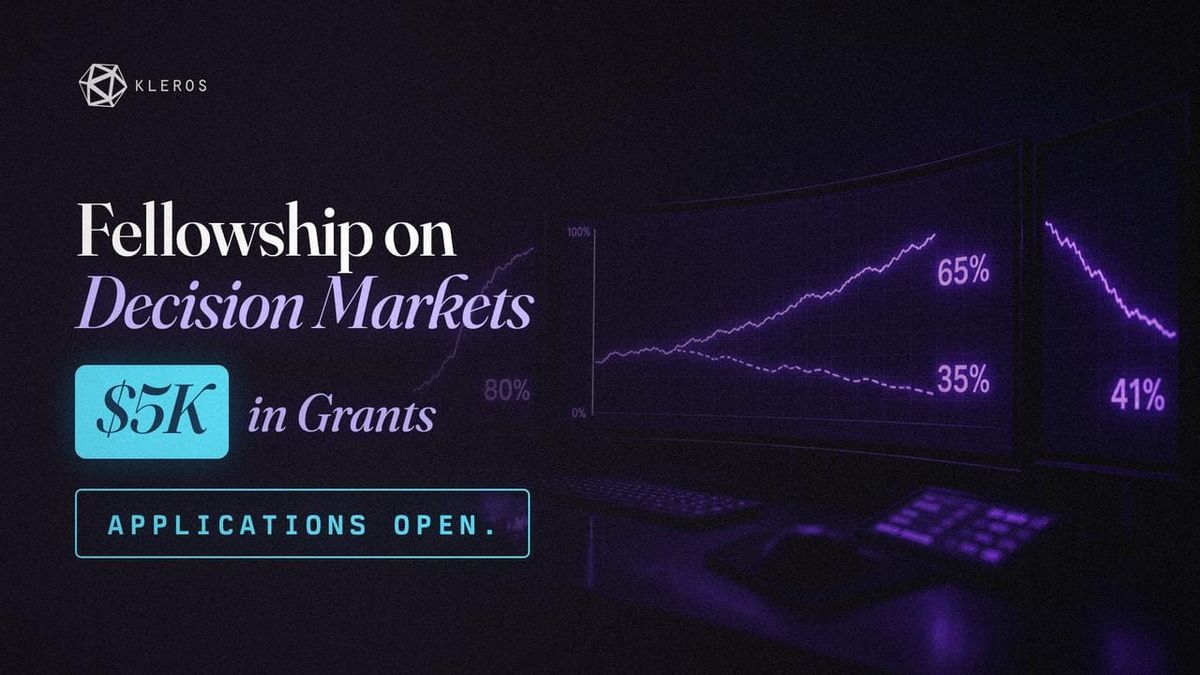
Coopérative Kleros is excited to announce a dedicated track of the Kleros Fellowship of Justice focused on decision markets and oracles: two of the most promising mechanisms for decentralized collective intelligence and governance.
A new Kleros Fellowship track on decision markets, oracles, and futarchy. Apply with a research project, a prediction market on Foresight prices its expected impact, and the top-priced project is admitted.
Grants pay $1,000 per impact point, up to $5,000. Six months of mentorship from Federico Ast and Clément Lesaege. Open to economists, lawyers, engineers, and mechanism designers.
Why Prediction and Decision Markets?
Prediction markets have emerged as one of the most powerful tools for aggregating distributed information. By allowing participants to stake resources on the likelihood of future outcomes, they create powerful incentives for accurate forecasting. Platforms like Polymarket and Kalshi have demonstrated that prediction markets can outperform traditional expert consensus on questions ranging from election outcomes to scientific replication.
Decision markets build on the concept of futarchy, a governance mechanism proposed by economist Robin Hanson that develops this idea further. As Hanson asked, "Shall We Vote on Values, But Bet on Beliefs?" Instead of voting directly on policies, communities use prediction markets to select the interventions most likely to achieve their stated goals. The result is a governance system that is resistant to motivated reasoning, rhetoric, and political capture.
Kleros sits at the intersection of these ideas in a unique way. As a decentralized dispute resolution protocol, Kleros can serve as an oracle, the mechanism that adjudicates the outcome events on which prediction markets are settled. The integration of Kleros with prediction and decision markets and futarchic governance opens a rich research agenda at the frontier of mechanism design, institutional economics, and legal technology.
The Decision Markets Track and the Grants
The Kleros Fellowship on Decision Markets is a research program for talented individuals who are keen to explore futarchy applications, decision markets, and oracle research.
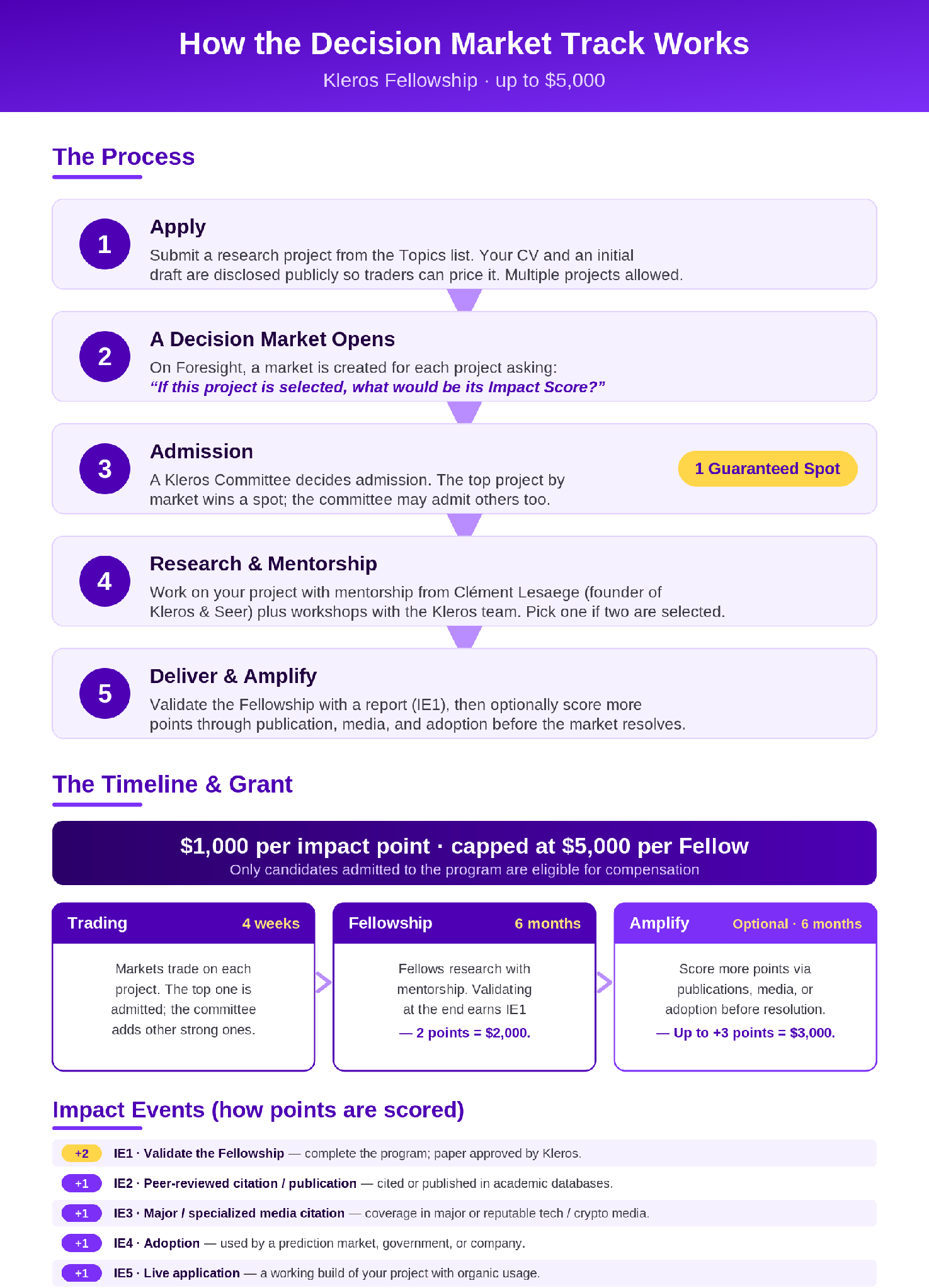
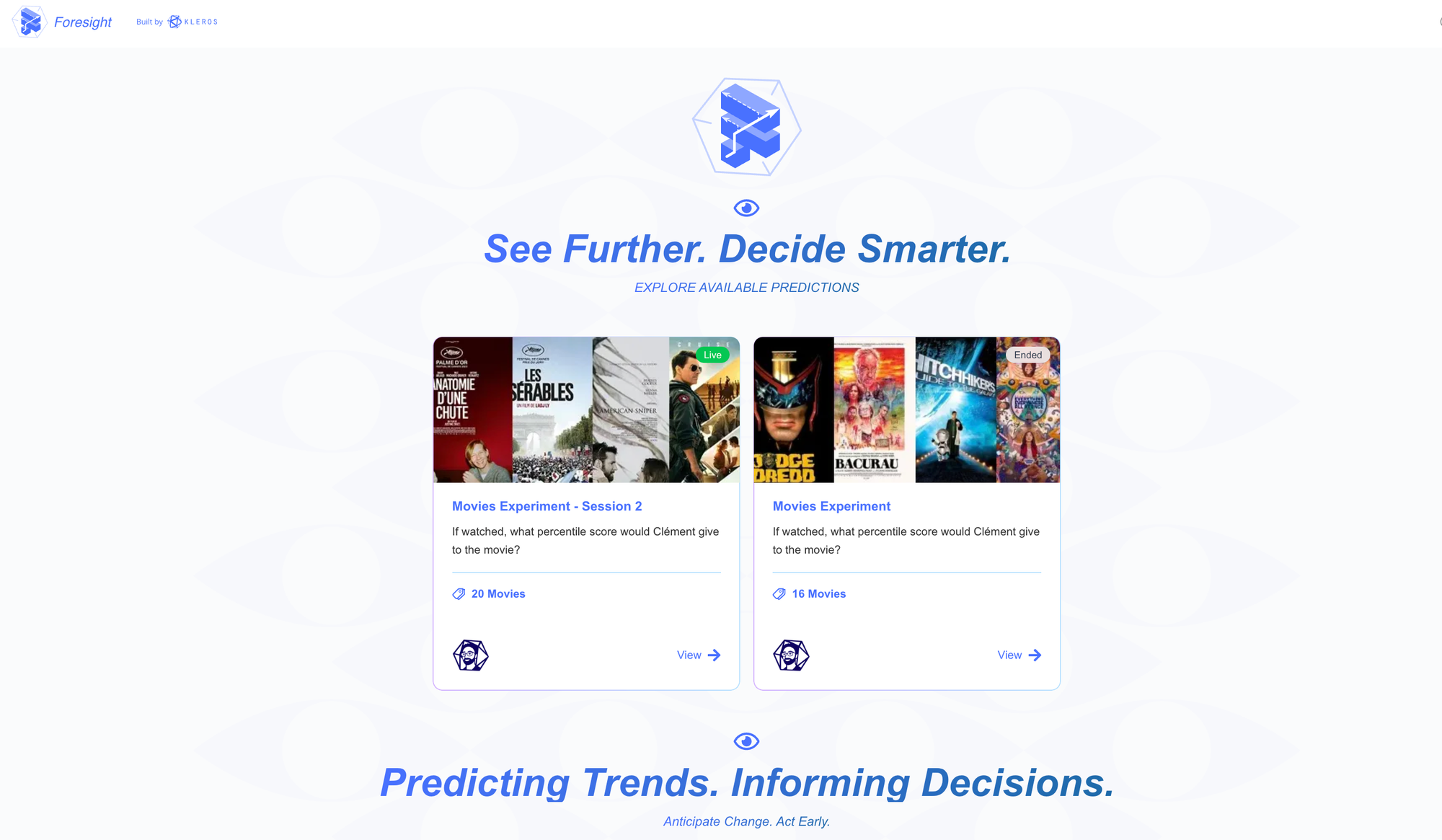
The program runs on Foresight, our in-house platform that lets anyone create decision markets. Each candidate applies with a research project drawn from the list of research topics below, and for every project a dedicated market is created around a single question:
“If this research project is selected, what would be its Impact Score?”
These markets let traders signal, in advance, how much impact they expect each project to deliver, giving the selection committee a real signal to weigh alongside its judgement.
How applications work
- You may apply with more than one project, but each must be listed as research topics below. For example, one candidate could apply with two projects: (1) an opportunity market for the music industry and (2) decision markets for hedging a portfolio.
- To provide traders the information they need to price a project, some materials are disclosed publicly: the candidate’s CV and an initial draft of the research idea.
- Admission to the Foresight market is decided by a Kleros Committee (which only removes obvious spam/off-topic content).
- The top project in the market guarantees admission, with only one spot available. The committee may admit additional projects at its discretion and will draw on the markets for insight when deciding.
- If a candidate has two projects selected, they must choose one to focus on (and may use the market to determine the most promising one).
Grants and compensation
Only candidates admitted to the program are eligible for compensation. Rewards are paid at $1,000 per impact point, up to a maximum of $5,000 per candidate.
The track runs in three periods:
- Trading Period (4 weeks). Markets trade on the candidate projects. The top project is directly admitted, and the Kleros Committee admits others if they are good enough.
- Fellowship Period (6 months). Admitted Fellows carry out their research with mentorship. At the end, each candidate whose work is validated earns IE1, worth 2 points, or $2,000. Validation is required to access any further compensation.
- Amplify Period (6 months). Fellows who wish to can score additional points by publishing in specialized journals or media or by driving adoption through a live application. The markets then resolve, and the committee assesses each candidate’s final Impact Score, up to the $5,000 cap. See the grid below for how each impact event is scored.
Which impact events could you hit?
Topics
Decision Market Research:
Options-based stablecoin
Build synthetic stable assets from ETH payoff pairs that are options-like instead of debt. This could remove liquidations and allow slower, safer oracles like Kleros. See this post from V. Buterin.
- Research whether ETH-collateralized synthetic assets can avoid liquidations by using options-like payoff pairs instead of debt.
- Compare this model to liquidation-based stablecoins/perpetuals on oracle security, MEV risk, capital efficiency, and failure modes.
- Study user rebalancing, slippage-minimizing market design, and prediction-market-style scalar options as the core mechanism.
Asset futarchy
Use conditional markets on token/stock prices to decide whether DAO proposals should pass. See this post from Distbit. We can collaborate with futarchy.fi.
- Research whether asset futarchy can improve DAO governance by using conditional markets on token prices to evaluate proposals.
- Compare asset-price maximization with KPI-based futarchy, especially for long-term value creation and public-good projects.
- Study manipulation risks, liquidity requirements, and whether token price reflects stakeholder welfare.
- Test designs using proposal/pass-fail markets, delayed execution, and anti-manipulation mechanisms.
- Evaluate when asset futarchy is robust enough to govern treasuries, protocol upgrades, or parameter changes.
KPI futarchy
Use conditional markets to predict whether a decision would lead to a good KPI. See this post from Distbit. We can run the required experiment on Foresight.
- Research whether KPI futarchy can improve DAO governance by making proposal execution conditional on predicted changes to explicit performance metrics.
- Compare KPI choice, oracle design, and metric gaming risks across revenue, user growth, decentralization, security, and public-good outcomes.
- Study how conditional prediction markets aggregate information about which proposals improve the chosen KPI.
- Test designs with delayed resolution, multi-KPI scoring, and safeguards against short-term metric manipulation.
- Evaluate when KPI futarchy outperforms token-price-based governance or simple voting.
Opportunity markets
Use prediction markets to reward outsiders for discovering valuable opportunities early. Applications include VC deals, hiring, grants, music, and research scouting. See this post from D. White and M. Liston.
- Research whether private prediction markets can turn opportunity discovery into a scalable, incentive-compatible scouting mechanism.
- Study sponsors such as VCs, record labels, grantmakers, employers, and research labs that benefit from early signals.
- Analyze privacy windows, hidden prices, liquidity subsidies, and delayed revelation as tools against free-riding.
- Compare AMM, order book, and TEE-based designs for private opportunity markets.
- Evaluate risks of sponsor self-dealing, manipulation, and whether reputation is enough to sustain trader trust.
Multiverse finance
Create conditional DeFi “worlds” where assets, lending, AMMs, and derivatives exist only if a future event happens. This enables decision-contingent finance and hedging. See this post from D. White.
- Research whether “multiverse finance” can reuse prediction market logic to make full conditional financial systems.
- Study how assets, lending, AMMs, and derivatives can safely compose inside event-specific “verses.”
- Compare the results with ordinary conditional tokens, futarchy, and options-based synthetics.
- Analyze oracle resolution, liquidity fragmentation, UX complexity, and contagion between conditional worlds.
- Evaluate whether multiverse-aware DeFi enables better hedging, policy markets, and decision-contingent capital allocation.
- Study how the parent universe can interact with child universes.
Distribution markets
Replace scalar markets with full probability distribution markets. Useful for forecasting dates, prices, KPIs, grant impact, and tail risks. See this article from D. White.
- Research whether distribution markets can improve scalar prediction markets by eliciting full probability distributions instead of bucketed outcomes.
- Apply them to futarchy, where proposals are compared by the predicted distribution of KPI or token-price outcomes.
- Study whether decision rules should optimize expected value, downside risk, or tail-adjusted utility.
- Compare L2-function AMMs with LMSR, LS-LMSR, and bucketed AMMs for capital efficiency and manipulation resistance.
- Evaluate use cases in DAO governance, grant allocation, attendance forecasting, and risk-aware treasury management.
Risk markets
- Bundle many rare events into one capital-efficient market. Such markets can price crypto tail risks like hacks, slashing, bridge failures, oracle failures, or stablecoin collapses. See this article from V. Buterin.
- Research whether prediction markets can price many rare tail risks more efficiently by bundling them into a single market.
- Compare bundled rare-event markets with independent binary markets, LMSR, multiscalar markets, and insurance-pool designs.
- Study how event correlation, bundle construction, and partial resolution affect pricing accuracy and trader understanding.
- Apply the mechanism to crypto tail risks such as stablecoin failures, rollup hacks, slashing, bridge failures, oracle failures, and lending-market crashes.
- Evaluate whether these markets can become useful risk dashboards for protocols, insurers, DAOs, and treasury managers.
AI micromarkets
Let AI agents trade, evaluate, and help resolve thousands of tiny prediction markets. Use cases include scam detection, AI evaluation, flight delay prediction, and recommender systems. See “AI as a player in a game” in this post from V. Buterin.
- AI micromarkets for info defense: Research whether tiny prediction markets can classify scams, fake accounts, malicious dapps, token authenticity, spam, or policy violations better than centralized moderation or wallet heuristics.
- Market-based AI evaluation / decentralized RLHF: Design a system where AI agents earn or lose money across many small prediction tasks, creating market incentives to build generally accurate agents rather than one-off predictors.
- AI + Kleros-style escalation: Study multi-round resolution where AI agents handle cheap first-pass adjudication, and humans only intervene when enough money accumulates on both sides of a dispute.
- Closed agents, open rules: Vitalik’s key security point is that individual AIs can remain closed, while the mechanism is open; research whether this reduces adversarial ML attacks compared with open-source AIs.
- Micromarket liquidity subsidies: Experiment with how little subsidy is needed for AI agents to produce useful prices on small markets: $1, $5, $50, etc.
- AI agents as market makers for long-tail markets: Study whether AI agents can create, seed, trade, and resolve thousands of low-volume markets that would be uneconomical for humans.
Prediction market oracle research:
Kleros as a compliant oracle
Legal and technical framework for Kleros to serve as a dispute resolution layer for prediction market platforms operating under regulatory oversight (CFTC, MiCA, etc.)
Oracle failure modes and Kleros as a remedy
Analysis of how centralized and decentralized oracles fail in practice (manipulation, ambiguity, downtime) and how Kleros’ mechanism design addresses each failure mode
Integration architecture
Protocol-level proposals for integrating Kleros as an optional or default oracle in platforms like Polymarket, Kalshi or other Prediction Markets, including comparisons with existing solutions such as UMA’s Optimistic Oracle
Regulatory compliance of decentralized oracles
How Kleros’ transparent, auditable, and appellable process maps onto requirements from financial regulators for designated contract market (DCM) operators
Case studies in oracle disputes
Empirical analysis of real market resolution controversies and how Kleros’ dispute resolution mechanism would have produced different outcomes
The ultimate goal of this track is to produce research that makes the case; theoretically, technically, and legally, for Kleros as the oracle infrastructure of choice for the next generation of prediction market platforms.
Beyond research, we also welcome creative submissions
Art:
- Storytelling “Life in a world of prediction markets”: Produce fiction or comics that show daily life in a world where prediction markets are everywhere. Explore governance, work, science, insurance, relationships, and AI coordination. Draw inspiration from this short text. Write some prediction market sci-fi stories (text, comic, etc.).
- Prediction market art: Produce some art forms about prediction markets. You can get some inspiration from the “Plantoid” work of Primavera de Filippi (the original was “blockchain art"; here it would be “prediction market art”).
What you get: Mentorship from Founder's
Decision Markets Mentorship is provided by Clément Lesaege co-founder and CTO of Kleros; his research and active builds in the space contribute to several pioneering mechanisms and applications, including
- Seer.pm a next-generation prediction market allowing the use of yield-bearing stablecoin and scalar, conditional and multicategorical markets
- KPI-based Futarchy and Distilled human judgment with a live platform Kleros Foresight
- DeepFunding leveraging AI agents: The Ethereum Foundation used this mechanism to allocate $350k, as documented in the referenced thread.
- A contribution to Vitalik Buterin's proposal on risk pricing through prediction markets, with a dedicated platform coming soon.
Prediction Market Oracle Mentorship is provided by Federico Ast; the CEO and co-founder of Kleros. He holds a PhD in Business Administration and is a specialist in deliberative democracy and collective intelligence, having followed prediction markets' evolution since the early 2010s. He is also a global blockchain and legal tech educator on Coursera. Some of his work on the topic:
- The Predictive Path of Justice: Can Prediction Markets Solve the Arbitration Efficiency Crisis? published in the Kluwer Arbitration Blog explores how prediction markets could be used in traditional arbitration cases (also check this EthCC presentation).
- Subjective Oracles: Using game theory and Schelling points to let decentralized, crowdsourced networks act as subjective oracles for complex, non-deterministic data Kleros White Paper
- How Kleros Oracle can be an alternative to traditional, slow-moving legal systems for the internet economy: see this When Online Dispute Resolution Meets Blockchain: The Birth of Decentralized Justice published in the Stanford Journal of Blockchain Law & Policy.
What We Expect
We expect Fellows to:
- Submit a high-quality final report at the end of the program, with concrete findings and, where applicable, actionable proposals for the Kleros ecosystem
- Share progress and insights with the Kleros community through at least one public post or presentation during the program
- Engage with the broader prediction markets and futarchy research community
Ideal Profile
The ideal Fellow combines intellectual curiosity with technical and academic rigor. We welcome applicants from economics, law, political science, computer science, and mathematics. Prior knowledge of Kleros, decision markets, and mechanism design is a plus but not a requirement; what matters is the quality of your research proposal and your ability to execute it.
Ready to shape the future of decision markets?
Submit your CV and a short research proposal. Traders on Foresight will price your idea over 4 weeks. Top-priced project is admitted; the committee may admit others.
Apply now →Questions? Email fellowship@kleros.io