
Kleros in June: AI on the jury, a UK academic tour, and the predictive turn
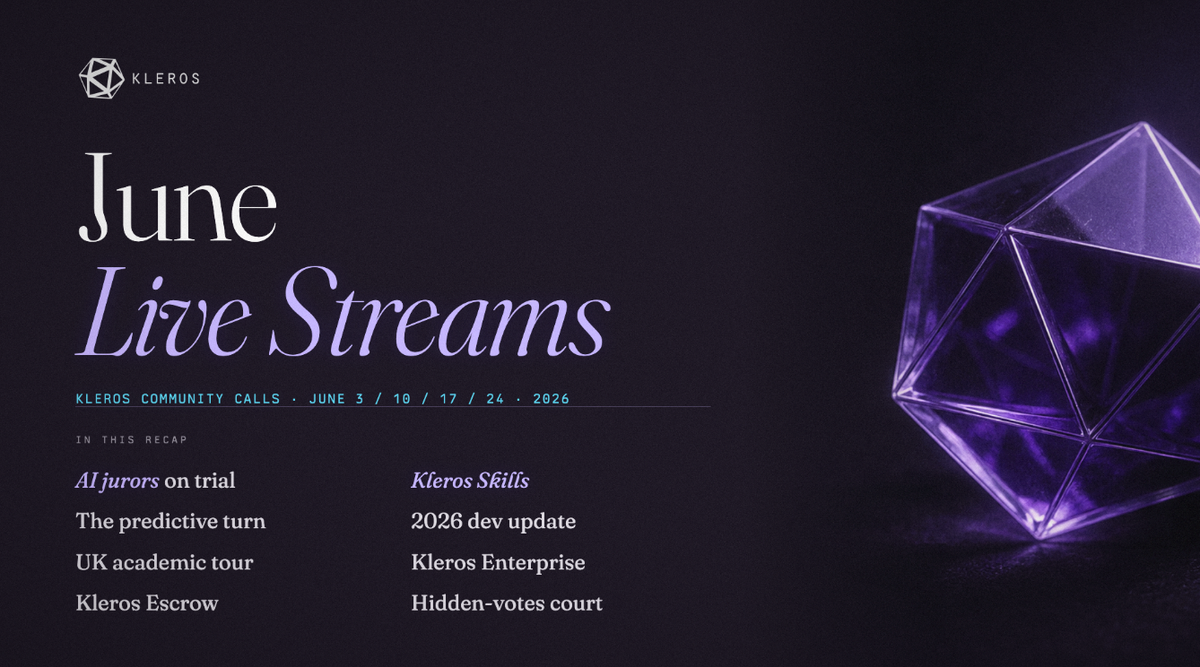
June was the month the AI question stopped being hypothetical for Kleros. Across four community calls we ran real experiments putting Claude and ChatGPT up against past jury decisions, carried the case for decentralized justice into King’s College, Oxford and Edinburgh, welcomed fellows working on everything from natural language processing to Spanish real estate, and started sketching how AI agents will plug directly into the protocol.
Underneath all of it ran a single idea that our co-founder Federico Ast calls the predictive turn: that prediction markets can show you where a dispute is heading long before it reaches a verdict. This is the whole month in one place, with timestamps, quotes, the recordings, and links to everything mentioned. Grab the section you care about, or read it end to end.
📋 June at a glance
- June 3 — Academia, AI jurors and the predictive turn. Nine years of the Fellowship, fellow Dr. Alesia Zhuk on NLP for justice, Claude vs ChatGPT on real cases, and the first Foresight experiment.
- June 10 — Real-estate escrow and the 2026 dev update. Fellow Günther Schramm on Kleros Escrow for Spanish property, plus Parul Yadav’s development recap and real consumer cases.
- June 17 — The UK academic tour. King’s College, Oxford and Edinburgh, the shift from first- to second-generation justice, Enterprise, and ten years of Kleros.
- June 24 — AI agents and Kleros Skills. Berlin Blockchain Week, the Ethereum economic zone, agent commerce, and AI jurors inside a competitive court.
Academia, AI jurors, and the predictive turn
Call one · June 3
Federico AstDr. Alesia ZhukWilliam George~1h 11m
The first call of the month tied our academic roots to our newest research. Federico opened on the Kleros Fellowship of Justice, which has been running for nine years and has brought lawyers, mechanism designers and social scientists through the project. From there he traced how Kleros reached the academy at all: the 2019 book, an early conference in Leicester held, as it happened, on the day of the Brexit vote, and a growing cluster of doctoral students at Oxford and King’s College London. “Every big movement needs a book,” as he put it, and much of June would be about what happens once the academics start writing yours.
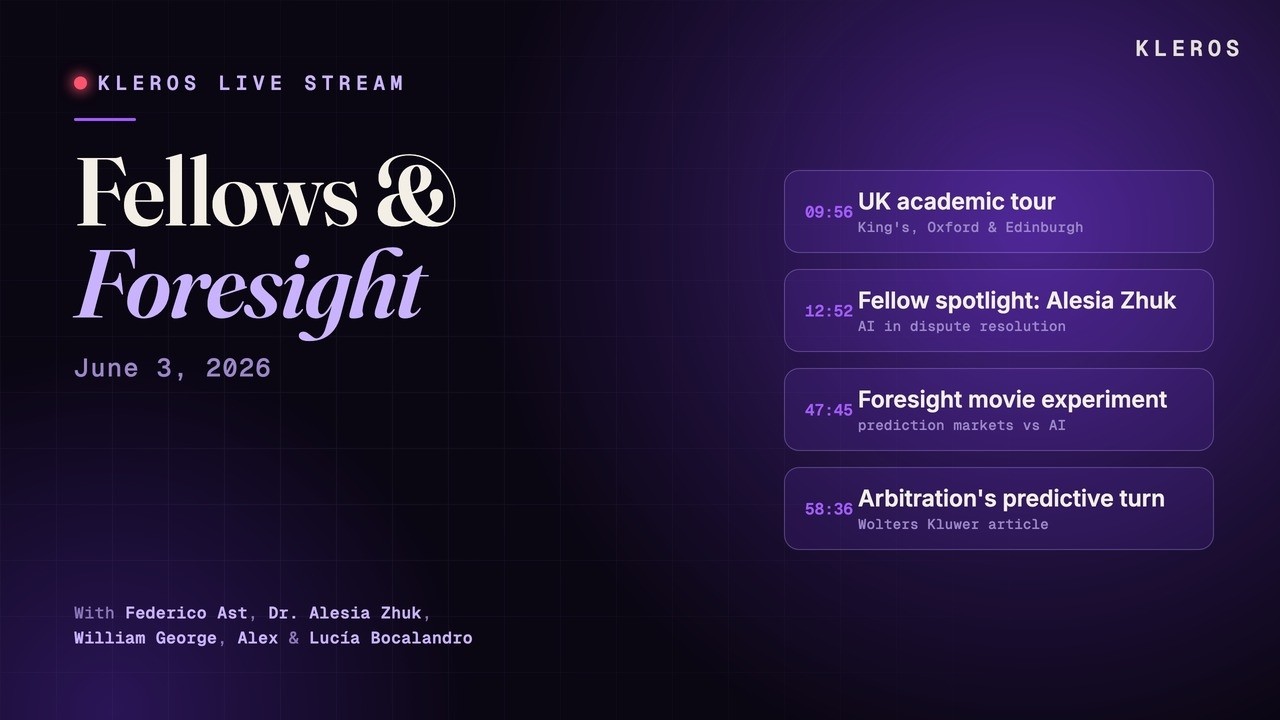
The full call · ~1h 11m, 19 chapters, every timestamp below deep-links into it · watch on YouTube
Chapters · jump to the moment
🎓 Guest spotlight
Dr. Alesia Zhuk
Kleros Fellow · adjunct professor at Esade · legal scholar on law and emerging technology
Alesia wrote her PhD at Universitat Pompeu Fabra in Barcelona about Kleros and decentralized dispute resolution, then continued the work as a Kleros fellow. Her focus is how natural language processing can make online justice more accessible: anonymizing sensitive case data automatically rather than by hand, translating evidence across languages, retrieving and extracting the facts a juror needs, modeling the topics in a case, and even a chatbot to explain unfamiliar legal terms. She now teaches at Esade and researches AI in international courts and tribunals.
Read her work: Enhancing Online Dispute Resolution through NLP: A Case Study of Kleros · the Fellowship
The research segment that got the most attention was the one on AI jurors. William George walked through an experiment in which Claude and ChatGPT were asked to decide roughly a hundred past cases that Kleros juries had already ruled on. The headline was not that one model was right and the other wrong. Both agreed with the human juries at a broadly similar rate. What was interesting was how they disagreed: the two models diverged in opposite directions, so leaning on any single one of them would quietly import that model’s bias. That is the argument for a panel rather than a judge.
“This is not going to be just one AI making the decisions. It is going to be a panel of AIs, because of the different ways the models are trained.”
Federico Ast · 31:44
“It is like a market mechanism where the AIs compete with each other to get onto the panel. They have to iterate, because some of them may be losing money if they are not doing a good enough job aligning with the community.”
William George · 34:49
Alex, who leads business development, then presented the first experiment from Kleros Foresight, our prediction-market product. Traders were asked to predict how our CTO Clément would rate a set of films, a deliberately playful stand-in for the harder problem of predicting a human judgment. The market outperformed simply asking a chatbot, and the traders with the most context were the most accurate. It is a small result with a large implication, and it sets up the idea Federico closed the call on.
That idea is the predictive turn. It comes out of an article Federico published on the Wolters Kluwer Arbitration Blog, The Predictive Path of Justice, on whether prediction markets can address arbitration’s efficiency crisis. His argument: arbitration was built to be fast and flexible and has become slow, bureaucratic and expensive, sometimes costing millions, which means it only makes sense for very high-value disputes. A prediction market that forecasts the likely outcome lets parties settle the easy cases without a full trial, while a fraction of cases still go to a real Kleros trial as quality control and as the anchor to the real world.
“If the prediction market says one party is very likely to win, maybe you do not need to go to a trial. Maybe you can just settle.”
Federico Ast · 1:02:16
The call also included the first of the month’s Enterprise updates from Lucía Bocalandro, and a thank-you to Marcos, who handed over the Enterprise role after building much of it. We pull the whole Enterprise story together in its own section below.
Full transcript · June 3 — auto-generated and pending a human edit. Open the recording and use the transcript panel under the video to follow along or search it.
Real-estate escrow and the 2026 development update
Call two · June 10
Jean Putzel (host)Günther SchrammParul YadavLucía Bocalandro~1h 02m
With Federico and William on the road for the UK tour, this was a builder-heavy call. It opened on a question that would echo through the month, whether different AI models reach the same verdict, and then went deep on two very concrete things: a real-world use for Kleros Escrow, and everything the development team had shipped so far in 2026.
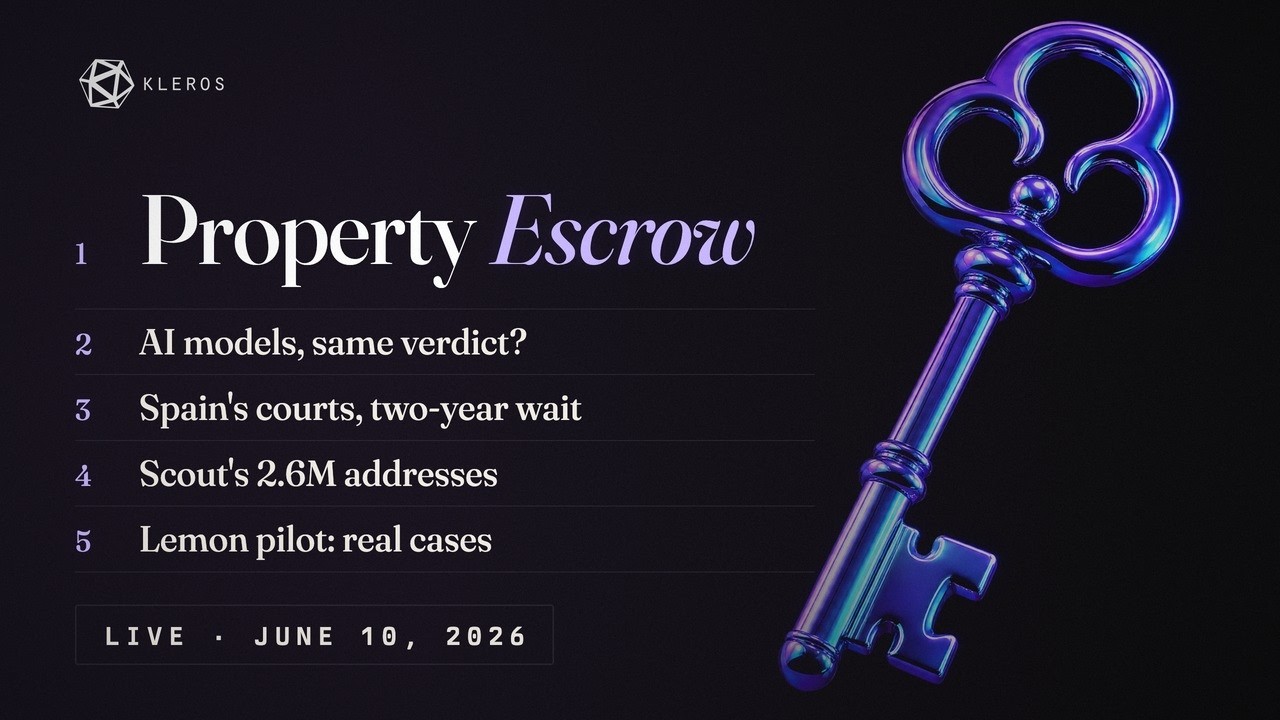
The full call · ~1h 02m, 15 chapters, every timestamp below deep-links into it · watch on YouTube
Chapters · jump to the moment
🏠 Guest spotlight
Günther Schramm
Real-estate lawyer in Málaga · 9th-generation Kleros Fellow
Günther took the long road from Argentina to Málaga, where he practices real-estate law during one of the region’s biggest property booms, much of it driven by international buyers. His fellowship research looks at where a smart-contract escrow can remove friction from Spanish property transactions: the early reservation deposits that often sit with an agency, the slow and expensive path when something goes wrong, and the new realities of buying property with crypto. He walked through Spain’s three-step purchase process, the country’s new mandatory mediation procedure known as MASC, and why a collapsed court system can turn a simple claim into a two-year wait.
His example was the kind of thing that makes the abstract case for escrow concrete. In a Spanish purchase the buyer usually puts down a reservation deposit early, frequently with no lawyer involved, and that money sits with the agency. If the deal falls apart, getting it back can be slow. Put the same deposit into a Kleros Escrow, he argued, and it can be released the moment the conditions are met, or disputed and resolved without waiting on anyone’s goodwill.
“Everything is smiles and happiness, until the money is involved and there is a problem.”
Günther Schramm, on property deals · 11:28
The 2026 development update
Parul’s development update, from 30:28 in the June 10 call · watch on YouTube
Parul Yadav then gave a compact recap of everything the team shipped from January to May, and it is worth watching in full if you want the state of the protocol in one place. The through-line was consolidation: the Atlas backend now powers notifications and file storage across every product, Kleros Scout reached its definitive version at 2.6 million tagged addresses, Foresight moved from concept to live experiments, Stake Curate launched, Escrow V2 went into production, and the Proof of Humanity V2 airdrop went out. Then she pointed at what is next: contract simplification, KIP-87, and Kleros Skills, the tooling that will let AI agents use the protocol directly.
“This year has been about solidifying our foundation.”
Parul Yadav · 31:51
“We are officially planning Kleros Skills, which will let AI agents interact with our protocol.”
Parul Yadav · 36:06
Jean added a note on Court V2: it has been through an internal review that surfaced a few possible improvements and vulnerabilities, and those are being fixed before the next external audit and a public bug bounty. Lucía closed with real consumer cases from the pilot, which we cover in the Enterprise section.
Full transcript · June 10 — auto-generated and pending a human edit. Open the recording and use the transcript panel under the video to follow along or search it.
The UK academic tour, and what it means for V2
Call three · June 17
Federico AstJean PutzelWilliam GeorgeLucía Bocalandro~57m
This one landed on the day of an Argentina match, so it opened with some well-earned World Cup banter before getting down to business. Fresh off talks at King’s College London, Oxford and Edinburgh, Federico and William reported back on what a room full of legal academics made of decentralized justice, and used it to frame the jump we are trying to make from first- to second-generation systems.
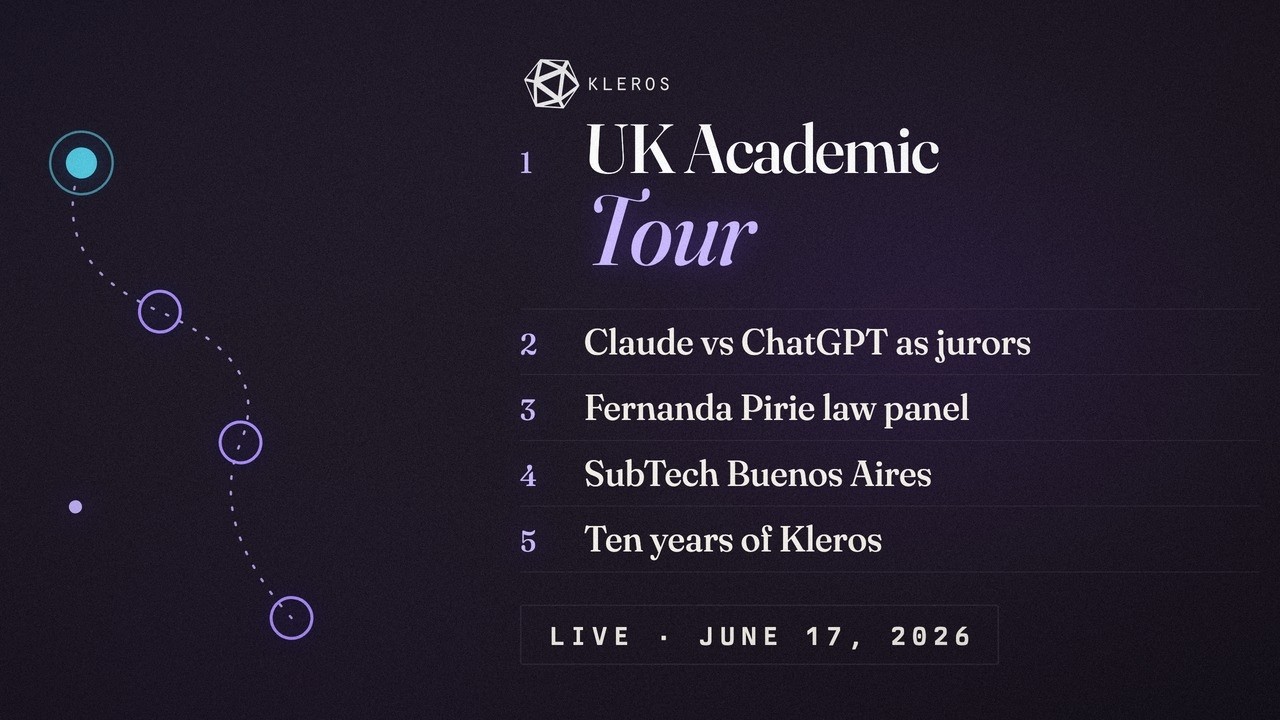
The full call · ~57m, 16 chapters, every timestamp below deep-links into it · watch on YouTube
Chapters · jump to the moment
William’s framing of Court V2 is the clearest short version of why the architecture looks the way it does. The system leans on two very different pillars at once, an identity layer and a set of crypto-economic incentives, so that breaking it would mean breaking both. The tour’s research message sat on top of that: not only do different AI models reach different verdicts on the same case, but the very same model can too, depending on when and where you run it.
“The same model can give you a different decision in the morning on the West Coast than in the morning on the East Coast, because of how the traffic is being routed.”
Federico Ast, on AI noise · 20:08
That noise is exactly why the goal for second-generation decentralized justice is not just raw accuracy. It is legitimacy: a system that is legally compliant enough to be used across more jurisdictions, and that people actually perceive as fair. The academic panels reinforced the point, with sociologists and anthropologists of law such as Florian Grisel and Fernanda Pirie putting Kleros in the longer story of how communities have always built their own forms of order, what Federico summed up as “platform justice.”
“Something more legally compliant, usable in more jurisdictions, and also perceived as a fairer system of dispute resolution.”
Federico Ast, on second-generation goals · 23:11
Jean ran through where the team would be over the summer: Manifest for prediction markets, where the economist Robin Hanson, who first proposed using prediction markets for decisions under the name futarchy, was speaking; ETHConf in New York; DappCon in Berlin; and the SubTech legal-innovation conference in Buenos Aires. Federico also flagged a proposed reform to Argentina’s corporate-governance law, still under debate, that would let entities choose the law they use to resolve disputes. His half-joking follow-up, “why not Kleros?”, is not as far-fetched as it sounds. He closed on a personal note, ten years on from the Singularity University trip that started the whole thing.
Full transcript · June 17 — auto-generated and pending a human edit. Open the recording and use the transcript panel under the video to follow along or search it.
AI agents, Kleros Skills, and agentic commerce
Call four · June 24
Jean Putzel (host)Fortunato CinquepalmiWilliam George~56m
The last call of the month was about the agentic future arriving faster than expected. With Federico at SubTech in Buenos Aires, Jean and Fortunato hosted. Fortunato had just come back from Berlin Blockchain Week and DappCon, and two themes dominated everything he saw: AI agents, most visibly for auditing smart contracts and code, and a Gnosis-led push for an “Ethereum economic zone,” a standard that would let the various L2s and mainnet interact more easily, targeting a launch around the end of 2026.

The full call · ~56m, 16 chapters, every timestamp below deep-links into it · watch on YouTube
Chapters · jump to the moment
That framing led naturally to Kleros Skills, the release that lets AI agents use Curate, Scout, the courts and Escrow through the emerging ERC-8004 standard for agent identity and reputation. Fortunato was candid about why it is taking longer than a demo would: the hard part is the guardrails, because agents hallucinate far more than people expect, and a tool that acts on-chain has to fail safe.
“We are trying to put as many guardrails as possible. AI agents tend to hallucinate way more than anyone can imagine.”
Fortunato Cinquepalmi, on Kleros Skills · 19:22
Jean widened the lens to agent commerce more broadly: Stripe, Circle and Google are all pushing standards for agents that transact with each other, and every one of those flows will eventually need a way to resolve disputes. That is the arbitration layer Kleros already is. Fortunato’s reaction captured why the team is energized rather than anxious about it: the thing Kleros was designed for is finally showing up in the wider world.
William George joined for the mechanism-design view, and made the case that AI jurors are not a maybe but a when. A competitive market of models, forced to iterate or lose money, is a far better home for them than any single AI judge. Bots also make the court’s optimistic and appeal mechanisms smoother, since a bot can flag a promising appeal or challenge that a human might miss. And he pointed at a genuinely open research question: the behavioral economics of large language models, whether they resist certain bribes, or gravitate toward different focal points than people do.
“A juror has a human being behind them, but they can always just give their key to their LLM.”
William George · 43:18
Fortunato previewed the migration to a hidden-votes court, where jurors commit their votes before revealing them, so good jurors are rewarded for voting their honest read rather than following the crowd. Jean closed on a security story that ties the whole month back together: jurors recently rejected a malicious transaction aimed at the Proof of Humanity governor, one of several such attempts across the space that Kleros has helped stop. Whatever the machines end up doing, a human jury reviewing the evidence is the layer that is hardest to attack.
“There is a factor that is harder to attack than the smart contracts: you have jurors looking at the evidence and double-checking whatever is being proposed.”
Jean Putzel · 54:53
Further reading: How Kleros prevented more than $100,000 from being stolen from the Proof of Humanity DAO.
Full transcript · June 24 — auto-generated and pending a human edit. Open the recording and use the transcript panel under the video to follow along or search it.
Kleros Enterprise
Across the month
The Enterprise thread ran through all four calls, led by Lucía Bocalandro, and June opened with a thank-you to Marcos, who handed over the Enterprise role after helping build it. The centre of gravity is still the public-services work in Argentina, where consumer disputes from the Junín and Mendoza pilots flow into Kleros courts and new municipalities keep coming online.
The most useful thing Lucía shared is also the least flashy: real cases do not always go the way people assume. Officials often expect that a consumer complaint will automatically be resolved in the consumer’s favor, and the pilots keep showing that is not how it works. In one pair of car-related cases, one claim was rejected and the other upheld, decided on the evidence rather than on who was the smaller party. That is exactly the neutrality the system is supposed to provide.
“We manually anonymize every piece of evidence we receive and manually review everything, and that process takes us some days.”
Lucía Bocalandro · June 17
Behind that neutrality is a lot of careful human work. Every piece of evidence is anonymized and reviewed by hand before it reaches jurors, a process that takes days. The team is also testing more private, permissioned “private courts” with Facundo for partners who need confidentiality, fielding new interest (including an inquiry from an NGO in Asia), and studying how consumer-complaint platforms work, which Federico framed as a modern form of reputational enforcement: a way to hold people to their agreements through reputation rather than force. It is a quieter story than AI jurors, but it is where Kleros is already resolving real disputes for real institutions.
Where this is heading
Put the four calls together and June reads like a thesis. AI is coming to the jury box, so we are building it as a competitive panel rather than a single oracle. Prediction markets can tell you where a case is going, so use them to settle the easy disputes and save the courts for the hard ones. As agents start transacting with each other, someone has to resolve their disputes, which is the job Kleros was built for. And underneath all of it, a human jury reviewing evidence remains the part that is hardest to fake or attack.
Next up: Foresight round two, the Kleros Skills release, more Enterprise pilots, and the team on the ground at Manifest, ETHConf New York, DappCon Berlin and SubTech Buenos Aires. Full recordings and chapter timestamps for every call live on the Kleros YouTube channel, and the Spanish-language streams from June 1 and June 22 are recapped separately.