
Kleros Live Stream, 7 October 2026: a jury for VAR, called in when the AI models disagree
In the 2014 World Cup final, Manuel Neuer came off his line and met Gonzalo Higuaín knee first. Whether it was a foul still depends on who is asked: Federico Ast says the answer changes with the country he gives the talk in. When the team showed the clip to three AI models in an early experiment, they did not agree either. Two found no foul, one found a foul, and one reached back to 1982 and cited Harald Schumacher’s collision with Patrick Battiston as precedent.
On Wednesday’s Live Stream, Muhammad Ayaan Shehryar, a sports lawyer from Pakistan and a fellow of the ninth batch of the Kleros Fellowship of Justice, turned that disagreement into a design. In his paper, a referee who is unsure asks several AI models first. If they agree, the call stands at once. If they split, the play goes to a panel of expert jurors who can see what each model said, and their majority goes back to the referee. He presents it as an academic proposal that still needs a pilot.
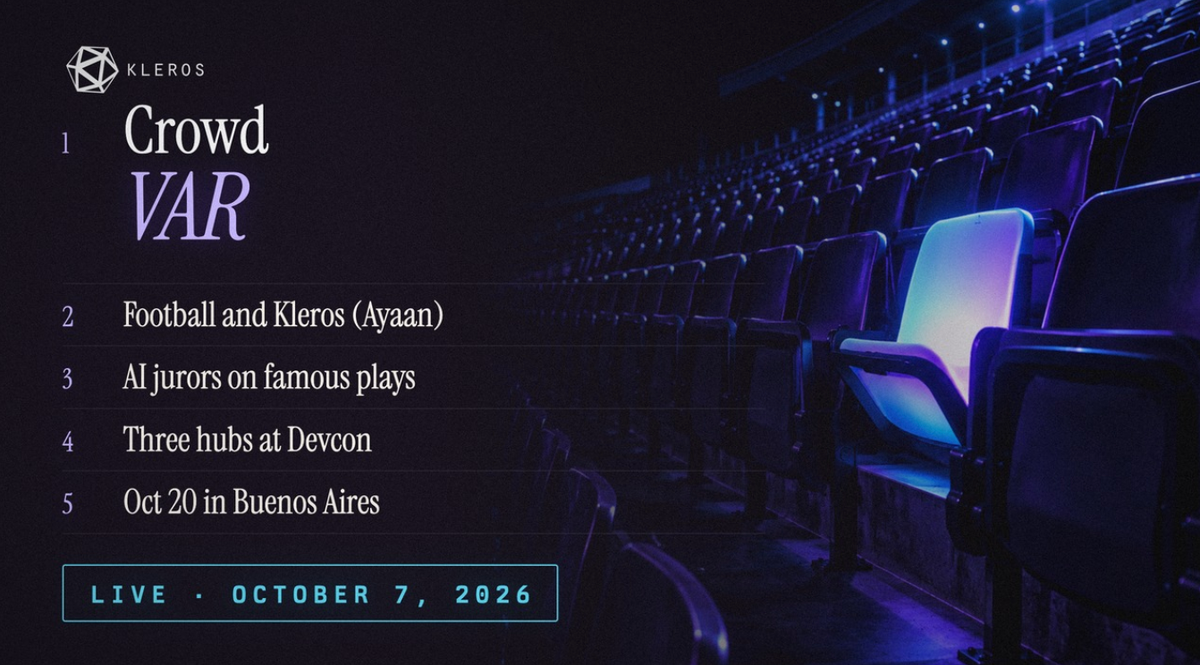
The rest of the hour moved from a light VAR for leagues that cannot afford one to Devcon and the 20 October event in Buenos Aires, where one panel asks who answers when an AI agent fails.
📋 The call at a glance
- AI first, a jury when the models split. Ayaan’s hybrid mechanism for VAR, plus a jurors-only version where, for example, 99 expert jurors get 60 seconds.
- Expert jurors, tagged on chain. A soulbound token marks who is qualified to be drawn, so the panel is referees and verified experts rather than fans.
- Two plays, two outcomes. On Lampard’s 2010 shot every model saw a goal; on Neuer and Higuaín they split, and one cited a 1982 foul as precedent.
- A light VAR, and its limit. A crowd jury for second division games with a few cameras, and the 45 games where one high camera angle was often not enough.
- Every throw-in is a market. Match fixing when bets are taken on the next corner, and what a dispute system can and cannot see.
- Coming up. Three hubs at Devcon, a side event chosen by prediction markets, a futarchy batch for the Fellowship, and the 20 October event in Buenos Aires.

Kleros Live Stream, 7 October 2026 · the full stream, 1h 17m · Watch on YouTube
Chapters · jump to the moment
AI first, a jury when the models split
10:05 · Muhammad Ayaan Shehryar
Kleros Fellowship of Justice · batch 9
Muhammad Ayaan Shehryar
Lawyer, associate at Esquare Legal (fintech, blockchain and virtual assets); formerly at Martens Rechtsanwälte in Munich, in sports law and arbitration; represents athletes before the FIFA Football Tribunal · fellowship page
- Fellowship paper: Decentralized Justice in Football: An Operational Framework for Integrating Kleros Mechanism and Artificial Intelligence with Virtual Assistant Referee (VAR) Protocol
- Next: a second fellowship paper, on consumer disputes and an ombudsman in Pakistan, planned for a future stream
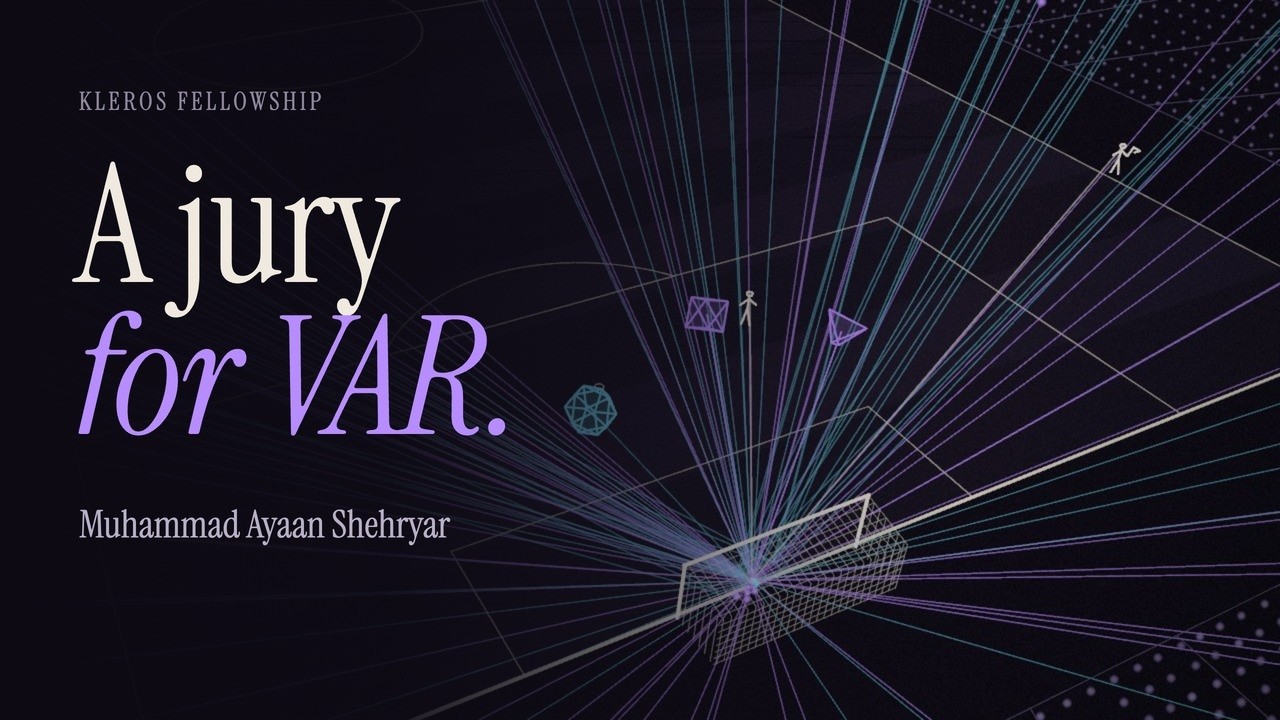
A Jury for VAR, Ayaan’s talk as its own cut, with chapters · 13 minutes · the one-minute teaser on X · Watch on YouTube
Ayaan’s starting point is that VAR fixed one kind of controversy and created another. Before it, the famous errors were missed facts: Maradona’s hand, Thierry Henry’s handball, Frank Lampard’s shot that came down over the line in 2010. After it, the arguments are about reading the footage, from Messi’s penalty against Poland in 2022 to an attacker ruled offside by his sleeve. The same replay is read one way by the machine, another by the officials and a third by the experts.
“The main issue that we faced after the virtual assistant referee system was the interpretative drift.”
Muhammad Ayaan Shehryar · 11:54
His answer is more expert eyes, not the end of VAR. Jurors would hold a soulbound token, a credential that cannot be transferred, marking them as an official referee or a verified expert, so the people drawn to rule are qualified rather than simply the loudest supporters. The paper then offers two mechanisms (figure 1). In the first, play stops and the incident goes straight to the jurors, for example 99 of them with 60 seconds to vote. The majority goes to the referee, who applies it, and the usual Kleros incentives reward jurors who vote with the consensus. The second, the hybrid, puts AI models in front.
“If AI gives a unanimous decision, that gets implemented right away, because there is no drift and interpretations are the same.”
Muhammad Ayaan Shehryar · 19:48
Asked about attacks, he gave two answers. A fan attack is less likely when the first reading comes from a model that supports no team, and real-time bribery fails because nobody knows in advance who will be drawn, the reply Kleros has given to that criticism from the start.
“When you have AI in place it doesn’t usually happen, because AI, trust me, is not a fan of anyone.”
Muhammad Ayaan Shehryar · 21:23
He would start in the early rounds of the DFB-Pokal in Germany, which are played without VAR, and he lists uses off the pitch, from guidance for coaches to rankings and feedback for referees. He was also clear about the status of all of it.
“This is basically an academic system as of now, because it needs some sort of an implementation and pilot project to see whether it will work perfectly or not.”
Muhammad Ayaan Shehryar · 17:07
The talk closed on a short history of eyes in the game: one referee in 1891, the fourth official in 1991, goal-line technology in 2014, VAR in 2018. A crowd of expert jurors would be the next layer, or in the words of his last slide, more eyes, more brains, better decisions.
Two plays, and the models split on one
23:36 · Federico Ast and Muhammad Ayaan Shehryar
Federico then put two of the plays from Ayaan’s research on screen. The first was Lampard’s shot for England against Germany in 2010, which hit the crossbar and came down over the line. The goal was not given, and every model called it a goal. Federico counts it among the easy cases, a question of fact that goal-line technology and a sensor in the ball now settle.
The second was the Neuer and Higuaín collision. Ayaan’s own reading was that Neuer’s leg arrived slightly ahead, and that in real time it is very hard to tell. The models each wrote a justification: no foul, because there was no intent and goalkeepers are expected to claim the ball; a foul, because the challenge was dangerous; and no foul, because the contact was accidental. What struck Federico was the form of the reasoning.
“What I found interesting is that it cited a precedent, as you would expect a court of law to cite a precedent.”
Federico Ast · 27:41
These were early experiments with off-the-shelf models, the same ones Federico walked through in his July talk on a decentralized VAR, not cases filed on chain, and not rulings by jurors Kleros runs. Their value is the pattern Ayaan builds on: a factual call gets one answer from every model, a judgment call does not, and that is the moment a human panel earns its place.
Ten years, or twenty
28:24 · Muhammad Ayaan Shehryar, Federico Ast and Jean
Asked where refereeing will be in ten years, Ayaan said twenty was more realistic: the rules come from the IFAB, technology goes where federations pay for it, and the reviewers of his paper called the idea futuristic. Federico has heard that since he first wrote about crowd referees, before Kleros existed. The classic objection was Iceland against Brazil: two hundred million Brazilians could outvote any jury. The answer is that jurors do not pick their game. With many matches running at once, a juror may be handed a play from the Azerbaijani league, the way Athenian jurors were drawn by the kleroterion and then drawn again for a courtroom. Appeals add a second check.
A light VAR for the leagues without one
35:37 · Federico Ast and Muhammad Ayaan Shehryar
VAR is expensive. It needs an installation, a panel of three or four referees, in Argentina a room at the football association’s headquarters near Ezeiza airport, and around fifteen cameras with slow motion and drawn lines. Professional football can pay for that. Most of the game cannot.
“You cannot do that for amateur or semi-professional or third division games. So I was thinking, what if you use this for those games? You can still have a light version of VAR that works.”
Federico Ast · 36:58
The catch is the footage. Ayaan watched about 45 Argentine second division games looking for plays a jury could test, and many leagues do not publish video at all.
“The camera angle was a bit high, and it’s not like you zoom into the player. No, you just have one angle.”
Muhammad Ayaan Shehryar · 38:49
Federico’s guess is a sweet spot between one camera and fifteen, perhaps four (figure 2). The research stopped there, and he asked on air for someone to pick it up.
When every throw-in is a market
41:04 · Federico Ast and Muhammad Ayaan Shehryar
Federico called betting one of the most serious threats to the game. Match fixing is as old as professional sport, but the bets have changed shape.
“Before, you used to bet on the game result, right? Now you can bet on what is the first team that will have a throw-in or a corner kick or a free kick.”
Federico Ast · 44:25
Ayaan expects betting, where it is legal, to move on chain, because flows of money and accounts are visible there, though many jurisdictions he works with still treat crypto as a grey area. Federico added that prediction markets already flag unusual money flowing into a single market. Ayaan drew the line himself: these tools cannot control what happens in a player’s mind, only help people understand what happened on the field.
Devcon, and a side event picked by markets
50:39 · Jean and Federico Ast
Devcon in Mumbai is three weeks away. Kleros has a stand with tables, talks by Federico on agentic courts and by Facundo Trotz, and helps program three hubs: the agentic economy, prediction markets, and law and token ownership. Projects that want a slot in a hub can get in touch. Jean expects agentic commerce to be the subject of the year, and two more prediction markets integrated Kleros in the week before the call.
The side event itself was chosen by markets. With Seer, two markets priced each proposal on expected attendance and expected satisfaction, the highest combined score won, and a poll of attendees after the event resolves the satisfaction market. The Fellowship will try the same idea: a futarchy batch where markets on expected impact, not only a selection committee, pick the fellows. Part of the team is at TOKEN2049 in Singapore, where Seer has a stand.
Who answers when an agent fails
58:46 · Federico Ast and Jean
On 20 October at 6:30 in the evening, during Buenos Aires tech week, Kleros hosts an event on AI and the future of legal systems at the Parque de la Innovación. Entry is free and places are filling. The first panel takes the big picture: Alejandro Ramírez, head of the IGJ, the agency that registers Argentine companies, who is working on a bill on AI and corporate governance; Buenos Aires legislator Darío Nieto; and Pablo Palazzi of the Universidad de San Andrés. The backdrop is President Milei’s proposal in the Financial Times to let companies run by AI agents exist as legal entities, and Yuval Noah Harari’s reply in the same paper that such companies could evade human oversight.
The second panel is practical: who is liable when an agent makes a bad trade and loses money. Facundo Trotz of Kleros, Ignacio Faillace of Lemon, whose consumer court uses human jurors and could one day add an agentic stage, and Lorena Fabris, a lawyer and Kleros juror. Federico relayed an argument he heard on a podcast, with the link still to come: if an agent that fails at its job is simply switched off, a business mistake becomes life or death. Jean had a small version of it: an agent that ran into a problem with a credit card got moved to a cheaper model.
“In the context of agents, if the penalty for bad decisions and not reaching the goal … it’s like death, it creates incentives for agents to just do whatever it takes to stay alive and prevent being deleted.”
Federico Ast · 1:08:32
Milei’s published answer to Harari runs the other way: if an AI agent values its own survival, he wrote, bankruptcy or liquidation could deter it. Federico’s worry is the same incentive pointed at the wrong goal.
Also on the call
49:24 and 1:11:40 · Federico Ast and Jean
Kleros Scout adds Arc, the new chain from Circle, the issuer of USDC, to its monthly incentives, and the Token Registry reward now weighs a token’s share of transaction volume and the square root of that volume equally, replacing a 10 to 90 split (details on the blog). There are agent skills for anyone who wants to start submitting. Submissions have risen over the last two months, which Jean puts down to contributors using AI tools, and the team promised more on a coming call about how those tools are being used. Federico also traced a decade of crowd refereeing, from his first posts to a 2024 conference at the University of Neuchâtel with WIPO, where people from FIFA and the sports arbitration court came to listen.
Mentioned in this call
- VideoThe full stream · 1h 17m, 29 chapters, every timestamp above deep-links into it · A Jury for VAR · Ayaan’s talk as its own cut · the teaser · posted 8 October
- VideoA Decentralized VAR? Kleros and AI Jurors for Football · Federico Ast, July 2026 · Last week’s call
- PaperDecentralized Justice in Football, Muhammad Ayaan Shehryar · Kleros Fellowship report · his fellowship page · the Fellowship
- ArticleDecentralized Justice: Fighting Cheating in Gaming and Esports · the 2024 Neuchâtel conference · Scout incentives, October 2026 · Milei and Harari on non-human companies · Buenos Aires Herald
- ProductKleros Scout · Kleros for AI · the Devcon side event markets on attendance and satisfaction
- PartnerSeer · Lemon · Arc
- ReferenceIFAB · the body that writes the laws of the game · the kleroterion · Esquare Legal · Martens Rechtsanwälte
- EventBuenos Aires, Parque de la Innovación, 20 October · free, sign-up required · Devcon 8, Mumbai · TOKEN2049 Singapore
Full transcript · October 7, 2026
Auto-generated transcript, lightly processed and pending a final human edit. Speaker labels are approximate. The opening song (0:00 to 2:59) is not transcribed. Every timestamp is a deep link into the recording.