
Kleros Live Stream, 12 August 2026: can Kleros plug into a country's consumer courts?
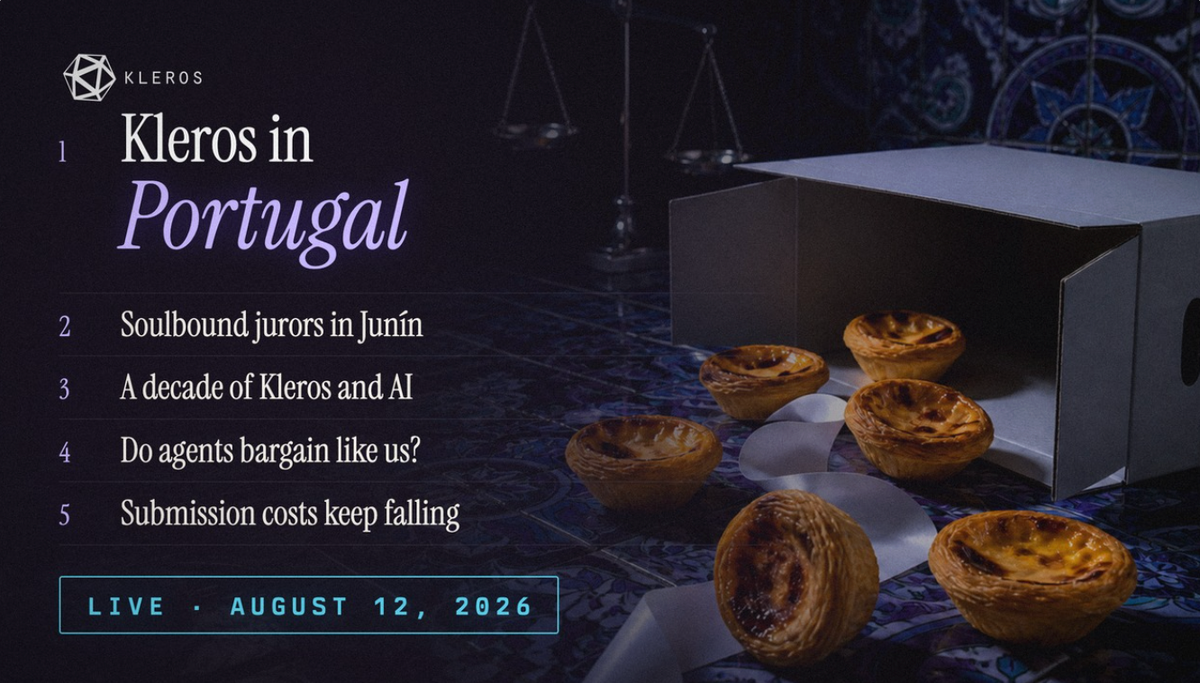
Inês Bragança Gaspar is the only person to have completed the Kleros Fellowship twice, and the second time was not her idea. Kleros went to her. Her ongoing research asks a question every institutional conversation eventually reaches: could Kleros actually be integrated into a country's consumer dispute system, in her case Portugal's, and what would have to change first?
Her answer takes up the first half of the call: four integration models, one legislative precedent from Mexico, and a hard collision between anonymous jurors and a law that requires arbitrators to sign the award. The second half is the ten-year Kleros thesis on artificial intelligence, published on the blog this week, and what happens to a court when some of the jurors are agents.
📋 The call at a glance
- Portugal's consumer arbitration system is growing. More than 12,000 new cases in 2025, up 17 percent, in a system where companies are obligated to arbitrate disputes under 5,000 euros.
- Four models for integrating Kleros: a fact-finding layer for arbitrators, direct e-commerce integration, a digital chamber inside an existing center, or a technical partnership.
- Mexico already wrote decentralized justice into law in 2024. That is the shape of the reform Portugal would need.
- The anonymity objection has an answer in production: the Junín court restricts jurors to KYC-verified lawyers using soulbound tokens.
- The decade-of-AI thesis is published, and the open question is whether agent jurors play fair or merely rational.
- Scout submission costs are falling, which reads like agents already doing the work. The numbers are public on rewards.kleros.io.
- The 10th Fellowship cohort is open. This kind of research, for your own jurisdiction, is exactly what it is for.
Chapters — jump to the moment
A consumer court the company cannot refuse
Inês is a Portuguese lawyer who found decentralized justice while researching her master's thesis in 2018, before there was much of it to find.
“I think that Federico coined that term, actually, so I was writing about it before it was even a reality.”
Inês Bragança Gaspar · 2:58
The system she studies has a property most countries lack. Since 2019, Portuguese law extends arbitragem necessária, mandatory arbitration, to consumer disputes worth up to 5,000 euros: once the consumer files with an authorized center, the company is obligated to take part. Around 40 arbitration centers exist, twelve of them authorized for consumer disputes, all non-profit, government-authorized and cheap or free to use. And they are being used more: over 12,000 new cases in 2025, a 17 percent jump, which Inês attributes to a government publicity push, television ads included, and to people simply buying more things.
That growth matters for the integration question, because a system processing more cases with the same budget is a system with a reason to listen.
Four ways to plug a decentralized court into a legal system
Kleros already resolves consumer disputes in the wild, and Inês built her models from those cases. Lemon integrated Kleros into its complaint process in 2024: if a user disagrees with the company's own resolution, they escalate to Kleros, jurors rule within five business days, and the ruling binds the company while leaving the consumer free to go to court. Maldo.uy, a Uruguayan freelance marketplace, is researching the same move, and an insurance pilot is underway in Mexico.
“The first model would be to use Kleros as a fact-finding or evidence assessment layer, so arbitrators could submit to Kleros jurors certain factual questions. For example, was the product delivered as described?”
Inês Bragança Gaspar · 11:45
“Mexico in 2024 was the first country to expressly recognize decentralized justice in its legal framework.”
Inês Bragança Gaspar · 13:47
Asked which path is likeliest in the short term, she did not pick the arbitration centers. Private companies first: they are comfortable with new technology, and food delivery platforms are resolving thousands of complaints a day with chatbots that do not understand what the consumer's problem is. The centers come later, with evidence in hand.
“If disputes are becoming more technological and digitalized, why are we still solving these disputes through the traditional routes, with lots of paper and going to court in person?”
Inês Bragança Gaspar · 22:42
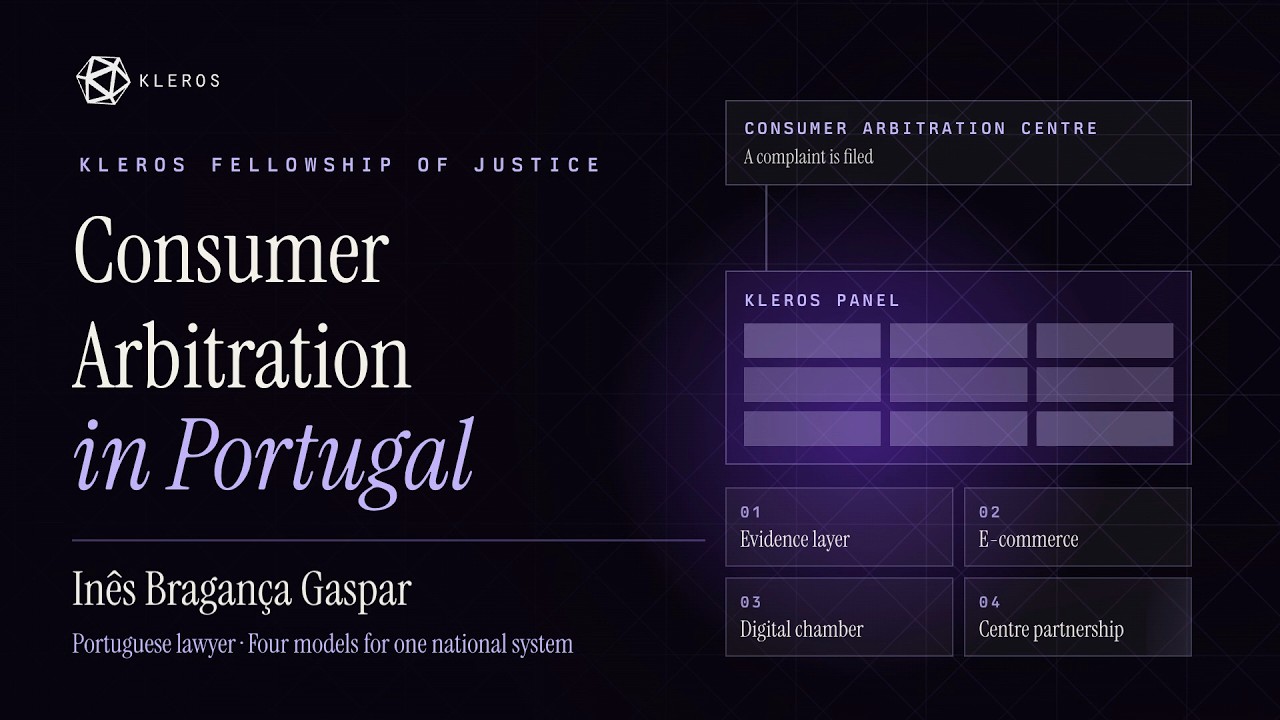
Inês's full presentation, published as its own video · Kleros and Consumer Arbitration in Portugal
Who signs the award?
The sharpest exchange of the call started with a detail of Portuguese law that cuts both ways. Any individual with full legal capacity can be an arbitrator, regardless of nationality, and parties can require specific qualifications. That opens the door to specialised chambers drawing on expert arbitrators from anywhere in the world. But the same law closes another door: jurors cannot be anonymous, because the arbitrators sign the arbitral decision.
“The jurors need to sign the arbitral decision.”
Inês Bragança Gaspar · 23:55
That objection, your jurors are anonymous so we cannot use you, is the most common institutional one there is. Facundo Trotz answered it with something already in production. The court used for the Junín pilot in Argentina is not open to anonymous stakers.
“In Junín cases there is a specific court in Kleros which is formed by jurors that are lawyers. And the way we do this is by using SBTs, soulbound tokens, that work as a kind of digital credential.”
Facundo Trotz · 25:08
The Kleros Cooperative runs a KYC process, the juror accepts terms and conditions, and the soulbound token gates the court: no credential, no ability to stake there. The protocol underneath is unchanged. Inês took the idea one step further: arbitration centers could issue soulbound tokens to their own existing arbitrators, with the credential encoding the expertise they already have on paper. The 2019 protocol she first wrote about is still there, Federico noted, Schelling point and all. What changed is how much can be configured around it.
Do this for your own country
The point of putting this research on the call was not Portugal. Applications for the 10th Fellowship cohort are open, and Federico's ask was to replicate exactly this shape of work, mapping how Kleros could attach to the legal system of whatever country you live in. Inês's endorsement carries some weight, being the only person to have done the Fellowship twice, and she was clear it is not a lawyers-only program: her cohort included mathematicians and economists. Her full report will be published soon.
Ten years of the AI thesis, written down
William George's update was brief: the confidential evidence talk he gave in English two weeks ago and in Spanish on Monday's call is becoming a blog article, a longer version of the toolbox. The bigger publication is already out: the essay tracing ten years of Kleros research on artificial intelligence, from the Doges on Trial experiment and the 2019 thesis it produced to the Lemon experiment published by Kluwer, where different AI models gave different answers to the same real cases.

The thesis has three parts. High-complexity, high-nuance cases stay with humans, because they require moral context. Mid-complexity cases become a combination, perhaps an AI first instance with appeal to humans.
“You don't want an AI to make just a final decision. That could be dystopian.”
Federico Ast · 34:38
And the third part is a category of dispute that has not existed before: agent against agent, at volumes and speeds no human process can serve, settled through escrows and reputation systems. Federico sketched agents using reputation as loan collateral, working capital lent from one agent to another on the strength of a record. Announcements in this area, he said, are cooking now.
“We just needed in some way the world to catch up with some of these ideas, which seems to be happening now.”
Federico Ast · 36:17
Do agents play fair, or merely rational?
The most fun stretch of the call was a behavioural economics question with real protocol stakes. In the ultimatum game, one player offers a split of 100 dollars and the other accepts or rejects; rejection leaves both with nothing. Pure rationality says accept anything above zero. Humans do not: offers under roughly 30 percent get rejected out of something like spite, or fairness, depending on your school. The known exception is the Machiguenga, a tribe in the Peruvian Amazon with almost no market economy, who accept low offers exactly as the textbook predicts. The anthropologists' thesis: notions of fairness and reputation come from operating in markets, where lowballing strangers has a cost.
So which are the agents? The empirical answer so far, from an emerging research field, is that it depends on the model: sometimes they reject low offers like humans, sometimes they behave closer to homo economicus. For a court that works because jurors converge on what other jurors will think is right, the difference is not academic. An agent juror weighing what other agents will do, all of them having read the same game theory literature, is a different equilibrium from a human crowd.
“The system needs to be robust against hyper-rational actors. But you may have a bunch of semi-rational actors that are kind of the average honest user.”
William George · 44:59
This, too, folded back into the Fellowship pitch: experiments on how different models decide disputes, and how agent juries behave, are precisely the research William and Federico want proposals for.
The falling cost of a submission
Jean closed with the rewards transparency page, which now shows all three programs in one place: monthly staking rewards for jurors on Ethereum mainnet and Gnosis, Scout rewards for registry submissions, and a PNK reward for registering on Proof of Humanity. The page, built by Marino, surfaces one number worth staring at: the cost per accepted registry entry is falling, several-fold.
“The submitter is not the manual worker anymore. It is the manager of the agents. Maybe one submitter in one hour can make 50 submissions, and before they needed eight hours to do the same thing.”
Jean · 49:48
The Scout skills released a few weeks ago point the same direction, and the effect cuts the other way too: the ATQ registry's entries can tag a million contracts each and used to require JavaScript knowledge to review, which meant few people could challenge them. With AI assistance, checking and challenging technical submissions stops being a specialist's job. Federico's summary was that this is what an AI economy at work looks like: the cost of finding, submitting and verifying information dropping across the board.
The papers nobody tells us about
The academic mentions digest is getting feedback from the universities and authors it features, and may become weekly, since the mentions keep arriving. The team is also reviving its ResearchGate and Academia.edu presence to catch the research that never enters the journal circuit: master's theses applying Kleros to problems nobody at Kleros thought of. The example that surfaced last week was a thesis on Kleros for dispute resolution in the horse industry.
“That's something we didn't see coming. I imagine how many people are doing master's theses that go under the radar, and maybe we want to know about that.”
Federico Ast · 56:07
Mentioned in this call
- VideoThe full stream · 58 min, 18 chapters, every timestamp above deep-links into it
- VideoKleros and Consumer Arbitration in Portugal · Inês's full presentation, published as its own cut
- VideoPrivate Evidence, Public Court · William's talk, given in Spanish this Monday, blog article coming
- ArticleJustice in the Algorithmic Society: A Decade of Kleros and AI · the ten-year thesis, published this week
- ArticleDecentralized Justice and AI: Friends or Foes · the 2019 original, from the Doges on Trial era
- ArticleThe New Arbitrator Selection Problem in the Age of AI · Kluwer Arbitration Blog, the experiment on real cases
- ApplyKleros Fellowship of Justice, 10th generation · replicate Inês's research for your jurisdiction
- Productrewards.kleros.io · Scout · Proof of Humanity
- PartnerLemon · the escalation integration Inês's second model generalises · Maldo.uy · researching Kleros for freelancer disputes
Full transcript · August 12, 2026
Auto-generated transcript, lightly processed and pending a final human edit. Speaker labels are approximate. Every timestamp is a deep link into the recording.