Cut compliance costs with Stake Curate: The High-quality verification tool
TLDR
- You have complete control to set the requirements and parameters that define compliance, allowing you to tailor the registry to the specific needs.
- By keeping information verified and transparent, Stake Curate helps build trust. When users see the data is accurate, they are more likely to prefer your platform over “unverified” alternatives.
Each approved item is tied to a permanent deposit, submitters have reasons to stay accurate or they’ll lose their deposit. Anyone can challenge false information and eventually “win” the deposit.
This system is designed to provide the most up-to-date information, faster than anything else made possible by the permanent incentives for contributors.
Items are verified at virtually zero compliance/legal cost while maintaining the maximum level of transparency, accuracy and speed.
Stake Curate is a tool to provide continuous verification for any set of items or entities, no matter how complex the requirements are.
Launch Status: Deployed on Gnosis Chain in mid-August 2025, with first major implementation through DAMM Capital in September 2025.
Key Characteristics
Permanent Deposits: Submitters' deposits remain locked indefinitely, creating continuous incentives to maintain compliance and avoid losing their stake. The deposit itself is a form of accountability: compliant entries keep it, non-compliant ones lose it.
Incentives-Driven Enforcement: Anyone can earn rewards by successfully spotting and challenging non-compliant items at any time, creating sustainable long-term maintenance without external funding.
Challenger Accountability: To initiate a challenge, also the challengers must stake their own deposits as a form of accountability. If they lose(failed challenge), their stake will also be lost and added to the item's deposit
Progressive Protection: Each failed challenge adds to an item's stake proportionally, the item’s stake will increase. Items become progressively more expensive to attack ensuring bad-faith challengers will lose money.
Safe Withdrawal: Submitters can recover their deposits through a time-delayed withdrawal process that allows the community to challenge before funds are returned.
Benefits of adopting Stake Curate
Before exploring the technical aspects, it’s important to understand the key advantages of using Stake Curate.
- Lower Costs: Economic incentives reduce manual internal compliance processes.
- Community-Powered: Continuous oversight without your intervention
- Transparent Operations: Full visibility for all stakeholders
- Scales Easily: Handle growth without verification bottlenecks
- Stronger Security: Permanent deposits demonstrate credibility
- Natural Marketing: Submitters and bounty hunters increase visibility
- Trust Signal: Economic backing shows serious commitment
- Keep Full Control: You define the parameters and criteria
- Use it as a filter: If you want to keep the final word, once an item is verified, you decide whether further verification is needed to fulfil your scope.
How It Works
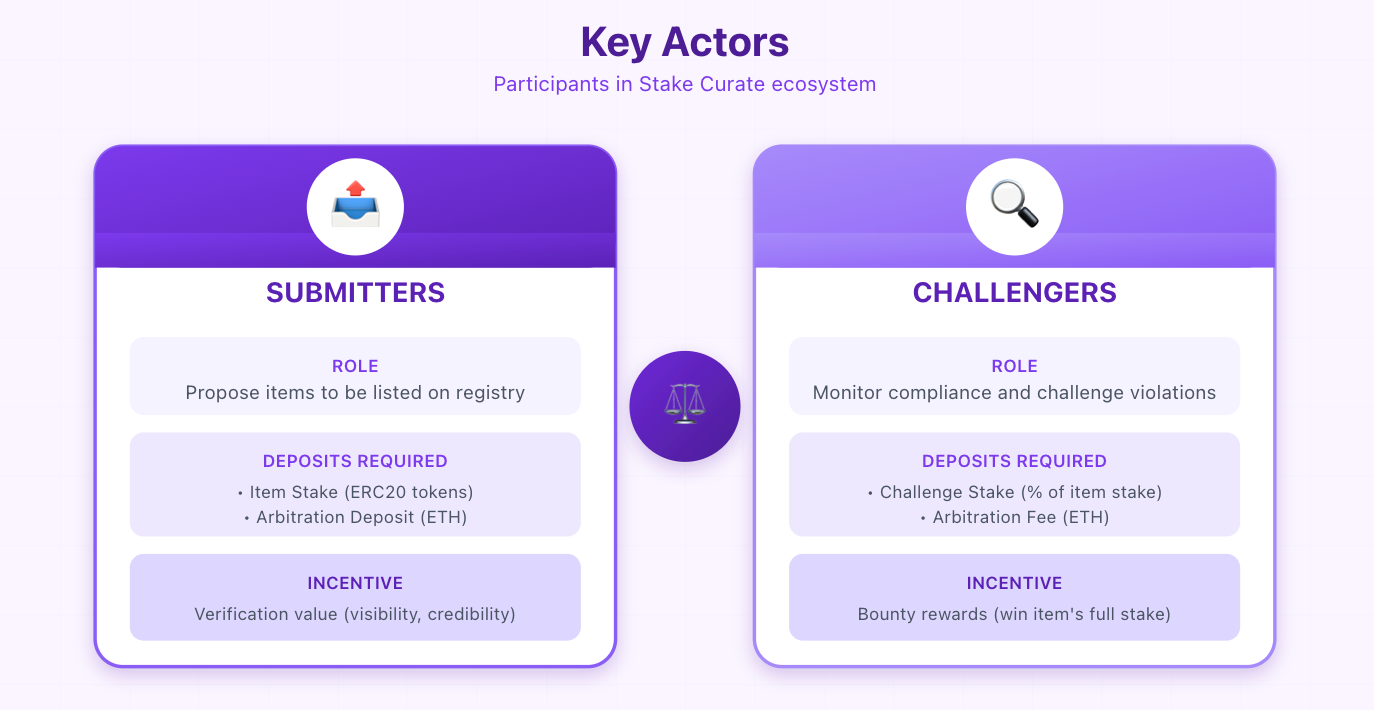
Actors in this process fall into two main groups:
- Submitters: They propose items to be listed and attach a permanent deposit as a sign of responsibility and accountability. As long as their item follows the rules, the deposit remains safe. If not, they risk losing it through a challenge.
- Challengers/Curators: They protect the system from incorrect or outdated information. By opening challenges when rules are broken, they ensure only compliant items stay active and are rewarded for doing so.
Submitting Items
- Review Policy: Submitter reads the policy to ensure item compliance
- Submission and Tokens Deposit: Submitter places a deposit in ERC20 tokens (submitters can stake more than minimum to deter challenges)
- Lock Stake: Staked deposit stays locked in the contract indefinitely
- Acceptance Period: Community reviews before item shows as "verified"
- Verified: The item is now verified as 100% compliant with the set requirements.
- Continuous Monitoring: Item becomes active and remains challengeable till withdrawal . The Item’s stake becomes:
- A bounty for challengers
- In incentive to stay compliant for the submitter
Challenging Items
What Challengers place as deposit:
- Challenge Stake (ERC20): Percentage of item's current stake
- Lost to item if challenge fails
- Set by the registry operator
- Returned if challenge succeeds (plus the item's stake as reward)
- Arbitration Fee (ETH): Covers dispute costs
- Consumed regardless of outcome. In case of challenger victory, the value will be compensated by the bounty
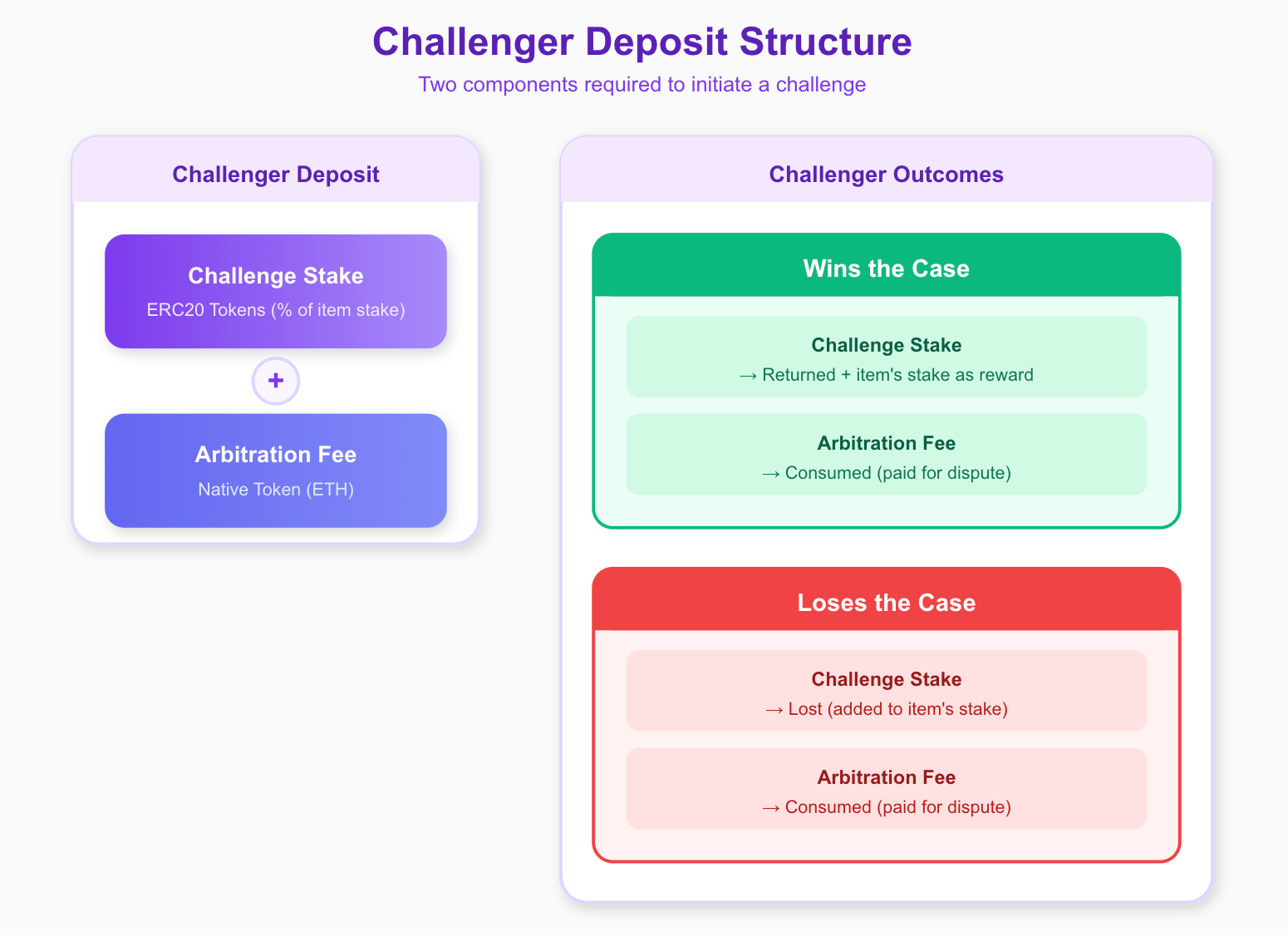
Challenge Process
- Active Monitoring: Challenger identifies a non-compliant item
- Challenge Initiated: Challenger places a required deposits (stake + arbitration costs)
- Item Status Update: Item status changes to "Disputed"
- Dispute Resolution: Dispute is sent to arbitrator for resolution
- After resolution: Community can fund appeals on either side
Dispute Outcomes
If Challenger Wins:
- Successful challengers recover their deposit and earn the item's stake as a reward
- Item is removed from registry (Status: Absent)
- The submitter loses its entire Stake/Deposit (awarded to the Challenger).
If Submitter Wins:
- Item status becomes "Reincluded" (not just back to "Submitted")
- Item gets its own reacceptance period (after this period, it will go from “reincluded” back to “Verified” status)
- Challenger loses its deposit in full.
- Challenger's challenge stake component is added to the item's stake, increasing future challenge costs
- Item can continue to be challenged, but now at higher cost
- If submitter had initiated withdrawal before the dispute, withdrawal completes automatically
- If a submitter withdraws after a successful challenge, the amount withdrawn will be higher than the initial deposit because it includes the challenger’s stake.
If Arbitrator Refuses to Rule (RtA):
- Arbitration costs are split equally between both parties
- Both stakes (item and challenge) are returned to respective parties
- Item is removed from registry to minimize damage to both sides
- This scenario assumes arbitrator malfunction rather than policy issues
Withdrawal During Disputes: Submitters can initiate withdrawal even during disputes. If they win, withdrawal completes automatically. If they lose, the item is removed and stake goes to the challenger.
Important: Items can face multiple challenges over time. Each successful defense increases the stake, making future challenges more expensive.
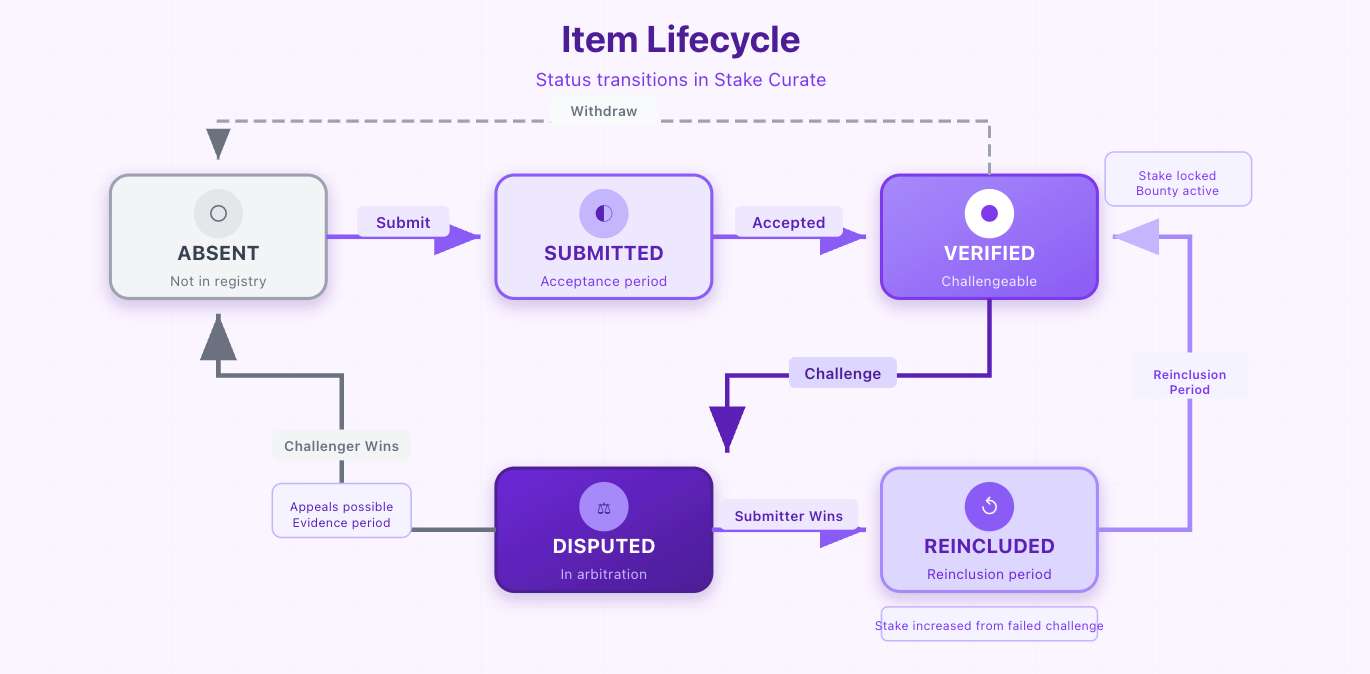
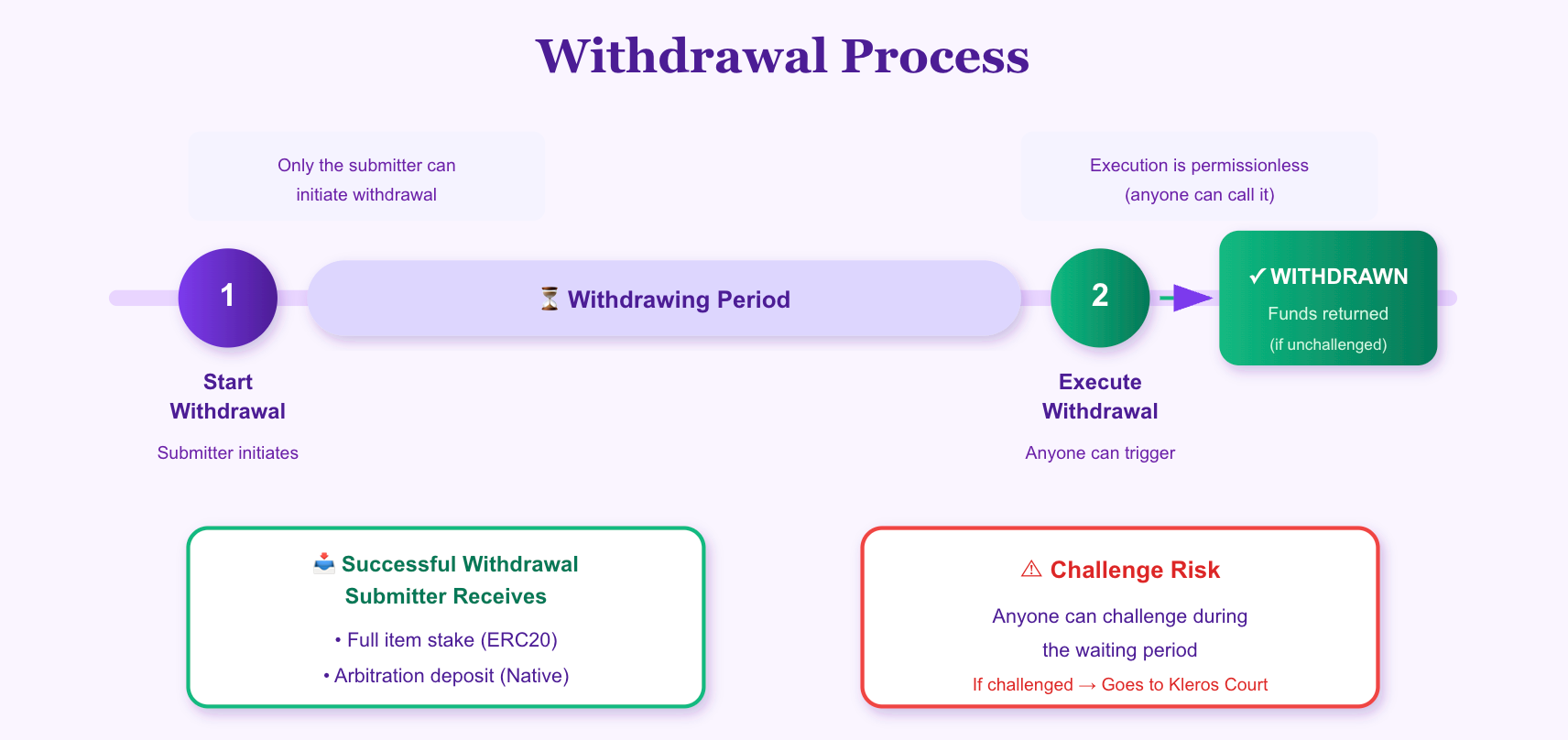
Withdrawal Process
- Initiate Withdrawal: Submitter initiates withdrawal (possible during disputes)
- Waiting Period: Must wait through the configured withdrawal period
- Community Review: Anyone can challenge during this period
- Complete Withdrawal: If unchallenged, submitter receives:
- Full staked deposit (ERC20 tokens)
- Arbitration deposit
- Extra staked ERC20 in case the submitter won disputes.
- Item Removed: Item status becomes Absent and leaves the registry
Safety Mechanism: The withdrawal period ensures the community has time to challenge before deposits are returned, preventing "rug pulls" where submitters violate rules then immediately withdraw.
List Creation
When a company, project, or individual wants to create a new list, the process is straightforward. The creator has full control over how the registry works and how verification happens.
1. Define Your Rules
Write a clear document explaining what belongs on your list and what doesn't. This becomes your registry's guidebook everyone uses it to determine if items meet your standards. You can update these rules later if needed.
2. Configure Your Settings
Choose how your registry operates:
- How much submitters must deposit
- Which token submitters use for deposits
- How much challengers must deposit (as a percentage of the item's deposit)
- How long submitters must wait to withdraw
- How many judges review disputes
- Who can update registry settings
Once you've made these choices, your registry is ready for submissions.
Incentive Structure
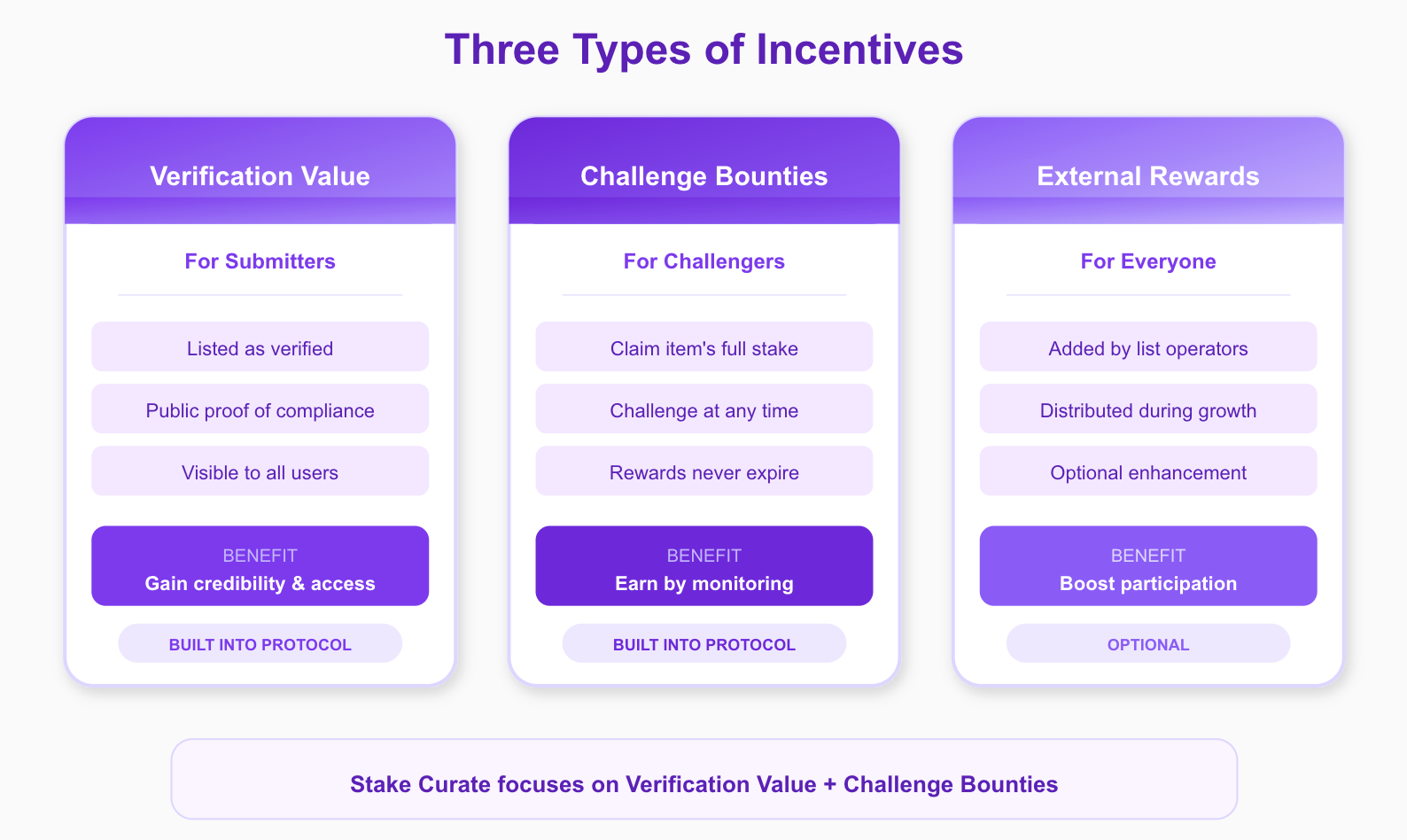
Stake Curate operates on three types of incentives:
1. Verification Value (Built Into Protocol)
What It Is: The direct benefits submitters gain from being verified
How It Works: Items gain immediate value through visibility, credibility, marketplace access, privileges, or reputation
Impact: Works best for lists where inclusion itself is valuable to submitters
Examples of instant benefits:
- Verified investment funds attracting more investors through a “low-risk” certification.
- Certified suppliers gaining access to exclusive procurement platforms.
- Verified AI agents gaining authorization to operate on regulated networks.
- Approved service providers displayed as verified partners on official websites.
2. Challenge Bounties (Built Into Protocol)
What It Is: Rewards for successfully identifying non-compliant items.
How It Works: When submitters lock their deposits permanently, those deposits become bounties. Challengers can claim these bounties by proving an item is non-compliant. To challenge, you must place a deposit (a percentage of the item's stake). If you win, you get your deposit back plus the item's entire stake as your bounty. If you lose, your deposit gets added to the item's stake, making future challenges more expensive.
This creates continuous monitoring without requiring you to fund moderation. Unlike traditional systems, this incentive never expires—the community constantly monitors compliance to win bounties. The deposit structure prevents abuse by discouraging baseless challenges: unsuccessful challengers lose their deposits, while successful challengers earn rewards
3. External Rewards (Optional Enhancement)
What It Is: Additional incentives you or Kleros can provide beyond protocol mechanics
How It Works: You manually distribute rewards to attract initial submissions or boost activity during growth phases
Impact: More common in traditional Curate; often unnecessary in Stake Curate since permanent bounties already incentivize monitoring
Use Cases
Content Moderation
- Social media profile whitelists.
- Verified creator registries.
- Approved contributor lists.
Examples:
- A decentralized social media platform maintains a whitelist of verified celebrity profiles to combat impersonation. Each verified account stakes tokens, and anyone spotting fake accounts can challenge them to earn the stake.
- A marketplace for content creators or artists which distinguishes between the authentic creators from scammers copying their work. Each artist will stake deposits that remain locked as long as they maintain their accounts.
Credential Verification
- News outlet integrity.
- Academic journal compliance.
- Professional certifications.
Examples:
- A news aggregator keeping a registry of all the outlets that maintain the journalistic integrity standards. Anyone can challenge the authenticity and can claim stake, if they believe the outlet is publishing misinformation or loses accreditation.
- A professional licensing board verifies member certifications that can be challenged and further revoked if suspected for misconduct. Members stake deposits that ensure they maintain their credentials and ethical standards, or lose their stake to challengers who prove violations.
Financial Monitoring
- VC fund strategy tracking.
- Treasury transparency.
- Investment policy adherence.
Examples:
- A DAO tracks whether partner funds are adhering to their stated investment strategies (e.g., "invest only in climate-focused startups"). If a fund deviates, token holders can challenge and claim the staked deposit.
- Public companies or crypto projects maintain transparent treasury records with community oversight. If treasury actions violate stated policies, stakeholders can challenge and win the compliance deposit.
Quality Assurance
- Software security
- Bio-certifications
- Product authenticity
Examples:
- An app store verifies that software packages remain malware-free over time. Developers stake deposits, and security researchers who discover malware can challenge listings to earn rewards.
- Organic certification registries ensure farms maintain compliance with environmental standards. Farms stake deposits, and inspectors or whistleblowers who find violations can challenge to claim stakes.
Gaming & Communities
- Anti-cheat registries
- Verified streamer lists
- Reputation systems
Examples:
- A competitive gaming platform maintains registries of fair-play gamers. Players stake deposits to prove they won't cheat, and anyone who catches them cheating can challenge to claim their stake and remove them from fair-play pools.
- Streaming platforms verify creators to prevent viewbotting and platform manipulation. Streamers stake deposits, and community members who prove manipulation can challenge to earn the stake and remove bad actors.
First Major Use: DAMM Capital (September 2025)
How It Compares
Traditional Curate
Process: Submit Item + Deposit → Verification Period → Item verified→ Deposit Returned
Timeline: Fixed verification period (e.g., 7 days)
Post-Verification: No ongoing incentives for compliance monitoring
Challenge Requirements: Challenger pays arbitration fees only
Best For: One-time verification or periodic renewals (like Proof of Humanity)
Stake Curate
Process: Submit Item + Staked Deposit → Acceptance Period → Item Goes Live → Deposit locked indefinitely → Continuous monitoring
Timeline: Indefinite continuous monitoring after acceptance period
Post-Verification: Permanent economic incentives for compliance
Challenge Requirements: Challenger pays two-part deposit:
- Challenge stake (ERC20 tokens): Percentage of item's current stake
- Arbitration fee (ETH/native token): Covers dispute resolution costs
Best For: Items that can change status and need constant supervision
Important: The acceptance period gives the community time to review new submissions before they're widely displayed as "verified" in your interface. This period can be set to any duration during list creation, including zero. Items are technically challengeable immediately on-chain, but most interfaces wait for this period to pass before showing items as verified.
Examples flows
Example 1: Academic Journal Registry.
An important NGO financing free information decides to create a list to grant funds only to academic journals that keep their research fully public without paying to access it.
List criteria: a verified journal pledges to keep articles free to read.
Traditional Curate Implementation:
- Journal submits credentials and policies
- 14-day verification period with community review
- After approval, deposit returned, journal listed
- Problem: If the journal later starts charging, there's no economic incentive for removal. Someone must act as a "good samaritan" and flag the item without compensation.
- Potential Solution: External rewards system can be financed externally, but the journal faces no direct economic consequences.
Stake Curate Implementation:
- Journal submits credentials with permanent deposit (e.g., 1000 USDC)
- Listed after acceptance period
- Deposit remains indefinitely staked
- Ongoing Monitoring: Users can challenge if journal starts charging fees
- Challenge Example:
- After 1 year, the journal starts charging fees.
- A user identifies this issue and challenges the Journal
- If challenge succeeds, the user gets the 1000 USDC deposit
- Result:
- The Journal would lose its status as “free information” source, lose its deposit, and lose financing source
- In an ideal scenario, instantly losing all these benefits would incentivize the journal to follow the rules
Example 2: Software Package Security Registry
An aftermarket application store (or just an independent user) wants to display only applications that are guaranteed to be free from malware, viruses, or malicious code.
Scenario: Developer submits an app and claims their package is "malware-free."
Traditional Curate Implementation:
- Developer submits package claiming security
- Verification period, then approval
- Developer gets deposit back, package listed as "verified"
- Problem: Package could be compromised later with no economic risk for bad faith developers.Only after a potential scam a “good samaritan” could flag the app as malicious.
- Solution: External incentives- the marketplace owner could finance bounties from their own funds for users who find bugs.
Stake Curate Implementation:
- Developer named Bob locks 500 DAI deposit claiming package security
- After acceptance period, the package is usable by community
- Continuous Security: Anyone discovering malware can challenge
- Escalating Protection mechanism: Each failed challenge increases deposit (e.g., 500 → 525 → 551.25 DAI with 5% multiplier)*
- Example:
- A user (secretly competing) challenges Bob for frivolous reasons just to get Bob’s app out of the marketplace.
- In order to initiate the challenge, the user needs to place a deposit
- The information provided by the “Challenger” user is insufficient and the user will be penalised with a "sanction".
- The sanction consists in losing its deposit.
- This sanction will add up to the item’s stake using the “Escalating Protection Mechanism”
- Incentive Alignment: Developer motivated to maintain security to protect deposit; malicious challengers lose money increasingly.
*Note: Increase percentage is set when creating your list.
The Path Forward: Permanent Incentives for Evolving Truth
Traditional registries excel at one-time verification but are less suitable for dynamic items, when truth changes over time. For traditional verification, once verification ends, no one profits from monitoring compliance. This leaves registries vulnerable as news outlets lose integrity, software becomes compromised, or entities violate commitments.
Stake Curate maintains economic incentives permanently. Submitters lock deposits indefinitely to prove ongoing compliance. Challengers can profit from monitoring at any time. Registry operators need no external funding to maintain quality.
The result is a virtuous cycle: Higher-value items require larger deposits, creating bigger bounties that attract more monitoring, ensuring higher compliance, which attracts even higher-value items. This creates natural economic scaling.
For registry operators, this means creating systems that maintain quality indefinitely, scale economically, provide transparent verification, align all participant incentives, and build credibility through locked collateral—all without ongoing operational costs.