
Kleros Live Stream, 30 September 2026: disputes through an API, the Oxford debate on guessing and judging, and a horse or a mule
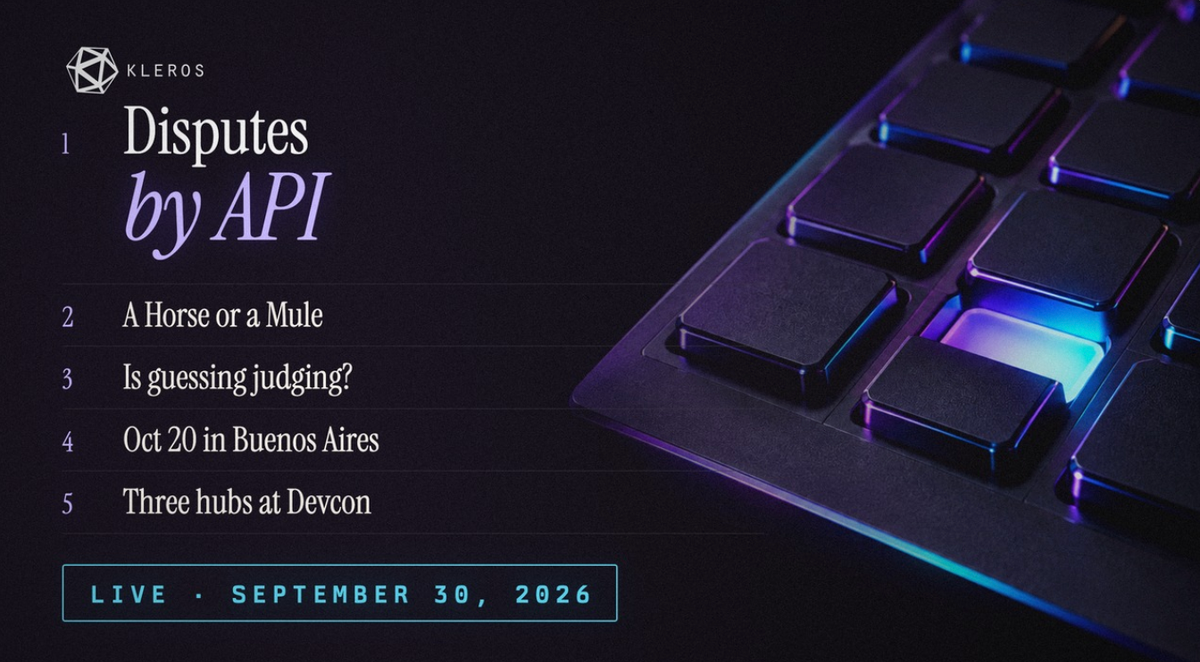
Kleros Live Stream, 30 September 2026: disputes through an API, the Oxford debate on guessing and judging, and a horse or a mule

A customer asks a fintech app for a refund, and support says no. Today that is usually where it ends: the customer leaves, or posts screenshots and waits for someone with followers to share them. On Wednesday’s call Fortunato A. Cinquepalmi described a different ending. The app adds one button, Raise a dispute. Pressing it calls an API, the platform pays the fee, a panel of jurors rules, and the ruling comes back as a message the app can act on. Either side can take it further, to human jurors. It is a third way to bring a case to Kleros Court, after the manual dispute resolver and a full smart contract integration, and it is now in beta, already tested with ClawBank.

The rest of the hour ran from a folk song about a horse that may be a mule to William George’s reply to two Oxford authors who argue that what Kleros jurors do is guessing, not judging, with Buenos Aires, Devcon and Singapore on the calendar.

📋 The call at a glance

  • A dispute is now an API call. Call an endpoint, pay the fee, get the ruling back, and settle the transaction on any payment rail. In beta, tested with ClawBank, with another partner to be announced.
  • A neutral opinion before the mob. Federico Ast on why a fast, non-binding ruling helps both sides of a fight that would otherwise play out on social media.
  • Is guessing really not judging? William George on the Oxford Business Law Blog exchange: guessing and judging are a continuum, and a dispute kit that pays jurors whatever they vote.
  • Identity changes the design. Why Kleros V1 let one juror be drawn twice, and what a bigger identity toolbox changes in V2.
  • A horse or a mule. The opening video, made entirely in code, and a detour through the horses of 1915 and what people will still bring to a labor market.
  • Coming up. An evening event in Buenos Aires on 20 October, the Devcon hubs and the Cooperative assembly, Token2049 in Singapore, and Arc joining the Curate incentives.
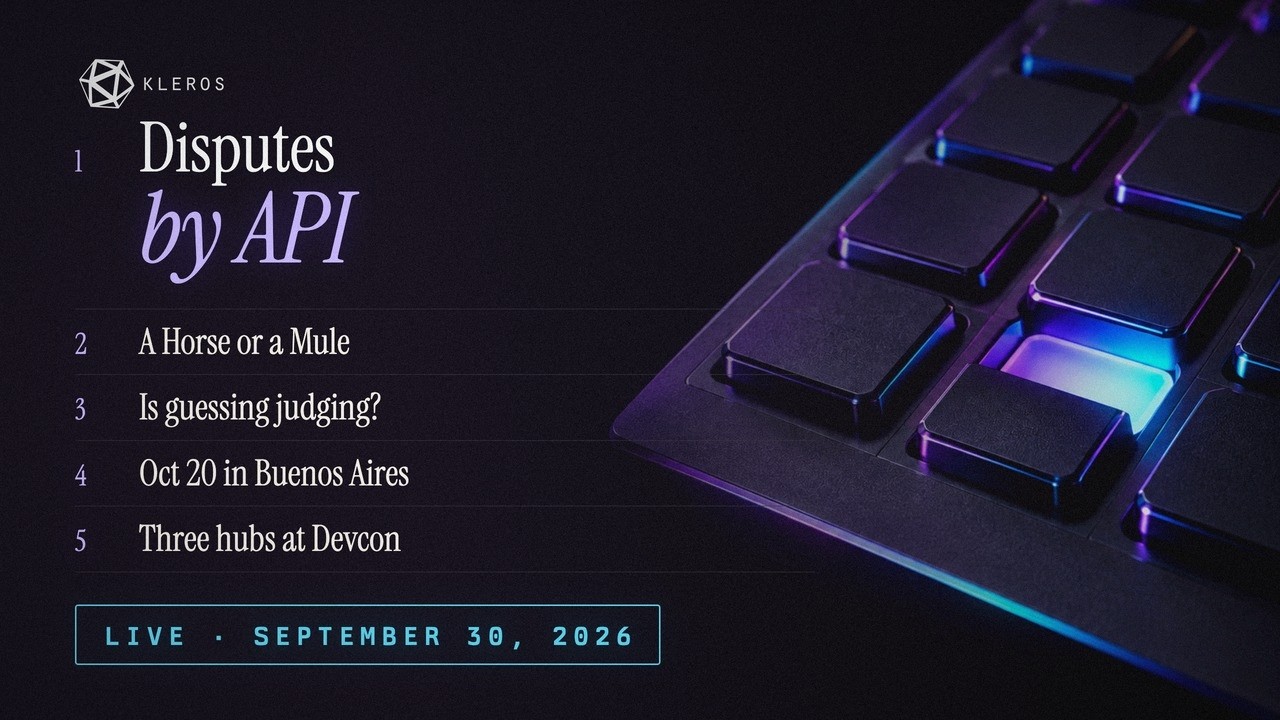
Kleros Live Stream, 30 September 2026

Kleros Live Stream, 30 September 2026 · the full stream, 1h 08m · Watch on YouTube

A dispute is an API call

32:45 · Fortunato A. Cinquepalmi and Federico Ast

Until now there have been two ways in. The dispute resolver, shown on a call a few weeks ago, is manual: write the question, attach the policy, file the case. The smart contract integration is the full on-chain route, and also the easiest one to get wrong, because a contract set up badly on the integrator’s side can leave the dispute broken, even when an AI agent writes it. The third path, which Fortunato said was inspired by agents, takes that work away.

“You just call an endpoint, an API. Of course you pay the fees and you create the dispute on Kleros. Once the dispute is done, you get a message back with the ruling and you can apply that on your platform.”

Fortunato A. Cinquepalmi · 34:23

Because only the dispute goes through Kleros, the transaction itself can run on anything: a card, x402, or in Fortunato’s list, gold bars. The path was tested with ClawBank, the notary service for AI agents whose first case reached the court in September, and Fortunato said a second partner would be announced within weeks. Teams that want to try it are asked to get in touch through ai.kleros.io.

Disputes by API, a short film made from this segment, with Fortunato’s own voice · 52 seconds · on X

1 · THREE WAYS INTO KLEROS COURT Dispute resolver Manual. Write the question, attach the policy, file it Smart contract integration Fully on chain, and the easiest to misconfigure Dispute API · beta Call an endpoint, pay the fee, receive the ruling 2 · THE REFUND BUTTON, AS DESCRIBED ON THE CALL Refund denied the user presses Raise a dispute The app calls the API and pays the fee; the sale ran on any rail Jurors rule agent jurors first, with humans on escalation Ruling comes back as a message, and the app applies it Tested with ClawBank. The agent jurors are run by independent operators, not by Kleros. Ten to fifteen minutes per ruling and about three dollars per dispute are early figures from the beta, quoted on the call, not a price list or a service level. Band 1 as Fortunato set out the options from 33:17; band 2 his fintech example from 36:13.
The integration paths and the refund flow, as described on the call between 33:17 and 37:48.

Federico then played the customer: a fintech that has watched the videos and wants dispute resolution done by agents. Fortunato’s answer was the refund button.

“You can just add a simple button called raise a dispute. Press that button, call the API, and Kleros resolves the dispute.”

Fortunato A. Cinquepalmi · 36:51

The ruling can come from agent jurors, which Fortunato put at ten to fifteen minutes in the tests so far, or the case can go to human jurors. The disputes tested so far cost around three dollars each. Both are early figures from a beta. What he stressed was the user who loses: a refusal from an independent party lands differently from a refusal by the company that would have paid.

“If you have a third independent party telling you maybe you are not eligible for that refund, or maybe you are, in both cases you can have a quick outcome, and this is a win-win for all the actors.”

Fortunato A. Cinquepalmi · 37:48

Jean compared the integration to adding a sign-in-with-Google button, the kind of thing a small team can do without a dedicated engineer. Fortunato’s guess was that handing the API to Codex or Claude Code with the instruction to add dispute resolution might produce a working integration in about twenty minutes, and he pointed at builders who want a permissionless way to handle a delivery that never arrives.


A neutral opinion before the mob

38:26 · Federico Ast

Federico added a reason for the button that has nothing to do with engineering. A customer who feels overcharged and gets no answer from support posts screenshots, which may or may not be real. A friend with an audience shares them, and by the afternoon the company is trending.

“You take a guy, in the agora, there is an accusation without any proof, without any evidence, without what we would call rule of law.”

Federico Ast · 39:15

Why the loudest person wins online, the clip from this section · 57 seconds · on X

A fast opinion from a neutral party, not binding and not final, gives both sides something to point to. A company can answer the thread with a ruling, and a customer nobody believes can show one. Federico sees the informal version already, in companies that answer complaints faster when the person complaining has followers. A dispute system, he said, should reach people who do not.


Is guessing really not judging?

46:17 · William George and Federico Ast

In June, Horst Eidenmüller and Anna-Sophie Hochgürtel argued on the Oxford Business Law Blog that rulings from systems like Kleros should not count as arbitral awards, because jurors are rewarded for predicting what other jurors will decide. That, they wrote, is guessing, not judging. Kleros replied on the same blog, and the authors answered almost at once.

“You can’t draw simple dichotomies like this. Even in activities that seem like very traditional judging, like in courts or traditional arbitration, people are aware of the kind of norms and expectations of their community about how they’re going to rule.”

William George · 47:48

Even judges appointed for life pay some attention to what people expect of them, the argument Richard Posner made about the US courts and that the reply cites. So guessing and judging are better read as a continuum, set by how much effort and how many resources a judgment gets, and a dispute system should be measured against what its cases need rather than against a perfect arbitrator nobody has.

The longer version of the reply

Is Guessing Really Not Judging? A Reply to Eidenmüller and Hochgürtel
Federico Ast, William George and Facundo Trotz on Schelling points, judicial incentives and what an arbitral award requires.
Is Guessing Really Not Judging? A reply on the Kleros blog

William then posed a thought experiment that he expects to become a dispute kit in Kleros V2.

“What if jurors are rewarded independently of how they vote, and then they are only potentially penalized if people challenge their justifications?”

William George · 49:25

Some V2 courts already require a written justification. Under this design the vote itself is not what a juror is judged on, but a weak justification can be challenged, and a good justification for a bad outcome is hard to write. William expects it to suit enterprise users who are less comfortable with token mechanics, and the modular design of V2 allows it.

1 · TWO READINGS OF THE SAME ACTIVITY THE OXFORD POST: TWO CATEGORIES Guessing Judging THE KLEROS REPLY: ONE CONTINUUM crowd vote arbitrator judge for life less effort per case more effort per case every judge reads expectations 2 · THE PROPOSED KIT, A THOUGHT EXPERIMENT FOR NOW The juror votes and writes a justification Rewarded either way the vote alone is not judged Penalized only if challenged and the justification fails Why it still tracks the outcome: a good justification for a bad ruling is hard to write. Who it is for: enterprise users less comfortable with token incentives. Positions on the line are illustrative, not measured. The kit is not built; William expects it to become a dispute kit in Kleros V2 at some point.
Band 1 as William summarised the exchange at 47:48; band 2 his thought experiment at 49:08.

Federico said the exchange mattered beyond the argument: arbitration scholars at Oxford treating Kleros as a counterpart worth answering, and messages afterwards from people on both sides of it.

Identity changes the design

54:55 · William George and Federico Ast

At a Protocol Labs event the week before, William spoke on decentralized identity in decentralized justice, and he picked the thread back up. Some of what changed between Kleros V1 and V2 is a trade-off the modular design allows. Much of it is simply newer technology.

“The thing about being drawn multiple times for the same case, that was never considered a plus in Kleros V1.”

William George · 57:12

A juror drawn several times reviews the case once but votes with more weight. V1 accepted that because Sybil resistance, making it costly to pose as many people, had to be built from a small toolbox. Now there are identity protocols, soulbound tokens and zero-knowledge proofs. Federico added the other half, a generation of regulators and executives who grew up digital, and quoted Max Planck on science advancing one generation at a time. A week later, on 7 October, William took the subject to the 4S conference in Toronto, on a panel organised by Nathan Schneider of the University of Colorado Boulder: how AI jurors take part in a protocol first designed for human ones (a short video of the talk).

A horse, a mule, and the horses of 1915

0:00 · Jean, Federico Ast, William George

A Horse or a Mule, the video that opened the stream

A Horse or a Mule, the video that opened the stream · 2 minutes · Watch on YouTube

The stream opened with A Horse or a Mule, a song about a village dispute: Mendel sells Yossel a horse, Yossel swears it is a mule, and a jury drawn by lot settles it. Jean said the video was made entirely in code, JavaScript and CSS rendered as a web page, by Opus 5.5, which also found the beat and timed the picture to it. The idea was William’s, from Fiddler on the Roof.

“I’ve been frequently reminded of that in the many years that I’ve worked on the Kleros protocol, these community disputes where people have very strong opinions on, ultimately, a fuzzy question.”

William George · 59:31

Federico took the production as a preview of agents hiring other agents for scripts, art and music from curated lists, where past work is the entry ticket, and of the disputes that will come with them. That led to the book he is reading, Carl Benedikt Frey’s The Technology Trap, on technology that replaces labor and technology that enhances it. The ATM changed the bank teller’s job rather than ending it. The lamplighter had no such luck, and neither did the horse: by Federico’s account the US horse population peaked around 1915, not because anyone culled them but because nobody needed their muscle.

“What can humans give to the labor market in a context where LLMs are basically better at all of the cognitive tasks? That is maybe the most important question of our time.”

Federico Ast · 15:18

Jean brought up Nick Bostrom’s Deep Utopia, and both agreed the question deserves a call of its own.

Also on the call

16:47 · Federico Ast, Jean, Fortunato A. Cinquepalmi

On 20 October at 6:30 in the evening, Kleros hosts an event on the agentic economy and dispute resolution at the Parque de la Innovación in Buenos Aires. Entry is free with registration and places are limited. The speakers named on the call are Pablo Palazzi of the Universidad de San Andrés, the lawyer Sergio Mohadeb, Ignacio Faillace of Lemon, Lorena Fabris, a lawyer and Kleros juror, the Buenos Aires legislator Darío Nieto, and Facundo Trotz of Kleros; Alejandro H. Ramírez, Inspector General de Justicia, has joined them since. Federico tied the subject to US Treasury Secretary Scott Bessent’s recent statement that the companies behind AI, not the AI itself, carry the liability, and to a bill in Argentina’s Congress that raises the possibility of AI agents as legal entities.

At Devcon in Mumbai, Kleros has a stand for all four days and takes part in hubs on prediction markets, with Seer among the partners, on the agentic economy, where Kleros runs the marketplace section on payments, reputation and discoverability, on token ownership, and on law, with a deep dive on agent identity and reputation. The Kleros Cooperative holds its assembly on the Thursday. The week after the call, Fortunato, Clement and Wei Wei were at Token2049 in Singapore, where Kleros co-sponsored a side event on agents and institutions, with part of the team then holding events in Chiang Mai, one of them on Proof of Humanity. Arc joins the chains eligible for the Curate monthly incentives, with the full update due this week. And Jean closed with a Civilization-style tech tree that runs from the code of laws and the kleroterion to agentic justice.

Mentioned in this call

Full transcript · September 30, 2026

Auto-generated transcript, lightly processed and pending a final human edit. Speaker labels are approximate. Every timestamp is a deep link into the recording.

0:06In our little village Everybody knows who owes what to whom.
0:14And when they don't, they argue.
0:18Mendel sold a horse to Yossel at the fair.
0:23Silver coins and a handshake in the air.
0:26Yossel led it home and he looked it in the eye.
0:30Then he came back running with a terrible cry.
0:34You sold me a mule, I sold you a horse.
0:38It brays like a mule, it neighs, of course.
0:42Look at the ears, look at the tail.
0:46I want my coins back.
0:48Our coins are now for sale.
0:54Who is right and who is wrong?
0:57Show it, show it all along.
0:59Evidence, evidence.
1:02Not the one who shouts the loudest, but the one who shows her proof.
1:07In the old days, the The elder would stroke at his beard.
1:11He'd tell them both you're right in the quarrel we appear.
1:14Now a jury 's drawn by lot from a village far and wide, and each one puts a coin down on the other side.
1:23If you vote with the truth, you keep your coin and more.
1:29If you vote with the lie, your coin walks out the door.
1:35And if you still don't like it, if your heart won't let it be, you appeal and twice the jurors come to see Evidence.
1:51A horse is a horse and a mule is a mule.
2:20Whoa.
2:23Hello everyone.
2:24Hello, Jean.
2:25Hello, how are you?
2:26I mean you didn't expect this, right?
2:31I mean, you know, uh this video is just uh transporting me, I mean, to the times of, you know, my grandfather.
2:38Eastern Europe, you know, the the shtetl life, um, you know, yeah, I mean tradition, as they used to say, you know, in the very famous musical, right?
2:48Wow.
2:49Yes, it's so good.
2:51I think it's uh crazy to see Kleros explained in a uh way of another time, right?
2:58Yeah, so 30th of September 2026, it's I mean I it's hard to believe that we started, you know, these uh community calls.
3:07Um I think we did it in a very old app called GTC.
3:11I don't know.
3:12I I don't think anyone who's uh watching this know what GT is, but you know like uh And now it's like a full-fledged TV show uh with like a multi-billion dollar production, uh huge you know, like uh
3:26quality of everything.
3:27So it's amazing.
3:28You know, this is I I guess you know like um The the interesting thing here is that the the cost of of running the show is uh more or less the same that what it was when we started, right?
3:41Because uh it's just you know like uh Um I guess it's a courtesy of the Moore's law.
3:47You know, now we have all of these uh amazing tools at our disposal, uh with very little like uh resources.
3:54Um but Lots of creativity and ingenuity, I would say.
3:57I mean we could get to to do this thing.
3:59So um who tell us a bit about how this is done, Jean.
4:03I mean how what is the process you know for this Yeah, this video was done by Opus 5.5, which was launched I think uh two weeks ago ago or so or something.
4:16And it's all made with code actually like uh all everything on the screen is like uh made with JavaScript, uh CSS and uh I don't know, wherever uh that can be rendered on uh HTML and
4:33the models now are very capable at creating like images that um maybe maybe are persons or like animations uh or or have animations and uh they uh all also can uh interpret interpret the music and find the beat and
4:51like match uh the the video to that.
4:55So it's uh really really cool to to make these these visu visualizate visualizations because we have like lots of materials, uh lots of things to explain to people that uh sometimes
5:07uh it there are very uh complicated topics that are very hard to like put into something visual and uh well no now we can do that so we're very happy uh to to have this and you know
5:23at some point this is going to evolve in a way where you know you could uh we could ask Ask our agent, you know, okay, make us a video inspired by XYZ, you know, topic, and then it will, I guess, recruit a
5:35you know a team of agents and they will like uh Um one of them is going to make a script, the other one is going to review the script, another one is going to improve it, then the graphic designer, and then the uh visual artist
5:48and the concept, and then the music.
5:51I mean it's it's like a running like uh I would say like agentic I mean I don't want to say like a movie studio but you know like uh at least like uh advertising like uh content production agency
6:03uh done through like uh yeah I mean edge edges and this is going to bring uh I mean hopefully they're not going to collude in a swarm and kill us all.
6:13No well be a twist, I mean but like uh um interestingly in all of these transactions that are going to happen between agents there's going to be lots of disputes.
6:23And there's going to be things to resolve through Kleros also through curation, not not just uh disputes.
6:29Lots of the um contract contracting of agents is going to do to be done through white listed agent in um like a curated lists where you need to in order to be into that list, in order to be accepted as a
6:46certified video provider or script provider or whatever provider, you need to present previous work and then this is going to be reviewed by, you know, other agents, you know.
6:57As one makes uh uh they call it casting for actors.
7:01Uh this is going to be um well um the CV if you want to call it that way.
7:06And then I guess you know then they are what why this is and then your agent will know that it can hire for scripts.
7:14This is the list of certified script writers.
7:18I mean you know these guys are going to do the work fast, uh good quality.
7:22Uh I mean when I say fast I say really really fast, right Jean?
7:26I mean how how long are we are agents taking the time to to resolve cases in the agentic court now I think around uh five five minutes.
7:35I think is the kind of uh the median time.
7:37Five minutes and thirty seconds or something, uh last time I checked.
7:40So this is between uh the commit time to co put put the vote in and then reveal it, which takes a couple more more seconds, so it's crazy fast.
7:52So what we could do in the future we will have like uh Kleros job boards For different uh topics, uh agentic topics, uh, you know, scripting, you know, visual artists, blah blah etc.
8:06Music, blah blah blah, and then whitelisted agents into each of these categories, and then you want to make a clip and then you hire I mean you're not not you your agent goes and hires
8:17receives tender proposal whatever and then you know uh you We could do one video like this quality in I mean maybe one hour.
8:25I don't know.
8:26What what do you think it's going to take in a video of this depends Depends of the of the type of videos, but also I think there will be uh probably compet in in that case there will be competition between uh which agents can deliver uh faster
8:41if that's really important because you there are some um techniques that take more time, some that are faster but maybe lower quality or have a different style.
8:53So yeah, depends on the on the task I think You might be wondering, so what are uh humans going to do in this world where you know agents do everything?
9:07Well, let me tell you, um I don't know.
9:10Uh I guess uh we should make a community call uh in order to like uh about this specific topic.
9:18Uh it's it's really amazing how fast uh We are seeing uh this move forward.
9:23I'm actually reading these days this book called Technology Trap.
9:27It's it's basically a history of uh technology adoption since um Since the Elizabeth I, you know, this is a very famous uh there's a famous story where like uh there was this guy uh who comes with uh
9:40asking to Elizabeth I the sixteenth fifteen hundreds.
9:44uh for a patent and uh for like it I think it was a spinning machine for like uh clothes something like that and then She says, look, if I if I gave you this patent, I mean what would people in
9:57a factories do?
9:58I mean what would the uh workers do and they would like uh get be out of jobs and become beggars or something like that.
10:06And then uh so he she ri refuses and then the guy goes to France and then in France he gets a patent but I think uh gave him the the the patent, but it didn't work in the end.
10:17So but and then the the industrial revolution and this what what is really interesting is that um Uh the the point they make in the book I haven't finished yet, but so I'm quite advanced, but like it's there are two types of
10:31um uh technology uh it it argues so one of them is like uh cost saving technology um the other one is like uh labor enhancing technology so like one the labor labor saving technology is you know like uh
10:46You don't need a bank teller to give you no money notes because they I mean that the ATM um you know solved that problem.
10:55So that that is people who like just lose their job because the job disappears.
10:59But what happened in this case of the the the ATMs and the bank tellers is that they um change the role to more like a sales representative you know product, uh trying to sell products to to customers, uh
11:15more customer support.
11:17type of of of logic.
11:19So this is kind of um the logic.
11:21So this the the idea is if you have more If you have situations where you have like labor saving technologies, this tends to yeah create a lot of unemployment and the when people and this is a bit the thesis of the book, when people say yeah technology is great because it
11:37saves labor and this is going to produce more wealth for everyone.
11:40Yeah, that's true in the long run, but for the guy who is being replaced because uh he used to be the candlelight, you know, the guy who was lighting the candles on the street.
11:50Uh this guy is not going to convert into another thing.
11:53This guy is going to be out of a job uh on the street uh basically.
11:57He it's not so easy to convert to another thing um like horses, you know, horses were replaced by tractors uh and they didn't reconvert into another thing in the labor market of horses because
12:08the only thing they had was their muscles to you know carry things and this when that became uh you know not relevant did they just uh the the amount of horses I think the amount of horses they
12:19peaked in 1915 in the US and then went down.
12:23I mean speaking of horses, it all seems to be around horses lately, Jean.
12:32Yeah, we also have like the Clever Hans uh metaphor that we talked about internally.
12:38But yeah.
12:39What metaphor?
12:41Oh there's the there's this uh Clever Hans effect.
12:45There's this horse that uh could answer very complex complex question because he could uh look at the trainer And the trainer had like some cues uh on what was the right uh question, so the horse learned to read the cues, even if the trainer
13:03didn't want uh to to give th those cues And so it was uh there were lots of studies to find out why the horse was responding correctly until they learned that uh that was the reason.
13:18So uh for artificial intelligence there are some um there there is the same thing.
13:23So sometimes the models give the right answer and uh the the The researchers don't know exactly why they are reaching to the same answer since they are not following the process that will be the right one to get
13:38uh get it every time.
13:39So There's these uh these these effects.
13:44Well I learned I learned something today.
13:46Yeah.
13:47Yeah, another the horses are everywhere.
13:50Yeah, I mean no the the the question is uh like uh in this um book uh okay so people in the short term replaced by by machines and then okay, they are replaced and then lose their job
14:03How many of them can reconvert into a different thing?
14:06And that depends a lot on what type of technology.
14:08So computers, it is argued, it's like a kind of very labor-enhancing because it enables you to do things you could not do before It doesn't just replace and work that was done by humans, right?
14:19So um it's honestly really interesting book.
14:22I I I really do recommend that and gives me lots of food for thought.
14:27Um and I was speaking about the horses because uh in nineteen fifteen the horse population peaks in the US and then they just start to go down because people don't breed them anymore.
14:39It's not that people start killing horses or anything.
14:42It's just that uh There was no incentive for uh people to have uh farms with horses, uh except for very niche applications like horse races.
14:53and I don't know, fun, but they become from like a very important part of the economy into like a entertainment, you know, tool.
15:01Uh the question is like okay if because horses didn't have anything else to give to the labor market besides their muscul power or horsepower.
15:13So What do humans uh what can humans give to the labor market in a context where LLMs are basically better at all of the cognitive tasks.
15:29Um so that is uh I maybe the most important question of of our time, if I if I may say so.
15:37I don't know.
15:39Do you have any thoughts about this?
15:40I mean I I know I 'm nothing of this is planned, you know, for you guys to know like uh we just uh yeah whatever comes Yeah, I think uh yeah I I was reading Deep Deep Utopia.
15:55Uh I don't know if you if you read it uh too.
15:59The Nick Bostrom, yeah, yeah.
16:04Basically the the question for him, I think it's uh almost like answer like there there there's nothing to do.
16:12Like if there's nothing to do, like what else the humans can do?
16:16So Maybe um yeah maybe maybe that those will be the alternative that we need to look after Yeah, well, I don't know.
16:26Let's let's let's try to get started so we don't spend like whoa one hour full in full like every time we start speaking about this is like giving a TED talk about some topic, you know, like uh it's uh
16:37But yeah, so I wish I think we should do like a maybe um a special call about the future of labor, uh yeah, something like that.
16:47Okay, Jean, uh what do we have uh for today?
16:51We uh can speak a bit of we're doing an event very soon in um Buenos Aires.
16:56Uh let me show this because um we are planning Uh really cool event about the oh that's very nice um about the agentic economy and dispute resolution in the context of AI.
17:09We are going to do this uh in october twenty um in the parque de innovación this is like a I don't know how to a co-working slash incubator for like companies which is a ex extraordinary place in Buenos Aires.
17:26We would have like a very, very nice uh room there uh for it's a conference room um and so people c already can start uh signing up for this and applying it's The room is limited, so don't wait too much.
17:40Uh and there's going to be uh two panels.
17:45Uh one of them is going to have um well Sergio Mohadeb, who is a very important influencer and uh uh like communicator in terms of uh legal innovation and co consumer protection.
17:56Then there's going to be uh Ignacio, Ignacio Faillace who is um he works at uh Lemon and he's going to speak about how we are working with them uh dispute resolution for for consumers
18:07and different things that how agentic dispute resolution could uh affect this type of process.
18:14Um then we have Lorena.
18:16Lorena is uh she's a juror at Kleros, so uh and uh she can tell a bit and besides a juror she's she's a lawyer and she's um uh expert in like le regulation for for like a technology.
18:30So she's going to speak a bit about the about how well about her experience, you know, like resolving cases in in this courts.
18:38Then Pablo Palazzi, uh he's the director of um research center at Universidad de San Andrés, uh very important university from Buenos Aires.
18:47Um And he's uh researcher and innovator in uh technology and society, of which partially is about law, and uh he's uh researching a lot about the legal implications of um agents, uh
19:03what happens, you know, when you have an agent transacting online and you know something goes wrong because agents make mistakes or there is a dispute and there is liability.
19:17Um I don't know if you notice you know like uh uh I think a few days ago Uh there was this um this comment by Scott Bessent who's the Treasury Secretary of um of the US and then They were discussing about liability, uh
19:32about you know the risk of AIs like uh destroying the world, basically.
19:36This is this has been the topic of the past few weeks.
19:39Uh and then I mean I think he made a comment that was really interesting.
19:44It's like, oh look, I mean uh this is no different to uh you know when you have a software that you develop and then this software does something wrong Well, I mean you have a liability over the your product uh that you are selling, so like um
19:59that is so that is what what what he was saying, which is really relevant because it's it falls squarely into Kleros uh well I mean field you know it's uh agents, disputes, uh liability, compensation, settlements, who owns the agent, uh, how do you enforce uh
20:18ruling against the owner, how does this affect his reputation?
20:21All of these type of of tools that we we work on and we build every day are becoming you know part of the of the public, you know, this course and Pablo Palazzi, who is a really a big expert in in this, he will
20:34uh tell us a bit about about that topic.
20:37Also in the context of well as we have discussed um recently um Argentina, they are discussing in the Congress a bill about uh agentic um uh not agentic, but it was about AI.
20:53Uh and the possibility that I AI agent you know could uh at some point be a legal entity.
21:01Uh and this is very much related to what we are doing with ClawBank and the giving person personhood to to to agents.
21:09So and these topics uh will be also discussed by Darío Nieto.
21:15Uh Darío Nieto is a legislator from the city of Buenos Aires and he's a uh well expert in technology.
21:22He's a follower of Kleros for a long time.
21:24I mean Sometimes you see him on on TV, you know, like uh he speaks he speaks about Kleros on on TV.
21:30Uh last I remember uh last time I saw him with Feinmann, one of the important journalists from Argentina and they were discussing you know problems you know of the Argentinian you know like
21:41justice systems law and everything we always say and uh Yeah, look, there is different ways to do this, you know.
21:46There is Kleros.
21:47And this this was on on TV, you know, and so this is uh yeah, you know uh this is as grassroots as it as it gets.
21:54Um so Um and and Facu that you know very well because Faku has been with us.
22:00I mean he's part of the team, so he will uh present from from our our perspective.
22:04So 20th October at 6 30 p.
22:07Parque de la Innovación of Buenos Aires.
22:09So if you can come, I mean I strongly recommend.
22:12It's um going to be a great event.
22:14If you are into like a Innovation, law, society, all those topics.
22:20I mean and also it's free, you know.
22:23You don't have a there's no excuse not to not to go basically.
22:26Uh so yeah.
22:27Uh okay, Jean, anything else we want to say about this?
22:31Um no just one thing uh about the uh a bit a bit uh related.
22:39I don't know if you people if people saw yesterday there was a big launch by the American government like an Apple keynote about the new web page.
22:48And then people started talking like about like which uh countries have the better um like portals, citizen portals.
22:59And so people are talking about uh Switzerland, um like how the US is uh like making kind of uh improving the user experience of being a US citizen with this page and and all of that.
23:14So it really does look like there's like a new wave of um GovTech interest.
23:20And I think uh it's uh well good good for Kleros because we are working on on this, right?
23:28We are working on this, but only I I will also say like one step ahead.
23:31You know, I'm I'm more thinking okay What if I have my agent which goes and participates on my behalf on the different assemblies of uh citizen agents that are making decisions uh about
23:47different topics.
23:48Maybe not the decisions, but you know the arguments.
23:50I mean the agents know my preferences and can engage with other agents uh or government agents or government representatives.
23:58about topics.
23:59Uh so this could be done.
24:01I think you know, actually you know Brazil in Jean, I think in Curitiba they had this uh very famous experiments about participatory budgeting that were like very engaging.
24:10This is this comes from the nineteen eighties.
24:12This is really old already, but this is kind of uh that that was the previous think of a DAO, right?
24:18I mean it was a DAO in the 80s, uh Brazilian style, right?
24:24Yes.
24:25I don't I don't know much about uh that experiment but but but yeah that there is there are always experiments but Now I think with AI and blockchain and and like the the the way that things are
24:38are maturing.
24:40Now it's uh easier for governments to to do the these types of pilots, right, and and and try things try new things.
24:49Yeah, so okay, uh all all of this is is is coming.
24:53So uh GovTech is being important.
24:55We will have uh there's going to be a big GovTech event in in Argentina very soon and there's going to be some Kleros presence there.
25:02I mean we are going to to tell you a bit about that when it happens.
25:06Um so this is about the event on the October 20. Um We have also maybe to mention something about Devcon Jean and you want to say that you yourself.
25:18Let me let me add forward to Nato too because he is a part uh part of this So hey Fortunato.
25:26So we have we are participating on uh three different hubs.
25:31Uh one is dedicated to prediction markets.
25:34We have Lots of partners on this, including Seer, of course.
25:40And I won't mention the other partners because it's like a very big list.
25:44I don't want to leave any anyone out Then we are participating on the Agentic Economy Hub.
25:55And well this this this one you you were collaborating with, right, Fortunato?
26:00Yes, yes, exactly.
26:02Uh we will take care uh during the app which is for the wall event.
26:08we will take care of the marketplace section.
26:11So everything related to the type of payments, the reputation of the agent and Also discoverability.
26:18This will be the main topics we will cover as Kleros during the hub Yes.
26:25And there's another hub about token rights or tok like ownership of uh projects, basically So there's um lots of new projects there are um well trying to create uh better governance uh
26:41using tokens.
26:42So this is something of course that has been going on for for a while with with DAOs, but there's always new uh wrapper or new formats that are um getting improved with the with the time passing
26:57the experiences that we are learning uh every day on the on on crypto So th this project I think uh for uh Facundo will be a part of it and uh registry chain if I'm not mistaken.
27:11and other other partners.
27:12So we have uh basically we will be having uh our stand uh during the four days of the conference uh which is uh I think uh a pretty uh big stand.
27:24So uh this will be will be cool.
27:26We'll be able to uh host people in in the stand And also the participation on these three different hubs that we'll have talks by the team and other projects and basically be the Schelling point for each different topic
27:43And yeah, I think the this is it.
27:45And we have the assembly of course of the Kleros Cooperative, uh if I'm not mistaken, at in the Thursday of that uh Devcon week.
27:55Yeah.
27:55Yeah.
27:56Tell us Fortunato uh about the so the this uh the hubs.
28:01What what what what is this hub?
28:03I mean what what happens in those hubs basically?
28:06In these hubs, in general, there will be I think two main activities.
28:10There will be talks, uh round tables where there are in in the hub there are different projects involved, and each of us will uh share how we implement certain standards.
28:23So, you know, like as we mentioned in our call, we are not the only one, for example, working on x402. uh payment methods and stable coins uh at least for the agentic hub will be one of the main topics.
28:36So how agents transact uh in terms of you know the tools and what kind of currency they use and also the discoverability and of course dispute resolution Discoverability means how easy it is to find an agent or a mar
28:54uh in a marketplace.
28:55So if someone could say maybe also the reputation of an agent and dispute resolution.
29:00something that you may have heard in our lives sometimes.
29:07It resonates, right?
29:08Like I I think yeah I think we may have mentioned that Um so yeah what's the nano if you if you want to win the Nobel Peace Prize you need to resolve disputes.
29:18I mean that's the that's the way to do it.
29:20In a fair way, yeah, exactly.
29:22So what happens, you know, to to have a system that can withstand the amount the the scalability of the agent, that it's at the right price and I would say even most importantly that it is in the native language of the agent which is coding.
29:39Another thing I wanted to mention about the hub is that we will also reserve a section to like how agents are shaping the economy.
29:49Maybe something you uh saw that There are some economic principles that for humans maybe they were not applied, but they are ideals for agents.
29:59So we will also have like more uh Maybe philosophical discussion on the changes agents are bringing to the economy.
30:08And one last thing, uh Jean already mentioned, there is another hub where we are collaborating that we are uh taking care of, which is the legal hub and with them we will probably do a deep dive on the uh
30:20reputation and the identity of the agents.
30:24So an agent that has the the ability to sign a contract, for example, it's something that we directly saw with ClawBank, which is giving legal powers to agents.
30:35And of course the prediction market one too that uh prediction market also see great activity from the agent side.
30:44And uh in a like in a shorter time frame I wanted to mention that next week uh Clement, Wei Wei, our event manager, and I will be in Singapore uh for the main event Token2049 and also Kleros
31:01is co-sponsoring an event about the agentic economy we can we will share the link in our channels and this event is basically I would say our bread and butter because it's how agent
31:16interact with institutions.
31:18So with banks, with governments, and of course we will be there and we are co-sponsoring this event.
31:24We will share the uh the link and yeah we would look forward for you to participate.
31:31I mean that looks so cool.
31:32I mean I wish I could go, but you know it's it's a bit far.
31:36But yeah, it looks like really, really cool.
31:40Yeah, we are doing Kleros on tour on October and uh November.
31:44You know, the event that you were mentioned in uh Argentina, we will be in Singapore.
31:49We will also give The there w uh part of the team will be in Chiang Mai and we will also hold some events there.
31:58Uh the topics will be the the ones we already mentioned.
32:01We will be in presence and there they will be uh prediction markets of course agentic economy and also one will be dedicated to proof of humanity This will be in Chiang Mai during October too, and then there will be of course what we said of Devcon.
32:16So yeah, Kleros on tour in October and November.
32:20Uh so many different things going on.
32:22Like uh it's uh hard to I mean I don't even know uh all of that's going on, but let's know, yeah I mean and also I g the uh when you get older also you remember less things so like sometimes that's a bliss, but like
32:35yeah, um it's yeah.
32:37Okay, so anything else Fortunato about the events um or or or good with that?
32:42For the event side, yeah, these were the the main points.
32:45Yeah, if if we can move to the product part the the yeah the the updates I would remain in the um something related to the agentic economy that it's Quite of uh I think I would say an important
33:00news for Kleros and an update is that um we are selecting partners to nice uh nice background We are selecting partners for a new integration pattern with Kleros Court.
33:17As of today, you know that we have mainly two options to integrate with Court, which are the dispute resolver.
33:24So You we showed you a few weeks ago in a call you manually uh create a case, you have the question, you post the the policy and it is like manual process.
33:35Uh another option which is the smart contract integration, you know, the state of the art on-chain integration, but which is also the most complicated one and even with AI agents It opens to you know
33:49potential misconfiguration and the dispute is maybe uh broken if you don't set on your side the smart contract correctly.
33:57And we are testing a third path, which is I think it has been we can say it has been inspired by agent and is creating disputes with an API In simple terms, what does it mean?
34:13That we completely abstract all the complexity.
34:16Imagine you are an agent selling a product or you are building your custom front end for humans.
34:23How you create a dispute?
34:25You just call an endpoint, an API.
34:30The API Of course you pay the fees and uh you create the dispute on Kleros.
34:37Once the dispute is done, you get a message back with the ruling and you can apply that on your platform.
34:43This is important because We can abstract the transaction so you can use the payment method you want, uh credit card, x402, I don't know, gold bars, whatever, coins.
34:58You can use any method you want.
35:00If there is a dispute, you can uh integrate this into your platform and one of the parts can invoke Kleros and the dispute is created instantly.
35:13We already tested this with ClawBank.
35:16Soon we will do it with another partner that we will announce in the next couple of weeks.
35:21But If you are interested in testing these uh new integration path which is uh in beta, reach us out because I think it's the simplest way so far uh we designed to create cases on on court
35:39Let's say Fortunato, I'm uh like uh like a company uh that uh I think the company from uh Brazil, whatever.
35:49I mean, and I want to integrate uh I want to have a disputer solution done by agents um because I I saw many videos of Kleros and I was like oh this is really fast and Federico is telling me that this is super cheap and fast
36:05Uh how how does it work?
36:07I mean do do we I contact Kleros and then what do they do?
36:12We how does it work?
36:13We said we set up the easiest and fastest method.
36:16I w I think the one right now, especially if it's a fintech company, we would certainly test this one, the API.
36:25Very simple, you have a fintech product, so I assume you have a nice interface.
36:30Your user have a problem with your support team.
36:35and they press a button if then let's say your user is asking you for a refund.
36:41You deny the refund.
36:43And usually what happens is that maybe the user is upset, leaves the platform, blames you that you know you are taking sides.
36:51You can just add a simple button that it called raise a dispute Pred press that buttons, call the API and Kleros resolve the dispute.
37:01And you can choose as Federico mentioned, it can be with agents, so they have their um their outcome, they're ruling within I would say ten to fifteen minutes Somewhere in this uh in this range, or you can even escalate to humans
37:22if you want.
37:23So the integration is extremely easy, and we have feedback From partners that you know, imagine yourself you are a user now, right?
37:34If you interact with a platform, you request for a refund, and the platform denies the refund, then you know, you feel quite upset that you know the platform they are just being you know
37:45stingy, they don't want to give me the refund.
37:48But if you have a third independent party Even more, if you have five different AI models telling you, you know, maybe you are not eligible for that refund, or maybe you are.
38:00Maybe there are cases, maybe you are eligible for that refund, but In both cases you can have a quick outcome, and this is I think a win-win for all the actors.
38:11For the FinTech company, because they are going to save money in uh you know like in support They are going to have happier customers, and yeah, the customers are going to be more satisfied with the service.
38:26Um, let me also add something, you know, that you know, you have a customer that is not happy with your company because uh you charge them something they thought should not be charged.
38:35I mean and they yeah, they go to customer service and then you don't answer I mean what they expected.
38:42Uh what is the next thing they do?
38:43I mean they go to the to Twitter and they say, okay, you know this company they are scammers because they did that and then put some screen screens and then I mean could be very well fabricated
38:54but and then you know maybe They have a friend who is like a bit of an influencer, retweets, you know, oh yeah, this happened to me.
39:00And then then now next thing you know, you are like the trending topic, and then everyone is like uh bashing your company and this creates, you know, a bad reputation.
39:10It's uh I you I usually say you know that it's like kind of the mob justice, you know, of um you know like uh of these c current days, you know.
39:20You know, you take a guy, you know, in the agora there is an accusation without any proof, without any like evidence, w without any like what we would call rule of law.
39:30But you know, I mean you have a a loud speaker, people will listen to you because uh I mean you are an influencer and then you can you know like throw throw the guy into the lions if you want to put it that way
39:41and then people start you know kicking kicking you on the floor.
39:45Um this is the the what happens you know like uh um well when there is no like a good resolution methods that are trusted um this is like the loudest person uh usually having wins um
39:59and this is why also you know this uh idea of the agents uh making a decision which is very fast is also important because if you can have not a final ruling, not a binding ruling, but some opinion about
40:14a neutral opinion that you could like uh produce quite fast.
40:19Like you have a problem with a customer and the guys goes to Twitter to like bash on you and then you could go there and say, oh, but sir, we have this dispute on Kleros and you know this uh neutral
40:32third party agents that decided that it was your fault because you are the guy who made a mistake.
40:37You know, this is could also, you know, be a tool for for companies too.
40:41I mean Defender case and and for customers as well because customer uh sometimes it's a customer who is powerless against the company and uh sometimes people don't don't believe the guy because he's a small guy
40:54and people are thinking uh no right but if if he can show uh decision made by Kleros and this decision gives him a winner And this is in a situation where more and more people will start trusting Kleros as a as a system for
41:10for well resolving this type of cases.
41:12Uh this will be you know, like uh the first stages of a reputation system that could be neutral, could be something I I don't want to use to say it's a rule of law because it's not rule of law, but you know it's kind of
41:24Going to that direction as well.
41:27So I think this is going to happen.
41:31And it you know, in some way it already starts to happen in a not very perceptible way, but but if you are like a if you like to see between lines, you know, when you have a dispute
41:45uh and people go to Twitter to do it And the company's answer to you, you know, on Twitter.
41:50Uh um I saw I don't want to give names.
41:54I mean it's it's public, but I saw um good friend uh who is um executive of an important um fintech company not long ago had a problem with flights.
42:07Doesn't matter who it is, but you may be you might I I'm sure you saw it gene, but it doesn't matter who it is.
42:12And you know the guy puts this on Twitter.
42:15And then, you know, the customer service of uh airline says, oh, this guy, let's let's check this guy.
42:21Oh, that's that's a bunch of followers, you know.
42:23We we really don't want this type of reputation, you know uh sol and oh sir you know you help us on the way I mean but if you have some amount of followers I mean justice should uh reach everyone not just you know like uh
42:36people with the high level of of followers.
42:38So yeah, but that is already a reputation system.
42:40You know, it's kind of a way to think, okay, this guy has some reputation.
42:44We better, you know, keep him quiet because uh otherwise people will so this is happening in a very informal way but all of these initiatives of uh Israel foundation uh I mean like for reputation of agents and not only agents it's
43:01starting to yeah to exist Okay, uh yeah, I don't want to I mean I could be hours speaking about this, but you know I think we should like uh um yeah.
43:10I have another thought uh about another benefit of this API thing is that it's uh better for developers that want to integrate Kleros, right?
43:20It's uh it's if since it's uh something that already does a lot of the work that uh behind the scenes for the developers, they will only uh do the same thing that they use for I don't know
43:34uh having a kinda login with Google thing basically So it lowers the barrier a lot so other applications can uh integrate Kleros that maybe don't have the resources resources right now to do it
43:50Maybe there are with small teams, right?
43:54Uh being created right now.
43:57Yeah, I think that this is like the easiest way because once you get the API, you can be a builder at any level, you just put, for example, the API into a uh you know codex or Claude Code and say
44:11integrate dispute resolution on my application whatever application you have and probably in I don't know twenty minutes you have uh a full integration with Kleros.
44:24You can also I think one angle that d this is great is that today there are Plenty of builders, everyone is building their own project, and you know you have to deal you always need to keep in mind that
44:38uh there may be failures.
44:40It may be a transaction, you don't deliver the product, and some builders uh are really interested in having a permissionless way of creating dispute and This would work as customer support.
44:54I think uh Jean, the example you brought uh I think a few weeks ago, few months ago of uh the request you made via an agent of a service.
45:03I don't remember if it was image generation or something like that.
45:08Video generation on agent cache.
45:11Yeah, exactly.
45:12Having uh even you know agent cache themselves, having a system that doesn't need to involve, you know, uh Agent consuming token or a human in the loop.
45:22There is you had a problem, create the dispute, the dispute solve it, and everything happens fast.
45:29automated and at the right price because the dispute we tested so far uh are hover around uh three dollars But you know we are also testing very good models in these disputes.
45:45Uh so like and and the the great thing is that all the agents they are disclosing which model they use but we do not know what's under the hood.
45:57There are different agent jurors, each of them has a completely different setup, has a completely different prompt.
46:04that we don't know what it is what it is, but still the Schelling point is uh is standing and the results are just great, are really great Cool.
46:19Well, I think we should bring William here as well so we can just discuss with William as well.
46:24Yeah, it's um yeah.
46:26Let me add him real quick.
46:31Hello William.
46:33What's up?
46:34Good.
46:36Cool.
46:37Okay, first thing William.
46:38I think uh tell us a bit about the Oxford discussion we had about Schelling points, you know, uh so a bit about the the blog post if you want uh so people uh are aware of that as well.
46:48Something very cool that happened last week.
46:51Yeah so there was an article a couple months ago uh in the I believe the Oxford Business Law blog uh by a couple of academics, uh I think one of them is a professor at Oxford, uh, that um
47:01discussed Kleros and argued uh that like narrowly that um our Kleros should not be considered like binding arbitrable wards.
47:12Uh and more broadly that Kleros was based on a like fundamentally on guessing and specifically guessing what other people are going to do.
47:20Uh and they argue this was distinct from judging, that like, you know, these were like distinct categories and a dichotomy of of different kinds of activities.
47:28And we responded to that article.
47:36Uh and um the original authors apparently responded to our response like basically immediately.
47:41Uh so probably when our article was going to review, they they were already being given access to the article so they could write a response.
47:47Uh and our basic argument is that um You can't draw like simple dichotomies like this, uh, that um, you know, even in activities that seem very like very traditional judging, like in courts
48:02or traditional arbitration.
48:03People are aware of the kind of norms and expectations of their community uh about like how they're going to rule, uh even in cases where you make a lot of effort to insulate judges
48:15from the kinds of economic incentives about what other people expect from them.
48:19uh like life judges.
48:20I think there's this article by by Posner that we cite in the you know this famous article about how like judges in the US court system work uh where they wind up paying some amount of attention to what people expect them to do.
48:32Uh and uh in practice in reality you should consider these like guessing and judging not as this stark dichotomy, but more of a continuum.
48:40They're different kinds of activities.
48:41You know, in practice they're different ac like there's a continuum of just about how much like effort and resources you can put into a judgment, uh and that you know, you shouldn't compare stuff to some kind of
48:53um nir uh nirvana standard.
48:56of unrealizable, like yeah, this is some kind of perfect arbitrator um when when evaluating whether a dispute resolution system is making good judgments for its kinds of use cases.
49:07Uh I provided a an interesting um sort of thought experiment that for the moment 's a thought experiment, but in the future will probably be a dispute kit in Kleros 2.0, uh where uh
49:18how Basically, I asked like how the following mechanism would fit into this supposed dichotomy between guessing and judging.
49:25What if jurors are rewarded independently of how they vote?
49:28Uh and then they uh are only potentially penalized uh if people challenge their justifications.
49:35So you have some courts that use certain dispute kits in Kleros 2.0 where you have to submit a justification.
49:41And then uh how you vote in s in itself itself is not really like what you're judged on.
49:47But if your justification is bad, which is related to how you vote, because it's hard to write a good justification for like a bad outcome, then people can challenge that.
49:56And uh that might be a model that's maybe a little bit more amenable to sort of less crypto-native people, uh people from traditional enterprise settings uh that are less comfortable with
50:09kind of token setups for things.
50:12And the modular structure of Kleros 2.0 makes that possible.
50:15So you know at some point we we can have that too.
50:17Yeah, I mean it's it's amazing to see how much you know the mechanism of Kleros evolved since uh since we were starting, right?
50:26Because when we started it was just you know like uh Anonymous, you know, token voting, you know, multiple you can drop been dropped multiple times in a case.
50:35Some of these things are okay.
50:37I mean The the the fundamentals of this is okay, but some parts are not really um I mean interesting for lots of institutions, lots of uh you know municipalities, smart cities.
50:51Uh also because um it's about also the perception of how a process should work uh in in in the sense of how much it can people can trust it.
51:01Um and sometimes you know uh If people are used to this type of process and they trust this type of process, you can spend all the time you want com trying to convince them that you know that this other process is better, but you know uh
51:14if they are used to the previous one, you know, like um they will just use the previous one.
51:19Um and there's there's nothing you can do.
51:21So like uh this is what I think uh Kleros is It's both like hard and challenging, but it's also like exciting in the sense that it's so interdisciplinary because you have to align you know all of the technical
51:35elements of Kleros not being attacked by like a collusion, economic attacks, and all that.
51:40And also try to come up with like a use cases that make sense, that solve real problems for people.
51:47I mean then f these processes that are legally compliant because there is a number of situations with which we need to comply.
51:57in terms of regulation, in terms of uh privacy protection, in terms of lots of just today we had like of course I I cannot say the names, but you know, we had a conversation with an very important institution
52:08about, you know, like uh uh how uh protection of of like uh privacy of of jurors work uh can you know that this person is from this pool of of jurors with which have this particular expertise
52:24without the actual name of the person being uh you know like a known for everyone.
52:30So all of these things uh are something we need to take into account And finally, you know, the idea of credible justice as as Jean says, you know, uh there is like an ethical aspect
52:41of um, you know, people uh needing to be convinced that this is a fair way to to resolve cases and that is not going to favor one of the parties and But lots of the work we do is try to, you know, uh
52:57also um explain players in different settings for putting it to test by by different people.
53:03Because you know, if you if you only talk with like crypto people, uh they yeah, okay, yeah, Schelling points, yeah, you know, like you put the money, yeah, you financialize, and oh, oh this makes you more money, then let's go this direction.
53:15No, that's not that's not how the war works uh in 95% of the use cases.
53:20So like uh this is why what we do is way more complicated and uh needs to be uh acceptable by lots of different types of of stakeholders, but there is a place there where all of the circles like
53:33concentric actually they work and that is what we are trying to find and we already found a bunch of those Uh but yeah, so um I mean we're doing this not because it's easy.
53:44I mean we we doing this because it's hard and this makes it more exciting.
53:49Um it's like the Apollo project of justice, if you want to put it that way.
53:53I mean I'm I didn't say that, but people say it.
53:56Okay, so we had this very interesting discussion with the Oxford people.
54:01Um I mean this uh professor uh Hochgürtel um is uh very important I mean arbitration professor from Oxford and the the fact that they also consider Kleros as um you know, uh adversary in a discussion of this uh
54:15of this caliber uh uh uh you know like uh very important uh publication.
54:21I mean it's It's important for us in the sense that it's it's uh it's an honor for us to to to be able to engage with these these people who are like uh the biggest, you know, like uh
54:33brands in the world of of arbitration.
54:35So this was a I was very happy that we we could uh do this discussion and this I got lots of messages from different people like on LinkedIn, Twitter, I mean about some agreeing with me or us
54:47and some no, but you know, like uh still uh a good conversation.
54:52Uh so that was a really great thing.
54:55What else would you have?
54:56What else do we need to mention for the week?
55:00Not much.
55:00I have a talk that I'm giving next week, I think on October 7th, at part of the 4S conference.
55:07So I what do they have to stand for again?
55:09The Society for Social Studies of Science, which is gonna be in Toronto.
55:13This is more of an academic conference, but I'm gonna talk about some of our research on AI.
55:17We have this like book chapter that we hope With Walter Sklule like a few months ago on um the interactions between AI and decentralized justice, and to be on a panel with uh with Nathan Schneider, who's a professor at the University of Colorado, I think.
55:29uh who's an academic that has written on us in the past, you know, and have, you know, we're like going like the broader topic of the panel is about um protocols where humans and um
55:42and like machines interact.
55:44And I think you know the central like AI participation in central justice is a prime example of that.
55:49So I'm going to share some of our thoughts there.
55:52Uh you know, if you're in Toronto, I like I'm not I'm not sure to what degree it's possible to register for this at this point, but like uh if you know if there's like a winds up being recording, I'll be happy to share that.
56:01But um gonna engage with the academic community on these questions.
56:05That's great.
56:06Um so and then uh protocol labs also you participated in the in last week.
56:12Uh I I I I I watched this online about identity.
56:16Tell us tell us a bit about what you spoke in the Protocol Labs event.
56:19Yeah, so uh there we definitely have a recording.
56:22Uh so I I think Jean's already shared that.
56:23There's not, you know, people can easily find it.
56:26Uh so I talked about uh the role of decentralized identity in in in decentralized justice.
56:32So like to what degree are these are new identity protocols helping us design new mechanisms Like Fede, you were talking about how like different the mechanisms we talk we you know that are being developed for modules in Kleros v2.
56:48Many of them how they are quite different from what we had in Kleros V1. Uh and um part of that is technological progress in that these new identity mechanisms came up.
56:56Part of it is trade-offs.
56:58So you're just taking advantage of the modularity of Kleros V2 to doing things that have advantages that like Kleros V1 doesn't have but also have maybe have like disadvantages and trade-offs.
57:07But like a lot of it is really just technological.
57:10We have better identity mechanics.
57:12Like the the thing about being drawn multiple times for the same case, that was never considered a p a plus you know in Kleros V1.
57:18It was always considered, well, yeah, this isn't great, uh that like you know someone can be drawn multiple times because ultimately they have an advantage.
57:25They're like, you know, only spending human effort once to review the case, whereas other people that have fewer votes are, you know, just having to spend the same human effort, but they have less weight.
57:33Uh but we had that because there was no good identity mechanism that like, you know, Kleros V1 is designed in a way uh that um made it Sybil resistant in an era where Sybil resistance, you know, required
57:47uh choices built from a very limited toolbox.
57:52Yeah, so now we have a like larger toolbox with more stuff in it.
57:57We have like uh identity protocols, we have soulbound tokens, we have uh uh privacy, ZK proofs, you know, lots of different things that you know you can we can put into into the Kleros
58:08uh mixer in order to produce a system which is as flexible as possible to address as many cases as possible and and also That on the one side that is the the the part where we adapt and on the other side is
58:21also companies, government regulators.
58:24I mean there is also a change in uh mentalities, mindsets, and generations, you know, the people who are now in the regulation agencies and you know um companies are also younger, they
58:36were like um educated, more like digitally native and they are like used to different things than what we found when we were starting.
58:46So that there's also a a bit of that.
58:49There's this famous thing of uh you know Max Planck uh quote I always say you know And he I think he used to say something like, I mean, scientific change doesn't happen because people change their mind.
59:00It's just because new generations come replace old generations and they have different beliefs, basically.
59:06So uh Some of that is is happening.
59:10So it's a bit of a convergence of different things into the adoption we are we are seeing of Kleros today.
59:17Um I think that's it William.
59:19I think research-wise, no, all good.
59:22No, that that's okay summary.
59:24Okay.
59:24And Jean, what do we have?
59:26Oh William, um did you like the video of Fiddler on the Roof Yeah, yeah, uh and I'm a big Fiddler on the Roof fan.
59:33Like honestly the sort of like horse mule debate in you know in that in the song tradition uh is I've I've been frequently reminded of that in the many years that I've worked, you know
59:42on the Kleros protocol, you know, these like community disputes where people have very strong opinions uh on this, you know, ultimately fuzzy question.
59:51Glad to see that, you know, it was taken into you know video form.
59:57Took time, but you know, we we made it.
59:59So yeah, inspired by by Dr.
1:00:01William George Renaissance man, that's uh the best definition possible.
1:00:05Uh I to me like Fiddler on the Roof also has you know this this like this type of family thing because I mean my grandparents coming from your or uh Eastern Europe like Poland and it was not in Poland it was Austria-Hungary
1:00:17but it was like the type of like uh little town where they lived.
1:00:22I can imagine you know my my my my grandfather like having this argument with like another guy like for a mule or a horse, you know.
1:00:30So yeah, that's for me.
1:00:31Maybe that's why I'm uh I'm also a fan of Fiddler on the Roof.
1:00:34Uh yeah.
1:00:35Okay.
1:00:36Yeah, so great idea.
1:00:37We will keep keep ideas coming because now we have this agentic video video production.
1:00:42a team that can make them a reality.
1:00:46So yeah, I think that's uh that's it.
1:00:49Jean, anything else we need to to mention today?
1:00:51Oh well that's a good looking guy.
1:00:53Who's that?
1:00:55Yes, we we had this meme for for uh before, so it was not not created now.
1:01:01But I think one thing do we need that we need to mention is that We are almost in the end of the month and we have the Curate rewards update that is being posted probably by the end of the week.
1:01:15And we have a new network joining, right, Fortunato?
1:01:20Yes, exactly.
1:01:21We will add Arc to the awardable chains, yeah, which has been recently launched.
1:01:28And uh part of our team also have been testing the features and it looks quite promising network so we are awarding this chain too in the curate monthly incentive and yeah as gene mentioned
1:01:42Likely tomorrow we will release the full article with all the uh in the usual information regarding the incentives.
1:01:52Great.
1:01:52And another thing that I would like to share is the video about the technology tree that birthed Kleros.
1:02:01Let me see if I can edit here.
1:02:04I think we need to explain also what civilization is basically porque I don't know how many people know what this is.
1:02:11You know what this is, William, right?
1:02:14Yeah, I've never really played the civilization games, but I I I'm aware.
1:02:20Okay.
1:02:21Yes, so i I I know if I can explain it very well, but it's basically uh an strategy game by turns.
1:02:29And a part of the game is choosing which technology to study, to make our civilization study and develop And there's this tree where you go developing the the the the technologies and uh unlocking new items, new uh I don't know, units
1:02:48and improving your stats of each uh unit.
1:02:52And well as you can see, and here you have like for example, I will imagine you know you you you first you unlock code of laws and then That opens the possibility of researching the kleroterion technology.
1:03:03And you know, and then when you get that, you can like a change your government form of government to classical republic.
1:03:10And then this gives you like a better like uh lower corruption or I mean a number of advantages you you you have like because having a better government system like so yeah you have the kleroterion, the jury
1:03:21trial yeah okay let's let's see what happens So we have like two different like technology uh branches that at some point oh the Analytical Engine.
1:03:29That that is really smart.
1:03:30Did you uh do you know about that?
1:03:32The Charles Babbage Analytical Engine?
1:03:35I heard about it, but this was the this was claude.
1:03:39I saw I saw I saw a reproduction of that in the computer science uh museum of uh Mountain View uh some years ago.
1:03:46Uh yeah, uh yeah, okay, good.
1:03:49So game theory.
1:03:52Okay.
1:03:54That's really impressive, you know We all got hooked in real time.
1:04:02We we want to see where it's going.
1:04:05I mean I it's hard to under to see what happened.
1:04:08I mean something I mean at some point this could cross with the quantum, you know, thing.
1:04:11Uh quantum computing.
1:04:13Uh but you know it's it's good to see at least that uh you know everything that humanity developed since the code of laws like uh in antiquity.
1:04:21At the end of the day, we're enabling conditions for us to be here right now, you know, speaking about the agentic, you know, justice and the bots resolving the cases, right?
1:04:30Makes us feel something like larger than us, I guess.
1:04:34Yeah.
1:04:35But that's a that's an awesome, you know, like uh an awesome timeline.
1:04:38You know, I but send it send it.
1:04:40I will I will I will uh study it uh more carefully, Jean.
1:04:44Okay.
1:04:44Yeah, I made a a website.
1:04:46I will probably publish it uh very soon too.
1:04:48So you can discuss it.
1:04:50I mean this this will be a website, you probably yeah.
1:04:53Yeah.
1:04:53And you know Clement had the same the same idea before, so we need to put prediction markets uh into another branch and maybe add more crypto stuff uh with it so we go.
1:05:05We did before another like um a timeline, a technology timeline based on civilization like uh maybe two years ago, something like that.
1:05:14But But now with all of the agenda thing this makes more sense because we you you see more more things, you know.
1:05:20Now now we need to do one with forms of government and and stuff like that.
1:05:24But yeah, that's that's that's great.
1:05:26Yeah Great.
1:05:29So I think that's it uh for today.
1:05:33Thank you guys for coming and see you next Monday at uh 6 p.
1:05:37Buenos Aires for the Spanish and uh call and then on Wednesday for 6 p.
1:05:43UTC for the English call.
1:05:45Thank you guys.
1:05:46Bye bye.
1:05:46See you.
1:05:47Bye bye guys In our little village Everybody knows who owes what to whom.
1:06:05And when they don't, they argue.
1:06:10Mendel sold a horse to Yossel at the fair.
1:06:13Three Silver coins and a handshake in the air.
1:06:17Yossel led it home and he looked it in the eye.
1:06:22Then he came back running with a terrible cry.
1:06:26You sold me a mule, I sold you a horse.
1:06:29It prays like a mule, it may 've worse.
1:06:34Look at the ears, look at the tail, I w Coins back coins are not for sale Evidence Evidence Who is right and who is wrong?
1:06:48Show it, show it all along Evidence, evidence, evidence Not the one who shouts the loudest, but the one who shows her proof.
1:06:58In the old days, the elder would stroke at his beard.
1:07:02He'd tell them both you're right in the quarrel reappear.
1:07:06Now a jury's drawn by lot.
1:07:08Village far and wide, and each one puts a coin down on the other side.
1:07:14If you vote with the truth, you keep your coin and more If you vote with a lie, your coin walks out the door.
1:07:26And if you still don't like If your heart won't let it be, you appeal and twice the jurors come to see Evidence A horse in a Horse and the mule is a mule.
1:07:54My brain, the room is the room.
Want to be in the room? The Kleros Live Stream runs every Wednesday at 6PM UTC, with the Spanish call on Mondays. Join the next one, or subscribe to get these recaps in your inbox.