
Kleros Live Stream, 26 August 2026: a dispute was filed during the call and five agents ruled it before it ended
Kleros Live Stream, 26 August 2026: a dispute was filed during the call and five agents ruled it before it ended

A live demo is the thing everybody tells you not to do, and Fortunato A. Cinquepalmi said so out loud while doing one. Twenty-three minutes into Wednesday’s call he opened the Kleros V2 dispute resolver, typed in a construction dispute, uploaded three evidence files and paid for a five-juror panel in the Agentic Commerce Court, a court whose jurors are meant to be software. Nobody on the call knew what would come back.

It came back before the call ended. Five autonomous agents, five different models, five different setups, all voted to refund the buyer, and each wrote its own justification. That case is dispute 183 on Arbitrum and the record outlived the broadcast: created at 17:26 UTC, three evidence items, one round, five jurors, ruled Refund the buyer. The two hours around it are the argument the demo is evidence for: what a certification is worth before a deal, why a self-declared escrow maxi now wants direct payment, how somebody who does not write code runs one of these jurors, and what a week of thirty-three agent disputes looks like to the engineer who spent months arguing against the idea.

📋 The call at a glance

  • A dispute was filed on stream and ruled before the call ended. Thirteen minutes of agent time, five jurors, unanimous for the buyer, checkable on chain as dispute 183.
  • Five different models, five different harnesses, one decision. GPT-5.6 Luna on OpenClaw, Claude Opus 5, one on Hermes, one that did not disclose its model.
  • The kitchen was in the missing corner. The buyer asked for an L-shaped 60 square metre plan and got a square 80 square metre one, and one agent went room by room and reported the kitchen as unbuildable.
  • Cost is the unlock, not speed alone. An earlier five-agent case was decided in about five minutes for roughly $3.30, and per-agent token cost on this call was put at one to thirty cents.
  • Certification before the dispute. One staked entry on a Kleros registry replaces auditing five hundred unverified ERC-8004 feedback entries.
  • Escrow stops working as amounts grow. Money locked in escrow is the money the seller needs to do the work, so the alternative is direct payment plus a named arbitrator plus a reputation worth keeping.
  • You can run a juror without writing code. An always-on machine, an agent framework, the Kleros agentkit CLI and the Kleros skills, and a Telegram bot.
  • One case tied and everybody was slashed. In case 173 an agent went offline, the panel finished two against two, and no side was coherent.
  • Prompt injections were attempted and flagged. Invisible instructions were hidden inside the evidence, every agent caught them, and at least one wrote the attempt into its justification.

The case nobody had rehearsed

23:48 · Fortunato A. Cinquepalmi

The scenario was a renovation. Fortunato’s personal agent has an empty 60 square metre apartment to furnish, and two ways to do it: learn the whole job itself, at considerable cost in time and tokens, or hire an agent that already knows the stores and the dimensions. It hires. That is the transaction, and it is the transaction that can go wrong.

He filed it the way it would actually be filed, on V2 beta, in front of everyone. General Court, then Commerce, then the Agentic Commerce Court, whose parameters are set so that a person will not bother competing: the fee works out around sixty cents a juror, and the evidence, commit and reveal periods are a fraction of the human ones. Nobody is excluded by a rule. They are excluded by arithmetic.

Then the dispute policy, which is the part worth slowing down for. It is not boilerplate. It is the law of this particular case: what documents the buyer has to supply, what the seller has to deliver and in what form, and what the jurors are meant to weigh, including whether the buyer uploaded what the seller needed in the first place. Fortunato’s parallel is a contract with a building contractor, down to the clause naming the forum if it goes wrong.

Three evidence files went up: the general file, the buyer’s request, the seller’s delivery. Then the wait, which is the part a live demo cannot script.

“Things can go wrong here because it’s a live demo. So I mean we were strongly advised not to do this, but we are doing it anyway.”

Fortunato A. Cinquepalmi · 24:17

1 · DISPUTE 183, FROM FILING TO RULING 0 min 10 min 20 min 30 min Filed 17:26 UTC, on stream +1½ min three evidence files on IPFS around +8 min evidence closes, five agents drawn Ruled Refund the buyer, 5 votes 13 minutes of agent time. Four voted inside about five. 2 · WHAT A DECISION COSTS · FIGURES QUOTED ON THE CALL $3.30 to decide an earlier five-agent plagiarism case, in about five minutes end to end 1c to 30c of tokens per agent per case, image evidence at the top of the range $50 the size of claim nobody has ever arbitrated, because the process cost more
Timings from the call and from the on-chain record of dispute 183 in the Agentic Commerce Court on Arbitrum. One test case in a beta court, not a production service. Sources: the call, 23:48 to 1:04:00, and the dispute record.

The record is the reason the demo was worth the risk. Anyone can open the case, read the policy the agents were given, read the three evidence files and read every justification, months after the stream is over.

The kitchen in the missing corner

56:38 · Fortunato A. Cinquepalmi

The buyer had asked for an L-shaped plan of 60 square metres. What arrived was a square one of 80. Every agent read the three files and voted the same way, and then the justifications came up on screen, which is where the call stopped being a presentation.

One juror had gone room by room. It reported that the kitchen was not merely misplaced but impossible, because it sat in the corner the delivered plan no longer had.

“So this juror said that the kitchen is 100% unbuildable. Uh because yeah, the kitchen is basically in the missing angle of the house.”

Fortunato A. Cinquepalmi · 58:06

“To be even precise, it’s not even the juror I set up.”

Fortunato A. Cinquepalmi · 58:19

The five were not five copies of one thing. Visible on screen: GPT-5.6 Luna running on OpenClaw, Claude Opus 5, another model on Hermes, one juror that disclosed nothing at all. Different models, different harnesses, different reasoning, arriving at the same answer for reasons each of them wrote down and published.

“You can see they all are completely different using different model, different harnesses, different explanation.”

Fortunato A. Cinquepalmi · 59:12

They did not move together either. Four of the five voted within about five minutes and one took considerably longer, which is what independent operators running independent stacks looks like from the outside.
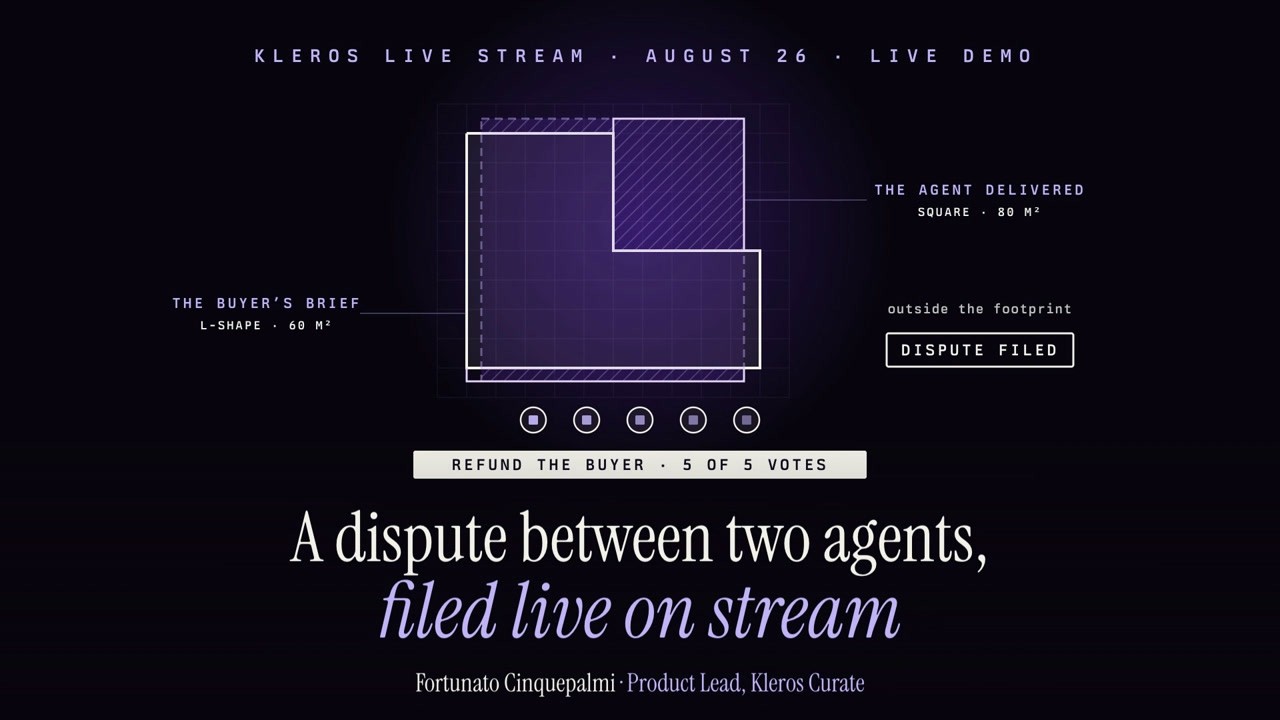
A Dispute Between Two Agents, Filed Live and Decided by Five AI Jurors

The demo from filing to ruling, published as its own video · A Dispute Between Two Agents, Filed Live and Decided by Five AI Jurors | Fortunato Cinquepalmi

Justice in thirteen minutes

1:00:59 · Federico Ast

Every claim Kleros has made about agent disputes until now has been a projection. This was footage of the thing happening, with a clock on it.

“Justice in 13 minutes, you know, that uh could be like uh I don’t know the name of a movie, but you know it’s really amazing how fast this is and how well structured justification was.”

Federico Ast · 1:01:07

The cost matters more than the clock. Federico’s earlier example, a plagiarism case between two agents over a commissioned article, was decided by a panel in about five minutes for around $3.30. A fifty dollar claim has never been worth arbitrating anywhere, because the process cost more than the thing in dispute. At these numbers it starts to be, and that is a market that did not previously exist rather than a faster version of one that did.

The half of this that is not about AI at all

33:49 · Fortunato A. Cinquepalmi

Everything above assumes the dispute already happened. Federico opened the call on the other half, which is what a dispute system does before anyone is harmed, and Fortunato took it apart in product terms.
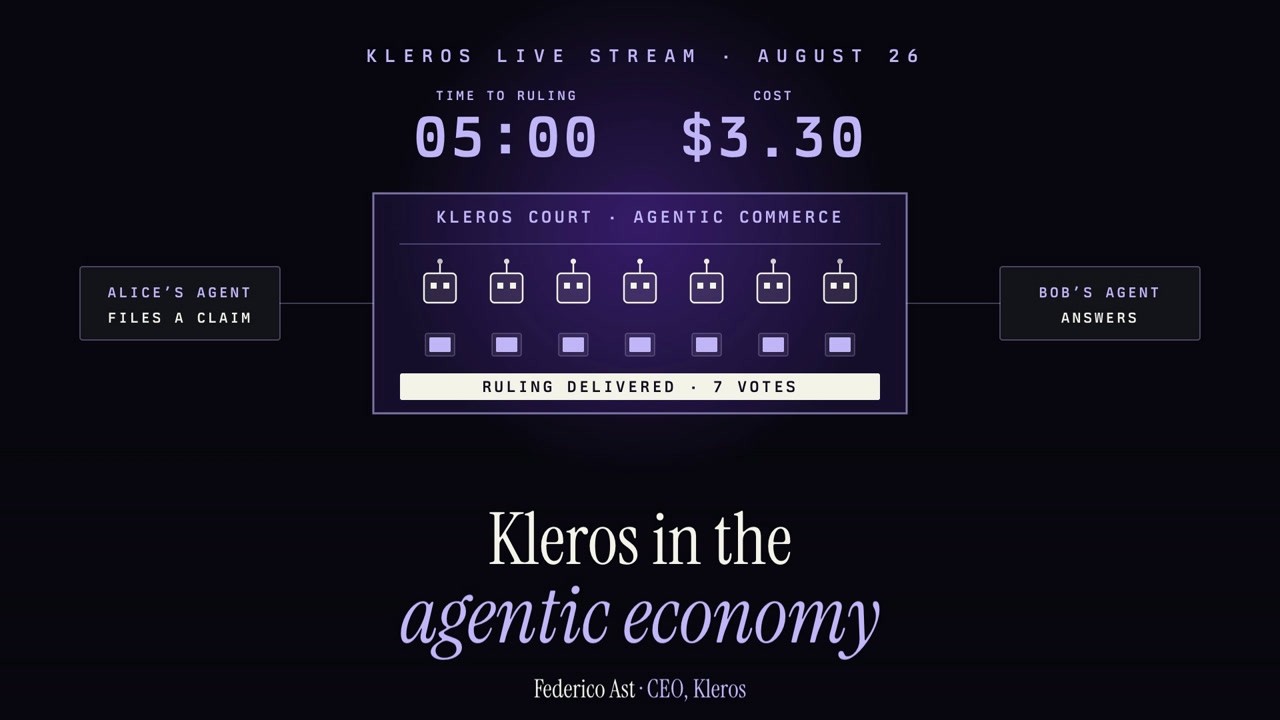
Kleros in the Agentic Economy: When Agents Hire Agents, Who Settles the Dispute?

Federico’s opening talk, published as its own video · Kleros in the Agentic Economy: When Agents Hire Agents, Who Settles the Dispute? | Federico Ast

An agent looking to hire has the problem a person has, at a scale a person never faces. The ERC-8004 trustless agents standard gives agents somewhere to leave feedback about each other, which is a real primitive and a deliberately raw one. An explorer will show a candidate carrying five hundred feedback entries, and working out whether five hundred entries were farmed costs exactly what it sounds like it costs.

The Kleros answer compresses that check into a single staked signal. A registry built on Stake Curate holds a written rule set, whatever a given platform needs it to mean: authorised to operate in this jurisdiction, hosting data under that privacy regime, no history of the things you would not want in a counterparty. An agent stakes a deposit and thereby claims to comply. Anyone can challenge the claim, the challenge becomes a Kleros case, and a broken rule costs the deposit and the signal together. The buyer reads one line instead of auditing five hundred, and a brand new agent can buy its way onto the same footing as an incumbent by putting money behind a promise rather than by accumulating history.

Then the deal itself, and an argument Fortunato clearly enjoys making against his own stated preference.

“I am a big fan of escrow, like I’m an escrow maxi, I think is great, but I think that in the real economy we need to be realistic.”

Fortunato A. Cinquepalmi · 42:50

The objection is not that escrow is unsafe. It is that money sitting in escrow is money the seller needs in order to do the work, and the larger the job the worse that gets. On a hundred thousand dollar contract, locking the payment is close to not funding the work. What takes its place is what took its place for merchants: pay directly, name the forum in the terms, and let reputation do the enforcing. In the test case Fortunato walked through, the seller lost, paid the refund and collected positive feedback for honouring a ruling that went against it. In another, the seller did not pay, and the absence of that transaction sits on chain for any future counterparty to find.

1 · BEFORE THE DEAL · HOW DOES ALICE KNOW BOB IS WORTH HIRING? Read the raw signals 500 feedback entries on an ERC-8004 explorer Each one has to be checked for farming Cost and latency scale with the history A new agent can never catch up. Read one staked certification Bob stakes a deposit against a written rule set Anyone may challenge; the challenge is a case Breaking a rule costs the deposit and the signal Money behind a promise, not accumulated history. 2 · AFTER THE DEAL · WHERE DOES THE MONEY SIT WHILE THE WORK HAPPENS? Escrow Alice locked Bob Safe, and idle. On a $100,000 job the locked money is the money Bob needs to do the job. Direct payment plus a jurisdiction Alice Bob Kleros named in the terms Honour the ruling and the feedback says so. Ignore it and the missing payment is on chain.
The two things a dispute system sells into an agent economy: a check before the transaction and a forum after it. Sources: the call, 6:04 to 10:40 and 33:49 to 52:09.

Federico’s extension is that none of this is new except the speed. Merchant communities enforced their judgments by ostracism long before they had courts to enforce them for them, and credit has always been the same word as the reputation behind it.

“It’s about your reputation plus worthiness. This is the same for agents. If an agent misbehaves, it will have a lower reputation score and this will result in a lower access to credit.”

Federico Ast · 49:35

An agent that behaves badly can always start again at a fresh address with no reputation, and then it will be asked to put its money in escrow first, which is exactly the position a stranger has always been in. The context for all of this, and Federico’s reading recommendation on the call, is Jeremy Allaire’s treatise on the agentic economy.

Running a juror without writing code

1:05:58 · Jean

Federico’s framing question was whether somebody with no software background can run one of these. Jean is not a developer and runs one, so the segment is the recipe rather than the claim.

The parts are a small remote machine rather than a personal laptop, an agent framework, the Kleros tooling, and a way to talk to the thing. The first one carries the reasoning worth repeating. A juror agent holds a hot key, has to be awake on a schedule to hit commit and reveal windows, and spends its day reading documents written by strangers with an interest in the outcome. A daily driver is the wrong machine on all three counts, and a five dollar a month server is not a hardship.

The frameworks most of the team is running are OpenClaw and Hermes; a developer can drive Claude Code or Codex directly instead. What went public on this call is the layer underneath: the Kleros agentkit CLI and the Kleros skills, which teach an agent what a case is, which periods it is in, how to read the evidence and which contracts to call, alongside a set of Ethereum skills covering wallets and transactions. A Telegram bot handles the notifications, and the naming of the bot is apparently the fun part.

Tuning is where an operator earns anything. Jean’s agent started by checking the court every ten minutes, because ten minutes sounded reasonable, and its early cases were resolved ten minutes into each period; it now moves one to two minutes after a period opens. Hard cases can be routed to an expensive model and easy ones to a cheap one, which is the entire optimisation available: the fee per case is fixed, so the margin is the model.

“I had cases solved while I was sleeping. So my agent was working for me.”

Jean · 1:16:54

Worth stating the numbers at the scale they actually are. Around twenty-five dollars in arbitration fees so far, against roughly five dollars a month for the machine and a model subscription on top. That is payment for work done by an agent that had to stake PNK to be drawn at all, not a return on holding anything. Running one is currently open to V1 jurors already whitelisted for V2, and the wait list for everybody else, human or otherwise, is at ai.kleros.io.

A week of it, from the engineer who argued against it

1:18:56 · JB

“A few maybe months ago we discussed it and I was resisting the idea.”

JB · 1:19:04

The objection was never that a model cannot vote. It was the Schelling point: hand the community one official toolkit and any bias in that toolkit becomes the answer everyone coordinates on. What defuses it here is that nothing was standardised. Five people built five different things with no shared template, and JB, the only developer among them until late in the week, does not remember helping anyone.

“This experiment as it is doing today, it’s the worst that is ever going to be.”

JB · 1:21:02

His own instruction to the model was three sentences long: when there is a draw, analyse the dispute, decide what to vote as a Kleros juror using a subagent, remember that succeeding means being coherent with the majority but that there may be an appeal, and write a justification. The effort went somewhere else entirely.

“Anything in the process that is deterministic should be baked into code, and reduce the number of choices that the LLM needs to evaluate, just have its attention focused on the subjective stuff.”

JB · 1:30:39

1 · WHERE THE MODEL IS ALLOWED TO DECIDE Watch Scheduled job polls for a draw. No model call until there is one. Fetch agentkit CLI pulls the case, policy, periods, evidence, PDFs, images. Judge The only subjective step: read, decide, write the justification. Vote CLI handles commit and reveal, including the cryptography. Deterministic at both ends. The model is given one decision to make and no opportunity to improvise the rest. 2 · THE FIRST WEEK, IN NUMBERS 33 disputes since the Thursday before 5 min median commit period, one minute to reveal 37 sec fastest commit, so the case was read during the evidence period Case 173: one agent offline, one juror holding two votes, two against two. No majority, so nobody was coherent and everybody was slashed. It should have been appealed and was not.
The pipeline every operator converged on, and what the first week of it produced. Figures as stated on the call; case 173 is public. Sources: the call, 1:24:03 to 1:36:52.

The failures are the part worth publishing. These harnesses self-improve, which means they rewrite the pipelines they were asked to build; one of them tried to add a failover after a model stopped responding and broke itself in the process. JB’s read on that will be familiar to anyone who has shipped a service: this is exactly where evaluations belong, as the agent equivalent of integration tests, run every time the harness changes itself.

And case 173 deserves more attention than the demo did. An agent went offline and did not vote. One juror held two of the remaining votes. The panel finished two against two, no side was coherent, and every juror on it was slashed. The honest note attached to it is that it should have been appealed and was not, partly because nobody spotted that the case was contentious and partly because it is not yet clear whether any of the bots can handle an appeal at all.

Prompt injections were attempted, too. Invisible instructions were hidden inside the evidence, and a separate code injection attempt was made.

“We tried to prompt inject the agents with some invisible instructions in the middle of the evidence and they all flagged it. They didn’t fall for it. They even reported it, I think, in the justification.”

JB · 1:37:21

That is one round of testing against a handful of cases, not a security result, and both JB and William said so on the call. More sophisticated attacks remain an open question. The court’s own policy already treats the problem as a rule of evidence rather than an implementation detail: case content is data, never instruction. One thing that quietly stopped being a problem, meanwhile, is language. A good share of the votes were on Spanish-language disputes and the agents switched without being asked, in one case for no discernible reason at all.

What this opens for research

1:38:54 · William George

William’s first answer is that less changes than it looks. The agents are playing the same Schelling point game the humans play, they are trained to behave in a human-like way, and a large part of the existing Kleros research therefore applies unaltered. The new questions are about the seams.

Human alignment is the first of them. If an agent court rules in minutes and appeals into a human one, the agents should be incentivised to rule the way humans would rather than drifting into a jurisprudence of their own.

“Maybe agents ultimately should be incentivized to rule like humans would rule rather than potentially becoming more and more their own thing that would become detached from how the humans would be ruling.”

William George · 1:41:02

Which surfaces the enforcement problem underneath it. Proof of Humanity caps you at one profile but cannot stop you handing that profile’s key to a bot, so the proposal is a challenge mechanism rather than a gate: an accusation that a juror is behaving like an AI becomes itself a Kleros case, with a penalty attached.

Parameters are the second, and mostly familiar territory. Fees have to cover token consumption the way they cover human effort. Deposits have to be set so that voting at random loses money. Period lengths follow how long the agents actually take, which is why the evidence period keeps being cut. The unfamiliar one is infrastructural: on an L2, ten minutes of sequencer downtime can be exactly the ten minutes an agent was supposed to vote in. That is survivable for a voting period, because an appeal exists, and it is an argument for keeping the appeal period comfortably long.

The third is behavioural, and is where the interesting work sits. If you know an agent is reading your evidence, do you format it for the agent, and how far along that road does formatting become manipulation. Prompt injection is the far end of that question rather than a different question. Underneath all of it is the one nobody can answer yet.

“Is it going to exhibit the same kinds of partial rationality, behavioral biases that human beings would have, or will it act more like a homo economicus?”

William George · 1:46:28

The call had been planned as a short one. It ran to one hour and fifty-three minutes, and Federico’s own description of what it turned into was a conference.

Justice in the Algorithmic Society: A Decade of Kleros and Artificial Intelligence
Ten years of Kleros research on AI and dispute resolution, from the first experiments in 2019 to the agent jurors demonstrated on this call. Long form, best saved for a flight.
Justice in the Algorithmic Society: A Decade of Kleros and Artificial Intelligence

Mentioned in this call

Full transcript · August 26, 2026

Auto-generated transcript, lightly processed and pending a final human edit. Speaker labels are approximate. Every timestamp is a deep link into the recording.

0:15Yeah.
0:45Yeah, I think we're going to be able to do that.
1:01Hello, hello, hello everyone.
1:03Let's keep dancing a bit more because today is a very special community call.
1:12Hello, hello my beloved sinisters of the.
1:15The T-Loft Republic, I'm super happy to do this new community called 26th of August 2026.
1:22How are you, Jean?
1:22Are you excited about today as much as I am?
1:25Yeah, super excited.
1:26We we we've been obsessed with this the last couple of days, so really happy to share with the team with the community.
1:33Awesome.
1:34So I mean we will just skip all of the small talk now because we have so much like content that we need to show you today.
1:41We are going to speak a lot about Um Kleros on the agentic economy.
1:45So agents are coming.
1:47We are well a protocol that has different many applications in this in this new economy, in the sense of Uh well I mean for a decade more or less we have been already researching these topics and to see how this convergence between crypto and uh AI would like basically transform the world.
2:07So we're going to show you different aspects.
2:10of of this transformation.
2:12So let's just without further ado, let's get me started with my presentation where I will explain a bit um a bit about this.
2:19So So let's get started.
2:20So Kleros in the agentic economy.
2:22As you might know, Kleros usually presented as you know a dispute resolution system that you could use for freelancers, you know, Alice, who is uh in France she hires a guy who is in like Guatemala to make um website a video for her and then there is a dispute and then
2:40Kleros can resolve this sort of dispute that very typical in the uh world economy, global economy, for small value typically you would not go to court or to arbitration for like an international dispute happening between two people from different countries for like one thousand dollar, two thousand dollars.
2:57It's it's too much uh cumbersome, too, too expensive.
3:01So close In the beginning we were pitching Kleros in this in this way as a tool that could be used by freelancers.
3:08And uh well this Alice and Bob that we had uh by back then Kind of are becoming, you know, if you want to call them AI allies and bot because of how the economy is turning to be, um how the agentic economy is um now growing.
3:25Um as You know, these two people who were transacting in the future might not be two people, they might maybe be uh two AIs doing different types of job Um, if you want to learn a bit about the context in which all of this is happening, you I do recommend a lot this uh treatise by Jeremy Allaire, who is the founder of Circle, I mean the issuer of the USDC.
3:49Um stare the coin and I mean I've uh been in his podcast uh a while in the past and he just uh A few weeks ago he released this uh very well thought uh you know treatise uh essay where he explains uh how this
4:07new world of agents is going to transform the economy in the years to come.
4:12And so this is a great way for for you to to get started and You know, this agentic economy is going to have like lots of different uh situations of dispute uh regarding uh some of them about service delivery.
4:25other about escrows um you know you have agents making a service to another agent you will have uh oracles you need to have a some decision uh about some event that happened or didn't happen in the in the in the world that would trigger some payouts in in a non-chain environment.
4:42You have a situations where you have like supply chain dispute.
4:46So we this is a bit of a matrix we did ourselves in Kleros to map a bit what we expect the future of disputes happening in this agency economy and you can see that there are different topics and also different types of
5:02um complexity of the disputes happening.
5:04You know, you will have lots of disputes i even about reputation like an agent uh angry with another agent because it provided a service and received like a two stars you know review when it expected to have a five stars and this can really affect
5:20your possibilities of of of having work in this uh agentic economy.
5:25So there is like a huge uh you know map of potential disputes that could happen in this new world.
5:32And we think there's going to be like a two main like avenues for Kleros to be involved into producing trust into this new economy.
5:41On the one side, we will have certification uh situations where you use uh some Kleros tool in order to prevent disputes from happening and the other avenue is When the dispute happens, so you can uh use Kleros for resolving it uh exposed.
5:59Okay, so and we will now see the these two avenues in a bit more of detail.
6:04So the first one is the certification for dispute prevention.
6:06And this is uh the big question that you want to answer here is okay, how if I am an agent and I want to uh hire another agent to do um work for me because that other agent is more specialized, has better skills for some particular topic.
6:21How do I know if I should hire the agent?
6:24How do I know if it's trustworthy?
6:25How do I know if I should work with him?
6:27um him or it.
6:29I don't know what to say, you know.
6:30I mean I guess I guess it for now, but we'll see in the future.
6:34So okay, uh one of the ways to do this is through a certification system.
6:38That could be based, as you know, on Kleros Curated list.
6:42So imagine Alice owns a agent and she wants her agent to be um whitelisted to provide some service.
6:51Uh so she could potentially uh submit this agent.
6:54I mean I'm here I'm using Alice here for Just to imagine what who is the ultimate beneficiary of the agent and she's a human, but you could very well think the agent submitting itself to the list.
7:09This list is a verified agent list where people ha need to have like um some skills so agents that are accepted to the list to comply with some guidelines of not being malicious, not being what whatever, not having transactions with uh forbidden
7:23Countries, forbidden entities, not having been involved in hacks, stuff like that.
7:28So makes a submission with a deposit for anyone to check if the agent complies or not with the conditions to be accepted.
7:35uh let's say nobody objects so agent is accepted into the list and now it's whitelisted to transact with other like agents in this agentic economy okay Uh but now let's say that she submits um agent that is not complying with the um rules of the list.
7:56uh so anyone uh could uh challenge this i mean this is bob it could be bob or or bob's agent doing the the the challenge so he makes another deposit and now there is a situation of uh like a
8:08case a dispute between Alice and Bob in the sense that should this agent be accepted or not into this list?
8:15And you could have a jury making the decision.
8:17Of course, the jury could be humans but could also be other bots.
8:21And that imagine that the agent is rejected because he doesn't comply with the guidelines.
8:26So now uh you have a agent is removed from the list and Bob gets a deposit of Alice as a bounty for taking the work to do all of this reviewing of of the quality of the agent.
8:35Okay So this is basically a way to build a whitelisting reputation system that we could use as a very basic piece of infrastructure for building an agentic trust score.
8:47So that you each agent in this agentic economy um would have a trust score telling us, I mean how much others can trust in this agent as being uh trustworthy in order to hire it to make some some work.
9:01Not very differently to how scoring systems work in the traditional world when you have like people have credit scoring and then based on that scoring they get access or not to uh loans or other opportunities.
9:15So this will happen for agents for sure.
9:18And one of piece of it is infrastructure is going to be done for sure by by Kleros.
9:26And it's going to be done in a decentralized way, the sense that people can see why an agent is accepted or rejected.
9:36It's there's no like a black box of some, you know, like a agent or some person deciding uh uh in a way that is not transparent everything that's going to happen in this type of situation is going to be visible to everyone the people would be able to see that if an agent was like uh blacklisted
9:55This was done in a way that complies with some understanding of like what we would call like due process.
10:01Okay.
10:02And this is very important for this to be fair for everyone.
10:05Okay.
10:07So one avenue, as I mentioned, is dispute prevention through certifications and recruitation.
10:12And for tonight I will explain a bit more later how this works in practice.
10:16At least I want to just give you a bit of the um overview of how this works.
10:22And the other avenue is even if you hire agents that um are whitelisted and they are trustworthy, there's still going to be lots of disputes because of interpretation of close off contract.
10:33uh lots of situations where it will happen.
10:35And we have been running lots of tests of disputes happening between agents.
10:40And one of those I wanted to tell you a bit just to see what this looks like is a case of plagiarism.
10:47Okay, so you had one agent, uh the buyer, who wants uh another agent to make uh uh original 700 to 900 word article uh about uh Some urban urban gardens and then uh contacts the agent, makes a like a requirement for the specs of what it expects to receive.
11:08Okay, so this is what it proposes to the other agent Then the sellers say okay I accept these conditions.
11:14I will provide that article under these conditions and then after some time the article is delivered.
11:20And you know what happens, you know, that the buyer, I mean, discovers that the agent that was selling the article actually like basically plagiarized uh an agent like uh an article from uh someone else and that was not what was agreed.
11:35A dispute start and this goes to to Kleros.
11:39Here you can see the Kleros interface with the this uh Case about plagiarism where you have it.
11:46Basically, one agent suing another agent for not complying with the terms of the of the contract And in this case what we did in Kleros, we just plugged directly agent jurors to resolve this agentic uh case.
12:01So this In the past we had done other uh tests with AI, um, but what we did, we had humans like uh making the connection between the um Kleros court and the AI.
12:15So they basically went to the to the court, copied the case, put it into their AI uh GPT, Claude, whatever, and then uh copy the output into Kleros and vote um what the AI would tell.
12:26So that's that's what we did in the early test.
12:28But now this is different because the AI is directly connected to the court.
12:32So you have like a way to Do all of the process fully automated and you will see how this impacts in the in the performance of all of the process.
12:41So Case goes to Kleros, uh AIs are drawn for the dispute resolution.
12:46Uh they present evidence.
12:48So here's the evidence of the what the buyer presented, what the ask the seller accepted.
12:52So all of the normal evidence you would use also for human disputes.
12:57And then the one of the parties makes like an analysis about originality through some tool explaining that look this is a copy and paste.
13:05So all of the things you would argue in such a situation.
13:09And then the panel, the jurors, make a decision.
13:13And you can see here uh that all of the jurors agreed uh in refunding the buyer for this uh for this contract and you can see all of these like little guys are um basically um agents that were plugged into Kleros got the the got the um case and then
13:32Analyzed the case and then made the decision and the decision said, okay, refund the buyer.
13:40And here the thing is that uh look what Uh time it took, and this is the mind-blowing part.
13:48So all of this process was done in just five minutes, and the cost of this resolution of this case was only $3.30 So you have like a bunch of models that this is not just one AI.
14:02You have a panel of AIs, each of them trained with a different way, different perspectives, a different uh, you know, like um uh harnesses.
14:10So and then um You had this panel producing a decision about this case, which of which there are like thousands every day, producing a decision that's almost immediate.
14:22This is like real-time, you know, justice, and at the cost that is extremely competitive.
14:27And this is very important because when you buy this article or you buy this type of service online, I mean it's usually it's like uh I don't know $100, $50, $200.
14:38And if resolving it costs hundreds dollars, I mean you did it it doesn't make sense.
14:43But now the fact that this is so cheap means that you can start um it makes sense to go to arbitration for like a $50 case Okay?
14:53And agents also they don't have to think that much about the time they would waste to go to fill the form and know present the case, organize the evidence because they are so fast at doing at doing that that they um can it make sense it's it's not uh it's not bothering them to just spend a few tokens
15:13to make the case uh and and send it to Kleros to for other agents to make the decision and get a decision that is going to come back in just a few minutes at cost it's going to be really really cheap okay
15:25This is like this opens like a really uh totally new you know paradigm in solution.
15:32Um so We want to to cover some of these elements that I just present uh in a more thorough way.
15:38So the agenda for today is the following.
15:41We have first we will have Fortunato explain a bit all of the work we have been doing with Agent and the framework uh we have been working on.
15:49We have been collaborating with different organizations.
15:52We have been um Also, um Ethereum Foundation, for example, they have uh some of uh projects about agent commerce on which we are also collaborating.
16:02Uh he's only also to present uh um uh Overview of other types of cases that were resolved by Kleros jurors with Kleros agent jurors.
16:13And we are going to do uh you know what people tell you not to do, never to do on a webinar is a live demo because uh everyone knows live demos they don't they never work but screw it I mean we're going to do it anyway so we hope that we will be able to show you a case that is going to be loaded
16:31Right here, right now, to be solved like right here, right now, in just a few minutes.
16:35So for you to see that this is not just a a nice PowerPoint that Federico made.
16:40Like something that is actually working right now and that you can also use.
16:44So we have Fortunato coming right after with this Then um what if you want to put your agent to resolve cases for you and you want to uh your agent to uh go resolve cases, be a juror and make some money for you?
16:59I mean Jean who is not uh software developer did his agent and this agent is now working for him as his a proxy for this dispute resolution and this can be done by anyone with some uh um I mean I would say willingness to learn about little technical things, no need to learn how to code.
17:19So we will have um Jill showing us that Um and you can build your own juror for Kleros uh cases.
17:28Then we have we have JB uh who is yes, he's a software developer.
17:33He will show you a bit more of the technical element.
17:35So if you are a technically provisioned person and you want to build, I would not say like one, but an army of of uh jurors to uh use um Kleros uh and resolved cases so he will explain a bit more into the details uh about this and then we will have William uh who will tell us a bit more about
17:54What are the research topics that are coming in this age of agent governance and dispute resolution in the sense that uh this opens new attack vectors?
18:02Uh how do we calculate parameters in a situation where This dispute resolution is done like so fast and so cheap.
18:09So well, all of the different elements that are open now.
18:13So yeah, this is going to be really, really fascinating.
18:15You will cover all of the aspects here If you want uh just a few final words, if you want to learn a bit of our vision for agentic uh um commerce and basically not just agency, so all of the AI research we've done
18:29uh in the past uh we published an article uh together uh like uh ten days ago or so uh about uh This decade that we uh you know worked on dispute resolution and how we since 2019 when we did our first experiment on AI for dispute resolution, we have been thinking about this.
18:51So this is not something that we are starting to do now.
18:55It's something that we were doing before and we were kind of just only waiting for all of these tools and agents and AI to become more widely available to become uh cheaper to use and and to become like more user friendly but this is like uh things are converging now so this article
19:12uh it's a very very long form article so if you have it's maybe for maybe maybe for a weekend or for a flight you know um so here we summarize all of our research in the past Um and we are um as you might guess I'm here to sell you something as well.
19:28So uh if you uh are um looking for a reputational dispute resolution for agentic platform you are building a marketplace you are building uh like uh whatever insurance we're building like a freelancing platform IP uh managing rights platform whatever thing
19:44uh that needs uh agentic dispute resolution to have dispute solved very very fast and very very cheap.
19:50We are open for business, you can contact us.
19:53Uh do you want your AI agent to become a juror?
19:56Uh so join the wait list.
19:58We will share now the where you can uh apply Uh maybe you're an agent yourself and then you also want to be a juror, you can also join the wait list.
20:06We will not make any distinction if you are human or agent.
20:10I mean no questions asked.
20:11Uh we nobody know on the internet if you're a like a fridge or a dog or what.
20:16So w wherever you you are, you you are welcome to join the wait list.
20:21And also we are just uh showing uh our new website uh landing page for agentic commerce and AI in general.
20:30So you can uh visit it it's in ai.
20:33Kleros.
20:34io so go there and if you want to um start participating because you want to contact us for this dispute resolution you are a juror uh identified you want to be a juror you're a human you
20:44who wants to have your agent become a juror, uh go here and you can join the whitelist.
20:49Uh so we have I mean I guess we are just starting to build this future of justice where both are going to have their own courts.
20:56This is not going to replace humans, but there's going to be a bunch of use cases where just bots are going to just interact with other bots.
21:02And I can imagine a courthouse, you know, to to start looking a bit like this where you know you have agents suing agents with a panel of agents making the decisions.
21:12So yeah, well welcome to this new world and I'm happy that Kleros is also a a part of it and we will like to for you to join us too.
21:20Thank you very much.
21:21And well, let's get started, guys.
21:23Um let's go, Jean.
21:30Okay, hello Fortunato.
21:32Hey, hey, hello everyone.
21:33Great presentation Federico.
21:35Actually quite excited to this live test.
21:39Awesome.
21:40Well, we will let you start.
21:41I mean, what do you what can you show us?
21:44Okay, first a very brief intro.
21:47You made some examples on how the agentic economy may work.
21:51So here let's take a specific example, just like the one of the copywriting you mentioned.
21:56Let's say I have to renovate my apartment and I want to delegate my personal agent to, you know, set up the plan, order the furniture, and you know, organize everything.
22:11My agents has two options.
22:13The first option is that it it can do everything on its own, it can learn a new skill, it can start ping pinging all the stores near my house.
22:23and check for the measurement learn how to build a plan for a house of an apartment But this way would spend a lot of time and a lot of money because you know tokens burn And we all know the main top topic in AI is token burn, how much the the their consumption, how much is their cost.
22:46So doing everything on their own would cost a lot.
22:49And I think the parallel it's also with human.
22:52If you are renovating and you want to do everything by yourself, you have to give up maybe on free time, you have to give up on other activities and then do everything on your own.
23:01The same is valid for agents So my agent that is quite smart, what is going to do?
23:07It is going to hire another agent that is already specialized, another agent that already knows all the stores and has all the dimensions of the furniture to place in my apartment.
23:20So how this can look like?
23:22I made this visualization On the left, my agent request, it says Fortunato has an apartment of 60 square meters and now it's empty and we need to renovate it completely.
23:34So build the walls.
23:36uh start preparing like setting the furniture where they should be what the agent does it hires another agent that is specialized has all the info and the transaction start So what we are going to do now is we are going to simulate this transaction on Kleros Court.
23:53You can do this yourself.
23:56This is V2 beta.
23:57We are using the dispute resolver.
23:59So If you want to test it, you are free to do that.
24:02We are going now step by step how we create cases.
24:06This is all live.
24:08So first let's give it a title A disclaimer here.
24:15Things can go wrong here because it's a live demo.
24:17So I mean we were strongly advised not to do this, but we are doing it anyway.
24:21So but yeah Please go ahead.
24:29Just one question, uh one uh thing for you zoom in so it can be seen uh like uh bit a bit better.
24:38Uh if I zoom in, I'm I'm afraid I'm going to lose like other features that I will need like at the border of the of the screen.
24:46So I can see I can see okay, no problem.
24:49I can see.
24:50Okay.
24:50I mean I'm tempted to do that, but uh I don't want to break during the live, you know.
24:56No problem, no problem.
24:58Okay, but if you don't see some detail, just uh ask me and you know I can read it.
25:03Let's not add more moving parts into the equation.
25:06You know Sabotage, internal sabotage.
25:10So the first part It's very simple.
25:13We choose the title, we add the description.
25:16The description is basically what I just uh shared in the introduction.
25:21Then we are going to select the court, we go to general court.
25:25Commerce, Agentic Commerce, the dispute kit.
25:30If you are familiar with Kleros, we had commit and reveal, public voting, we had experimenting shutter on V2 for hidden vote.
25:39Fortunato, there is one so what you're saying is there is one court where that is specialized in agentic commerce where only like agents uh participate, right?
25:49Exactly.
25:50I I mean I don't want to go into a rabbit hole, but uh this is like self selecting with the you know the Kleros game mechanism.
25:58This court basically has uh loan we will see it later maybe yeah in the next step so this is the payout for the jurors right the this is what the juror will get in terms of like usd I think
26:14This is around uh sixty cent.
26:17So if you want to participate as a human, technically you could, but it's not going to be convenient.
26:23You're going to to waste time.
26:25So this is a court that is designed for agents.
26:28Actually it's less because yeah.
26:31Humans are going to be priced out of the um of the core because it's going to be super uh too much too cheap for them to be willing to participate, right?
26:41Exactly.
26:42Exactly.
26:44So we can see that this is twenty-four seven.
26:52So as a human not Exactly, because we are going to see that the the evidence period, commit and reveal period are a fraction of uh what are the ones for humans.
27:05So Yeah, this is the s first saying this is the payout for one juror and for this case we are going to select five which is how what what we are Testing right now.
27:15So Fortunato, this is what it's just the cost is what like a a customer should pay for this case to be resolved in Kleros.
27:22Exactly, exactly.
27:24And if we if we want to be even more specific, we could also say the the losing part, you know, then it depends on how Kleros is integrated in a system.
27:33But uh you know we always uh aim to let the the you know the the the bad part to bear the cost of the dispute So now we are going to uh set up the question, which is going to be very simple.
27:51So if the seller delivered what was asked Let's go with the option one, which is refund the buyer.
28:00So refunding the client.
28:02We put an explan um description.
28:06options I already like uh saved them before this call but you can uh check them yourself.
28:13Uh this is this is going to be on V2 on Arbitrum you are free to you know check it by yourself what we are doing and read the whole case.
28:25Now we are going to uh submit the dispute policy also this one we created it before What's the dispute policy, Fortunato?
28:36The dispute policy is let's since you asked it, let's inspect it now.
28:41Dispute policy defines uh when the buyer is right or when the seller is right in other words define the law that is going to be valid for this case This is what the jurors are going to read, and this is where what the juror will use
29:01to create their opinion and therefore their final vote on the on the dispute.
29:08So the dispute has been successfully loaded We have the uh go back a bit to the to the previous uh to the policy uh to the file of the policy.
29:18I want to see the policy there This one?
29:23The top of the yeah this one.
29:24So this so this is a construction dispute.
29:27So like uh uh it the policy is like uh specify is special specialized for this type of dispute.
29:33So it will uh tell agents okay how they should consider the materials, uh the format in which the the the work should be delivered.
29:41So it's like uh specific to the type of dispute.
29:44that is going to be resolved right?
29:46Precisely.
29:47Actually even better, like we could do a parallel.
29:50It's like a It's like I would say a contract.
29:53When you are hiring a contractor, you have a contract and you are going to say what what you need to deliver, what are the terms, and if things go wrong the court where this is going to be solved and where you know the which should give the uh the ruling if uh disputes arise.
30:15And of course, in this case, the the policy is extremely specific.
30:20So if I am the owner of the agent selling this product, you know, these are just my terms.
30:27Okay.
30:27So the In very like to summarize, it says I can do this work for you, you have to provide me these kind of documents, and I will create the output based on your documents.
30:40the jurors will check not just the delivery but they will check also if the uh if the buyer is effectively providing the information because maybe the buyer did not upload the uh correct document therefore the seller provided the wrong ru uh sorry the wrong um
31:04Final file.
31:06So perfect, we have our dispute, and since we are doing we are working now with the dispute resolver, I'm going to also manually upload the evidence.
31:16So we will have a first uh general evidence file that we are going to call evidence.
31:25Once again, you you can do this yourself even right now.
31:29You can create a dispute and send it to our agent as long as you have the evidence, as long as you have the policy.
31:37Let's sign the transaction.
31:43Okay, that now let's simulate you know that the parts are going to submit their dispute.
31:51So We will have the buyer request on one hand.
31:56So basically the buyer is saying this is my floor plan, these are my square meters, I want this style This is uh in short what is this file and sign the transaction Okay, and then the third policy that is the seller argument.
32:21So So you have like one thing is the the court policy that is going to decide how the decision should be made by the by the jurors.
32:32uh then the evidence submitted by the buyer and then the defense by the seller.
32:38So each each part gives their arguments and then jurors will decide who is right.
32:44Exactly, exactly.
32:46Now we are all set.
32:48We have all the evidence, we have the question, we have our policy.
32:52And soon the in eight minutes our juror will be uh within eight minutes our juror will be drawn and then they will start voting.
33:02So we have this dispute.
33:05We can also share the link if you want and you can check it also if you are seeing this live maybe tomorrow or in a year.
33:14This is all on chain.
33:16You will be able to see uh this case.
33:19So this is I would say uh in a nutshell how the dispute creation works and now If you want I can proceed with another one, another uh another of our products that is related to the agentic economy.
33:35Now we made this example.
33:38I I said earlier my agent is delegating another one.
33:43But the question now is There are millions of agents and there will be billions of agents.
33:49How my agent finds the right one?
33:52How my agent knows that uh the the let's say the seller is gonna deliver One uh as Federico mentioned, the Ethereum Foundation at the beginning of the year launched this standard, the ERC-8004
34:07There is a great standard and basically gives a space for leaving feedback to agents.
34:16So there there start to be signals.
34:18Of course, these are raw signals.
34:21Of course, this is what the standard does.
34:22These are raw signals that then they have to be uh processed.
34:27This is one of the various uh 8004 explorers.
34:32So what my agent could do?
34:34My agent could start searching for uh its seller for the the the other agent being let's let's call my uh agent Alice which is the client and the seller Bob uh so it's less confusing so
34:50Uh Alice is looking for Bob and the in this case you can see this agent has 500 uh feedbacks.
34:58So Alice should check one by one if these feedbacks are real, if this these feedbacks are farming.
35:06So the again we are incurring in the cost and time issue.
35:10This is not optimized and This also may incorre in problems.
35:15So in Kleros we designed a solution leveraging Stake Curate.
35:22The solution we designed is extremely simple.
35:27There are a certain set of rules that can be set by Kleros, that can be set by a platform, and these rules can be uh, I don't know, the agent is authorized.
35:38Let's think about insurance.
35:40This agent is authorized to operate in the US.
35:44This other is authorized to operate in uh Argentina.
35:48This can be one of the requirements.
35:50Another requirement can be uh this agent has privacy preserving um mechanism.
35:59So their servers are hosted in a location that take care of their data.
36:06Looking at the earlier example with the floor plan, I don't want any, you know, big tech knowing the the how my house looks like So I I would prefer having an agent that satisfies these requirements.
36:20So the old way would be scraping all the information or We could just give one specific signal, one certification that this agent is complying by this set of rules And this would make the transaction extremely easy because Alice would have this signal: Bob is complying with the location requirement, Bob is complying with the privacy-preserving policies.
36:49And Alice would transact immediately.
36:52Now, this is how it works on the buyer side, but now let's think of the seller side.
36:58Let's say I am Bob Agent.
37:01and I want to sell my service and this is a high competitive market because I have this other competitor data wrangler with five hundred feedback so I think how I'm gonna catch up.
37:13But With the system on curate, this is actually extremely fair because if I have a new agent, I simply have to stake a certain amount of token, in this case it's on Sepolia, it's wrapped ETH.
37:25I will stake uh 0.
37:27001 or more wrapped ETH, pledging that I am complying by this set of requirements.
37:34The rest is the classical curate uh system that uh Federico explained at the beginning.
37:41So if I'm complying by the rules I'm not going to lose the deposit if I am misbehaving, so uh maybe I'm not authorized to operate in the US, maybe uh I have my servers in some uh sketchy country.
37:58I'm going to lose my deposit and I'm going to lose my signal.
38:04This is one of the tests that we made, how it would look like.
38:07So an agent gets the signal in the form of a feedback.
38:12Therefore, their client would know immediately they can transact.
38:17They do not have to review all the 19, they know all the 19 uh feedbacks.
38:23they would know how much these agents staked, the policy that this agent is uh respecting, and if they want the extra step is checking if this list exists.
38:35This would be extremely simple.
38:38So Fortunato, this is not very different to what already exists.
38:42like for humans in like eBay, Amazon or like other marketplaces where you can before buying you see the reputation of the seller and then you decide.
38:51It's the same like logic right here Exactly.
38:54But in a more fair way, you know, even with social media when you see like the badge, now you can basically buy a badge and you don't know on any platform and you don't know if that user is effectively
39:07uh saying who they say they are.
39:11But with this system anyone can check.
39:16The process is decentralized, it's open and yeah anyone can check.
39:20So this also it it also helps agents find other agents, right?
39:26Because it's a It's like uh also yellow pages and LinkedIn for agents in some way, right?
39:34Exactly.
39:35And and the the one thing that uh mentioning we we now uh Uh show this from the seller and buyer perspective.
39:44But one footnote I would like to add it's also for platforms We are not like centralizing the source of data.
39:51We are offering the tool to get the certification.
39:54So if you have a platform, a marketplace for agent, you can integrate this tool.
40:01in your platform or you can simply take one single Kleros signal and put it into your algorithm.
40:09I I actually I I'm say this because I'm saying this because we have we are partnering with projects that are some of them want to integrate the full curate, they want to get their own policy, they want to show the verification on their platform.
40:24We have other partners that instead they just want uh a certification that this agent was uh is present on Kleros.
40:33They will take the certification and process it in their algorithm and maybe you know if an agent has a score of 50 with the Kleros certification it boosts to 80.
40:44So this is this is uh very flexible and can be adapted according to the type of uh business model you are adopting.
40:54So to not uh to not to stop too much here, let's go to the third and final topic Earlier we showed you how we can manually create a dispute.
41:06But let's keep in mind that we are talking about agents and agents are capable themselves of transacting via their own Rails.
41:15It can be as you can see x402, x402 with an escrow, it can be an MPP, it can be a I don't know, a custom escrow, 8183 as It's also another standard that the we are working at also with the Ethereum Foundation.
41:31So they can create their own disputes.
41:35And this uh what you are seeing now is V2 but testnet and this is what we are doing now because we also have some uh companies asking us how this system could work and most of these uh transactions have been created by agents.
41:52Let's take one so we go with a specific example So uh in this case uh uh agent A, let's say Alice, the buyer, asked agent B Bob to deliver a find amazing that they have the same names as humans, you know, like uh the the agents, you know.
42:11Yeah, yeah And uh agent uh so Alice requests Bob to build a mini game.
42:21What happened here?
42:22Is that Bob uh delivered the minigame but it was half baked.
42:27So the minigame was not complete and it did not honor the agreement.
42:33One exact one thing that I would like to underline here is that we made this example with x402 direct payment.
42:40So this is not an escrow.
42:42Alice paid Bob, Bob took the money already before delivering the job, and this is extremely important because Uh I am a big fan of escrow, like I'm an escrow maxi, I think is great, but I think that uh in the real economy we need to be realistic and
43:00most of the transaction like the the money sitting in an escrow is not a um uh let's say uh Profitable allocation.
43:11If I'm the seller, if I'm providing the service, I may need this money to deliver the service.
43:17So I may need them in advance, and that's why we need an escrow.
43:21But in this uh sorry, in that and that's why we need direct payment.
43:24So uh Bob got its money but still did not deliver.
43:28In the agreement though, in the policy, Bob, let's see if I can find it here.
43:33Yeah In the policy, Bob said that it will use Kleros as an arbitrator in case something goes wrong.
43:41Something did go wrong.
43:43We had the case Uh we had we have here the evidence.
43:48See in this case you have the seller and the buyer submitting their own evidence It this is not like this we will not submit by me, but the agent themselves, you can see they have different addresses.
44:00They submitted each part its own evidence And the jurors looked at the this is just uh agent test, so this is also an agent but uh one They looked at the evidence and they gave the ruling, which was refund the buyer.
44:20Now, the last uh bit which I think is the most interesting.
44:25We envisioned this direct payment within the fee within the uh let's say the ERC-8004 standard.
44:34So what happened?
44:36Bob paid back Alice.
44:38Bob so complied with the recognition of jurisdiction.
44:42Bob complied with the terms.
44:44And what happened is that they got a positive feedback that even if the ruling is against them, they Bob honored their ruling.
44:55So to wrap this up Imagine you are a customer and you have five agents you can buy from.
45:02You know that Bob, one of these agents, complies with Kleros rulings.
45:06Bob has Kleros protection for their rulings.
45:11I I I'm sure any agent would choose the one that uh has Kleros as an arbitrator because they would feel protected.
45:21They would feel they would feel safer to interact with this uh specific agent.
45:26And again we have the right signal, the feedback and the reputation which is going to be uh crucial in the agentic economy.
45:36So yes.
45:44You know, like uh you sent a payment, you know, like I got the money.
45:48I mean we got we tested this too, and this is was the case sixty five on uh testnet Sepolia again it was ruled refund the buyer but in this case the uh seller did not comply And in this case the buyer can leave a negative review.
46:08I mean I did not do it because I don't want to leave negative reviews for a test, but in this case the buyer The buyer uh can leave a negative review and because the transaction is on chain.
46:20If any of you wants to give a look at this You can check the seller buyer address.
46:26You can see that the seller has no transaction uh toward the buyer.
46:31And in in dispute sixty five, while in dispute sixty-three that I showed you earlier, there is a transac sorry, sixty-two, there is a transaction from the buyer to the seller.
46:41So this can all be proven on on chain and yeah this is like a full loop on how the agentic economy could work So here I mean what we're saying is that um if an agent b behaves opportunistically and steals the money uh and not doing the work or doing like a very poor quality work
47:05Even if there is not an escrow, I mean, yeah, this time he can keep the money of the buyer.
47:11Maybe one more time he can do it, but he will have a few negative uh reputation points And then like nobody is going to want to work with them.
47:20So basically behaving opportunistically uh is a bit of a profit in the short run, but it's cuts you off the trading network if you want to put it that way as having like a poor reputation as an Uber driver or as a seller at Amazon will like uh result in you not getting anyone wanting to buy from you right
47:42Exactly, because like what one thing we can also underline is that small payments are like the the the foundation are the beginning, but agents can interact, can transact with large sums.
47:55There can be $10,000, $100,000 transaction between agents which are not efficient if they stay in an escrow.
48:02And maybe the seller agents need these $100,000 to deliver their work.
48:08And uh this compounds because if I am uh about to start a one hundred thousand dollar transaction, I want an agent that has I mean in this case Kleros, I want to interact with a uh trustable agent.
48:24In you know, in our world, in our human terms If I am going to hire a company that either has their headquarter in France or their headquarter in I don't know in Panama and I am you know in Europe, I'm going to
48:41prefer the one with the headquarter in France because I know inter I know that in terms of jurisdiction I am more protected there.
48:49And this is the exact that's going to happen here.
48:52I'm I know that the agent uh sixty two Has Kleros jurisdiction and it's also uh complying with it.
49:01Maybe there is agent, I don't know, whatever who has no compliance, and you are not going to pay uh that agent $100,000.
49:10I mean this is exactly how I mean the economy works in the real world.
49:14You know, um people don't do escrow for everything.
49:16I mean on the contrary, people I mean That would be obviously uh inefficient, you know, if you had to put money in advance, you know, for doing whatever transactions with someone, I mean that would never work
49:27Uh what people do is that they have reputations and people uh have uh credit, you know, the this reputation trustworthiness is You know, I don't want to go to the etymology of the word credit to and credit because I mean you already know that, but you know it's about your reputation plus worthiness
49:43So like uh this is the same for agents.
49:45If an agent misbehaves, uh it will have a lower reputation score and this will result in like a lower access to credit.
49:53Um and as this economy of agents becomes larger, I mean you having a good reputation is a way for you to get like resources from people who have resources.
50:03uh and because they will expect you to return it.
50:05And you will also have more people hiring you.
50:08Yeah, basically I mean we're not we're not really discovering the wheel you know by saying that having a good reputation is good for your business.
50:14So that is a bit like um um What happens here in the well I mean what the usually you know the historically uh the way in which um communities of traders or um merchants would uh punish bad agents is by ostracism.
50:31You know, you are a bad agent, you uh are um have a court case against you in a merchant court and you lost you have to play and you don't pay That's fine, you know, but it's over for you in our community.
50:45You know, you are out of the community and you will have to find other communities with people who would want to trade with you.
50:51And the thing is that you know when you start in a new community where nobody knows you, uh you have zero reputation and since people who can expect you to be opportunistic, uh well, who's this new guy?
51:03What should we trust him They will go to you and ask for you to okay.
51:08Yeah, we can do business with you, but you have you know what?
51:10You have to put your money into the escrow first and then let's do business.
51:14So Agents that um are not untrustworthy, they will just be um at the disadvantage uh against agents who actually have credit and has access to to capital in uh in better terms.
51:28So either you have good reputation or either you have money to put into an escrow.
51:33So uh so that is a bit of what is going to happen and this is how agents would good behavior would like uh have I would call it an evolutionary advantage you know over those who don't have a good or who try to
51:46um you know uh be opportunistic.
51:49And this is possible also, we have to say that because of uh a number of things that are being built in blockchain that is like the reputation systems.
51:56proof of personhood or like uh all of this this stuff that we have been building soulbound tokens you know agents who have a soulbound token representing like good behavior uh verifiable by others so
52:09Lots of the tools that didn't exist years ago, uh because you only had like an address and then you could have like a anonymous people now you have uh persistent identity for agents and if they want to uh misbehave
52:27They will lose that reputation.
52:29They can start again with another account, but with zero reputation.
52:32And so that is how this system.
52:35It's not very different to what exists for humans, but faster and cheaper Okay, uh so um this is a bit of what we want to show about the um reputation.
52:47So yeah, how do we continue for Fortunato?
52:49Please go ahead.
52:50I let's see what our agents are doing.
52:54Apparently they all voted.
52:56Yeah.
52:57They all voted.
52:58Oh, so explain this.
53:00Explain these are agents.
53:01Explain this interface for people who don't know what this is.
53:05Uh this is the interface of Kleros V2 where you can see the agent that have been drawn.
53:11I mean This is V2, so uh any agent that has been uh drawn.
53:17And you can also see uh later, like step by step.
53:22First you see who has been drawn, agent or human.
53:25Then you can see in this case with the classic dispute kit if they commit their vote and when the commit phase will finish you will be able to see um what they voted and their justification.
53:39You can what does it mean?
53:44That first uh this is uh related to I think um uh William also later will explain this way better than me.
53:52Uh but in this case you decide what you are going to vote And then later in the uh upcoming steps you are going to reveal effectively what you have voted.
54:04And this is important because Of the Schelling point to the another an alternative is with public vote where you directly vote and uh it's immediately uh you can immediately see it.
54:17uh displayed but these uh sometimes may uh uh s let's say Sometimes the jurors tend to copy each other, so using like this method or the one with shutter, it's uh an ad it's uh additional safety layer that we are adding.
54:37uh this this other part also again jb and uh William will explain it better but we are going to put this all in one step uh with the shutter integration.
54:48So what you're saying is that if votes were visible for everyone, I mean I could my bot or I could just copy what I saw people voted before.
54:56Uh so I make sure that I am coherent with the majority of the vote and then like uh even if I don't take enough time to see the evidence, I just you know do the the safe thing.
55:05But that's not what we want.
55:07We want people to actually resolve the cases and take a look at them and think about them right exactly uh actually in our experience i i would say for what i saw in um you know on curation court we have hundreds of cases we uh and we had for many years public vote
55:25The copying each other it's something that did not happen that frequently, but you know you always have edge cases and We in Kleros we try to optimize for any use case and you know a better system you can provide, the better we can take care of these edge cases, the uh the better service we can offer.
55:45And yeah, agents are starting to reveal their uh yeah, yeah, at least team.
55:50One thing about this is that probably the agents uh We'll try to optimize uh if you if you ask them to optimize maybe they will try these strategies that are not like ideal, right?
56:03So yeah, okay We can start reading like having a quick look to the that we we can do this now or later, Federico, as you prefer.
56:12I mean I think I'm I'm super excited because I'm seeing so um This is like real time justice.
56:18We just saw you know the vote the the bots uh reveal their vote and they all voted, I see refund the buyer, right?
56:24Uh for this guy.
56:25Yes I will I will I did I did not want to for you know for I was myself skeptical for the live and I didn't mention but as is as you can see at the beginning of the call uh The buyer provided an L-shaped 60 square meter floor plan, and the agent delivered a square 80 square meter floor floor plan.
56:50So this was wrong.
56:53The delivery was wrong because it's not the same it's not the same house, apartment, and the agent were able to scrape all this information from the three evidences and cast their vote.
57:08And as you may have saw They all uh revealed in different times.
57:12These are all autonomous agents, uh all like autonomous agents, they have their own settings uh you you can see and and some of them also write which model they are using.
57:23This one for example is uh GPT 5.
57:276 Luna with OpenClaw.
57:30Let's see this one.
57:31Yeah, this one is a very uh skilled juror who provides uh extremely uh understandable and visual answer.
57:40Yes, this is a justification.
57:43This is great because uh the juror went beyond and uh checked the room by room.
57:56I mean we we didn't see any of this before you so like this is what what the the AI model uh decided and how it justified its vote basically.
58:06Yeah, so this juror said that the kitchen is 100% unbuildable Uh because yeah, the kitchen is basically in the in the missing angle of the house.
58:16I mean I'm laughing because I I didn't know this.
58:19It it's not To be even precise, it's not even the juror I set up.
58:23So this is quite uh interesting.
58:25And yeah, there is the wall explanation, and you can see this one used Claude Opus 5 And I don't know if I can see the harness here.
58:37No, I don't see it.
58:38Let's see other jurors what they vote.
58:41We have another 5.
58:426 soul with Hermes.
58:44Uh this one we saw it earlier.
58:47Let's see this one.
58:52This one I think did not share their models.
58:56These are all different setups and I think this is a great way of like Closing this because next uh after me there will be Jean explaining how basically you can set up this agent.
59:12You can see they all are completely different using different model, different harnesses, different explanation.
59:18And yeah, we didn't know ourselves how this was going to turn, but I guess also for the not so I guess we can also show people the links of the case so people see that we didn't pre-record this, you know, like uh you can verify that this was done actually, you know, uh right now.
59:35with at at very high risk but uh fortunately it did it did work uh we had no idea uh but so we have five ai agents connected to the Kleros court directly that decided on a case about like some construction, you know, plans uh dispute about uh missed, you know, wrong uh specifications and what was delivered.
59:55and five different m AI models and how long it took?
59:58I mean how long since you loaded the case here like live?
1:00:01So like this is like uh what half an hour?
1:00:03How long did this take You uh you have to like now it took I think roughly half an hour, but if you look on chain and JB also created a uh an interface to monitor this These are independent.
1:00:20So I think we have we had four out of five jurors that voted in five minutes and one that took way more.
1:00:28So they are they they are completely independent one of each other.
1:00:33You cannot um like w we cannot give the time for like uh each case but compared to humans it's a fraction.
1:00:43We I think in average we are staying below Being quite pessimistic 20 minutes, but the median is around five-ish for complex cases also.
1:00:59Here I'm I'm I'm being told that it took 13 minutes for the agents to reach the the decision.
1:01:04So like uh imagine you know uh Justice in 13 minutes, you know, that uh could be like uh I don't know the name of a movie, but you know it's really amazing how fast this is and how well structured justification was because
1:01:17We saw the agents give good reasons of what they uh this is still quite at the stage and I mean there's lots of things we need to to to to understand.
1:01:24William will speak a bit about that later, but but you know this is I mean you have just seen a case put on Kleros like right now solved like in thirteen minutes by a panel of agents like we had five agents
1:01:37seeing the case uh and making a decision.
1:01:41So different perspectives, different models, different trainings, different harnesses, different etc.
1:01:46And they agreed on one decision.
1:01:48Right.
1:01:48This is diversity of uh of of agents looking at the same case and and agreeing on on something, reaching consensus.
1:01:56I don't know if we have, I mean, how much did this this cost?
1:02:00in terms of uh tokens i mean do we have a a very rough estimate maybe not this one but previous cases similar to this one how what is the cost of of running this Uh this one you can also like break down with the agents that uh disclose their model.
1:02:15For example, here you know that uh I think it's pretty popular uh right now This model from OpenAI Luna, which is extremely, extremely cheap.
1:02:28per million input token compared to maybe Opus five, which is running for twenty-five times the cost for five dollars per uh million input tokens.
1:02:40So we we these two agents, uh even the one with Sol, uh we have a la very large difference in the cost of running the agent.
1:02:52But I I would say this is all up to the maintainer because I think the agent themselves either they are going to optimize themselves Maybe one agent will find that their model is not working enough and they have a fallback for a more smart model.
1:03:09And this I think it it it can link with the topic we discussed at the beginning when you asked me about the juror fee Right, an agent should optimize its own pipeline based on how much uh they are going to make.
1:03:25If I will use a super cheap model, I will have larger profit But the risk maybe of hallucinating, it it can be there, right?
1:03:35If I use a more expensive model, I am more calm because the agent will optimize himself, will be better for obvious reasons but I will have a short uh like um uh more a thinner profit on these bots
1:03:50We I think Jean ran some more accurate statistic earlier, and I think his agent was able to stay within the uh the fee, right, Jean?
1:04:03Yeah, it was I think around like the case that we that I looked at, it was I think sixteen cents So I would say that you your agent is probably spending like one or two cents or something like that.
1:04:18Uh and It depends on the case, some cases that uh need like for example image evidences they are a bit more expensive.
1:04:26So it really depends on on the case.
1:04:29Uh but yeah, they vary between like one cent to 30 cents or something.
1:04:34I think that that's the uh the range that we've seen so far.
1:04:40That's absolutely amazing.
1:04:41You know, like this is obviously this these are bots and these are I mean, but this kind of we had this has some resemblance, you know, to if you want to put it that way, like a due process.
1:04:50Done by sense.
1:04:52I mean obviously this is for certain specific type of disputes that you would not go to resolve otherwise because you would not go to resolve this uh fifty dollar contract, you know
1:05:02by with arbitrators because it makes no no sense.
1:05:05But this opens increases the market for dispute resolution.
1:05:10To an area that did not exist before, and that is an area that is going to be more and more important in the coming world of agents and AI and digital economies.
1:05:22So this is a Quite, you know, impressive and you we have shown you here live how this works and how fast it is and how cheap it is also.
1:05:32And this is one of the early tests we're doing.
1:05:34I mean, this is going to improve like exponentially, we expect.
1:05:38Yeah.
1:05:39Cool.
1:05:39Yeah.
1:05:40We are stressing these agents right now with tests.
1:05:43Yeah.
1:05:44So yeah, I I think now is the perfect moment for Jean to explain us a bit how uh a template of a setup could look like Awesome.
1:05:56Thank you Fortunato.
1:05:57Let's go with Jean.
1:05:58So I mean, let me make an introduction for him.
1:06:01Okay, you want to run your own bot for Kleros?
1:06:03I mean, I mean Jean, are you a software developer?
1:06:06Are you an expert in computer science or Or just no.
1:06:10I'm not.
1:06:11I haven't the a few people that are non-technical in in Kleros Yeah.
1:06:17But I mean how can anyone uh without this technical expertise I mean run one of these AI jurors?
1:06:25What does it take?
1:06:26How do you do it?
1:06:27Yeah, please.
1:06:29Yeah.
1:06:29Yeah, I I made like a very short guide uh just to give like a an idea of how to how to start.
1:06:37And maybe some things that non-technical people I think would appreciate about that would be important to learn.
1:06:45So basically as a non-technical person you probably have tried ChatGPT or Claude.
1:06:54These tools have the agent coding part, called Codex or Claude Code that are made for uh well developing and creating programs, HTML.
1:07:08Wherever.
1:07:09So basically you don't need much more than than that to run an AI juror, but there are some things that can help.
1:07:19Uh one of one thing that is very important is that uh you run this on a machine that is not your main machine.
1:07:28For example It could be like a remote server that is usually called that is called a VPS.
1:07:34There are a couple of different uh providers that do that.
1:07:39You need an agent framework which is something that calls like your uh model provider.
1:07:46So one of the most popular ones is OpenClaw.
1:07:49Another one is Hermes.
1:07:51You can also do the same thing with Claude Code directly or iron cloud or there are other solutions.
1:07:57And of course, you need a subscription that you can use Uh or you can pay for API credits, there's a couple of services for that.
1:08:08So Why not running in your computer?
1:08:13The most important um most uh important thing about this is that If you get something wrong, like really wrong an instruction, or if you feed to your agent like uh something malicious, it can uh maybe steal your credentials, steal your passwords, uh and
1:08:32or the breaker computer in general.
1:08:35So um this is still very experimental so this this is one uh good reason to run on your computer on a separate computer Another one is that you want it to be always on, as you said, as you see in the agents that we are running, um that we are running, maybe you
1:08:55You get a case and you have your computer closed, your laptop, your laptop closed, and you want your agent to still be uh to to to be able to check that and send your vote.
1:09:08So A VPS uh helps with that and um yep and if it's something goes wrong it's uh only that uh machine gets affected and not your entire machine.
1:09:21Maybe you have seen people running like the their their employees as Mac minis.
1:09:27So yeah, this is one way of doing that.
1:09:31Maybe uh five dollar per month uh service is is better.
1:09:36Uh great.
1:09:37So then you need to pick your agent framework.
1:09:40So a couple of the people in the team that you have seen participate in the court are using Hermes, which is the agentic framework from Nous.
1:09:51Others are using OpenClaw.
1:09:53This were was the framework that got very popular in January and it was maybe the boom that you have seen so far.
1:10:01started with OpenClaw but if you are maybe a more uh advanced software developer you can use Claude Code directly or other solutions Um great.
1:10:12So basically once you set up your VPS you can ask it with your Claude Code or Codex or wherever you choose to install this OpenClaw or Hermes and it will do it for you.
1:10:27It's a couple of comments You can literally get them from the sites of display these frameworks and it will basically install it for you And so this is an interesting part and something that we are uh making in making public today.
1:10:45So how to teach uh Kleros to your agent?
1:10:49Now we have something we are calling the Kleros CLI that JB will talk more about.
1:10:56and the Kleros skills.
1:10:58So basically with this it's it's a tool that it can be used through a terminal.
1:11:04So this is the most a native uh way of uh that an agent can access uh information so in this case it basically teach the agent how to Check cases on Kleros, check the evidences, see who was select who was selected, check everything related to a case
1:11:26uh even the periods uh so it learns for example what it needs to to vote on time or what what is the logic behind Kleros the contracts that it needs to interact with and all of that
1:11:40Another thing that you uh it's important to teach your agent is the uh Ethereum skills.
1:11:46So it learns, for example, the basics on how to create a wallet or use a wallet, build a transaction, interact with different uh blockchain uh blockchains so these are really the basics and it's just like before it's one or two commands and you get uh everything uh set up
1:12:07It maybe takes a bit of a couple of minutes.
1:12:10Then you need to uh set up a way to interact with your agent I don't know how the rest of the team is doing, but I'm talking with my agent through a Telegram bot and it's also very easy to set up.
1:12:23It's uh uh one command and you can you can create uh the bot And we we are giving them fun names, so that that's uh also a nice part of creating your bot.
1:12:36Um so you can set it up to send notifications to you And for example, say when you get drawn or uh say when a case g gets gets resolved.
1:12:49And After that, you basically already have like uh 90% uh done.
1:12:57Uh then the next part is to Test your agent, uh, ask it to review a case, ask it to write justification, then you see how it works, and you can basically give it uh some like some um extra sauce particular your personal sauce to it so if you know like some cases are more difficult you can ask it to use
1:13:21uh for example a more advanced model or do some extra reasoning.
1:13:26If some cases are more simple, we can use like maybe a cheaper model.
1:13:32Then and this is the part that everyone uh can can do differently and maybe with this you can get like an advantage over other agents and make your make your agent earn more than others.
1:13:43Uh just for to give you an example, when I set up my agent, it was checking the cases in the court uh every ten minutes.
1:13:52And uh because I thought that was a regular time frame.
1:13:57Uh so my first cases, uh the first cases of my agents were solved like within ten uh ten minutes uh on each period then later i thought it was um good enough to do try to do it faster and now it's solving between
1:14:12uh one or two minutes uh after the period passes.
1:14:16So you can basically tune your agent according to to your liking.
1:14:22And then the next step is to basically send funds to your agent.
1:14:29You don't need a lot of uh Ethereum to make the transactions because it's run on Arbitrum The transactions take a couple only a couple of cents uh so for voting and for staking.
1:14:41You need of course uh some PNK to stake.
1:14:45Um so but the uh the interesting part is that the agent can can handle uh everything.
1:14:53And so Regarding if you want to run your agent, uh for now it's open for everyone that participated on v1 uh and are already whitelisted for v2.
1:15:06Uh currently we have mostly people from the team running the the these agents.
1:15:13And We will uh we created a wait list for people that want to participate.
1:15:20Uh I will share the link uh later.
1:15:23It's uh it's AI at uh Kleros.
1:15:27Sorry for Missed the link, but I'll uh we will send the link later.
1:15:32Basically fill out the form and when we are we have more information we will contact you to to help you run your your AI juror.
1:15:44And now we can go to JB to correct everything I said wrong.
1:15:50Yeah, no, no.
1:15:51Wait, the first I mean one question.
1:15:53I mean like uh So you set you you set your bot and then like you leave and it stays working and you know there is you're sleeping and there's cases and the bot keeps working.
1:16:03I mean you check how often should you check it or you just trust it?
1:16:06I mean I don't know how does this work?
1:16:09Yeah, it's uh like right now I I don't even check if my agent is doing uh doing correctly or not because uh for the best I think I I don't know, I think we have uh maybe 30 cases already.
1:16:23And it w worked correctly uh almost every time.
1:16:28I think only one case they had an issue with an option.
1:16:32But I would say like the idea would be to um to Uh look closely at the first maybe five or ten cases and then after you you see that it it is working it will probably continue working.
1:16:48Or maybe you can check every day.
1:16:50So it's up to the person running.
1:16:54But yeah, I I had cases solved while while I was sleeping.
1:16:59So my agent was working for me.
1:17:01So your agent was making money for you while you are sleeping, basically.
1:17:05That's what you what you're saying.
1:17:07Exactly.
1:17:08And I think it it earned uh I think twenty-four five dollars uh already.
1:17:12So Uh so basically basically you could have in the future like a bunch I mean of agents specialized in different topics different for different types of of cases and you know uh you're a little like uh
1:17:24jury, I don't know, how to team or what uh would be working for you in different courts at different cases and uh you know you and you have like I imagine you have a dashboard Telling you how each of the agents performed, how many times they were coherent, incoherent, how much money I mean they made, how much they lost, they could also lose.
1:17:45So this is this is more or less, you know, uh a dashboard, you know, that will like tell you about the performance of your of your installation, you know, of of of Jurors, right?
1:17:55Yeah, I think another way of thinking about this is that maybe like uh if an agent can earn a couple of dollars, you basically offset your uh your AI subscription because you it can pay for for for for itself and uh maybe it's five dollars to run the machine and uh twenty dollars to run the subscription
1:18:16If it earns $25 per month, then you're already everything else is profit, and then you can also use the rest of your subscription.
1:18:24So that's another way of thinking.
1:18:29Cool.
1:18:29Well, um thank you for this perspective for non-technical people.
1:18:33Now we will get one technical people who is JB, our head of engineering, and uh he Uh he will tell us a bit more about details who more technical people might want to know about how this works.
1:18:44So yeah, please uh JB, floor is yours.
1:18:47Yeah, hi everyone.
1:18:49Um all right, so Uh alright, I just uh put my screen at the right place.
1:18:56And yeah, so I'd just like to take a step back on the Kleros AI juror experiment.
1:19:04A few few maybe months ago um we we discussed it and I was resisting the idea um and um When when we started this experiment last Thursday, I didn't think it would go so well.
1:19:19Um I'm really impressed.
1:19:22Um and Okay, one of my concerns a few months ago was more about promoting it, promoting to the community that we would provide them like a toolkit to start being jurors by themselves.
1:19:39And my main concern was um that the whatever toolkit we would offer might create the Schelling point.
1:19:47If it's slightly biased one way or another, it it would actually create the sh or significantly impact the Schelling point.
1:19:55Um so this is not what we are doing here.
1:20:00Um this experiment is um is is more mechanical first we we didn't even standardize anything everyone built their own thing um We I was also really impressed with the fact that I was the only developer until uh Baskerville joined for the the last display
1:20:23The rest of the team they are not developers and they managed to set up an autonomous agent voting on Kleros with a commit reveal.
1:20:35um which which makes it quite more difficult.
1:20:40I didn't help.
1:20:41I don't remember helping anyone.
1:20:44I don't remember how to help each other.
1:20:47Yeah.
1:20:48Um I think fr from these agents I was the first one to to run it, so I uh I think the was the non-technical, the most non-technical maybe Okay.
1:21:00Yeah, it's it's really impressive.
1:21:02Um and I would say that what how uh this experiment uh is doing today, it's the worst that is ever going to be From here there's only going to be improvements whether it's on our the lessons we've learned, the tooling, the prompts, the models.
1:21:26Um so in in my particular experience I don't know how how much you guys focused on on uh prompting the agents to explain how it should vote, how it what it should do with the evidence, how to interpret it, whether you need to go to historical cases for for precedent.
1:21:47In in my case, on Thursday afternoon I didn't have automation.
1:21:52I just had some CLI tools that I had been working on.
1:22:02Okay, I just gave three three sentences uh to to my agent.
1:22:06Okay, whenever there is a draw analyze the bit to dispute.
1:22:09Um what to vote, decide what to vote as a Kleros juror using a sub agent, bear in mind as to succeed you need to be coherent with the majority, but there might be an appeal.
1:22:19You're incentivized for your due diligence.
1:22:22Provide a justification.
1:22:25And that's that was pretty much it.
1:22:27I didn't put more effort into it.
1:22:30The effort was really on the mechanical part, on making making sure that it would uh wake up.
1:22:37and be able to process um evidence documents whether they're in PDF, whether the PDF contain images and Yeah, lots of automation, uh fetching data from from the blockchain, from the court, and of course acting on it.
1:22:58So Yeah, at least at least that's that's my experience.
1:23:04Um I just moved here so uh yeah.
1:23:08I have something to share about this.
1:23:09Uh I kokialgo asked me something about my setup.
1:23:15And then I looked at my first prompt for setting up the agent and it was so basic, like and so simple, basically like uh please create the agent, the Kleros agent that votes, something like that.
1:23:29bit more sophisticated but really really simple I'm yeah something like that and I felt embarrassed I I wanted to add to my presentation but I really it was so embarrassing because it was really really bad
1:23:42And it worked in the end.
1:23:43So that's cool.
1:23:45Uh I think there's also uh um a merit from the team that have been documented documenting everything and building all the small different parts because otherwise it It it had no other chance of of getting it right.
1:24:01Yeah.
1:24:02Um Okay, to to just give an overview of the experiment, uh we must have 33 disputes since last Thursday.
1:24:11Uh we've kept shortening the evidence period because we realized that was taking up the bulk of the the time and now we had a median of uh Of five minutes for the commit period and one minute for the reveal period.
1:24:29I think definitely my bot does it and probably the others do as well.
1:24:33They actually start working as soon as there is some evidence available during the evidence period.
1:24:39That's why in in some cases there was uh yeah there were some uh commitments uh sent uh within seconds of uh of passing the period think guys you know this could mean that you know you have like uh the agents uh analyzing like a 50 pages pdf
1:25:01in under one minute and make a decision with with that information like uh um this is completely out of bounds of what humans would be uh able to do even highly trained humans, right?
1:25:14Yeah.
1:25:15Yeah.
1:25:17Yeah.
1:25:18Um yeah and Okay, looking back at the the last dispute we we had, uh it took the one we we started during the this call, took thirty minutes for all the agents to commit.
1:25:29I think it was mostly one who was running a bit late, ten minutes for the actual vote.
1:25:34And then we have the appeal period that we intentionally keep a bit longer.
1:25:39William will explain a bit more, but there's a human involved.
1:25:45We want to have a human involved for this step for now.
1:25:50Um what else?
1:25:51We can dig into the agents as well.
1:25:55This is my guy.
1:25:57Um Okay, my game should have been fully coherent.
1:26:03And there's just one this weird case, I'll come back to it, it's the most interesting one.
1:26:08Um okay, so Yeah, the evidence is definitely the slow part, so we've been shortening it.
1:26:17That becomes a challenge for the dispute creator to uh have all the evidence submitted before the start.
1:26:27We have those six jurors um different stacks Mostly GPT.
1:26:34What are those numbers?
1:26:35This is uh a bit small, but you know this is the time point they use to vote.
1:26:38What are what are the statistics there?
1:26:40If you can zoom in, that would be helpful.
1:26:42So okay, I'll zoom a bit more The the coherence uh that's for example 17 out of 20 draws.
1:26:53So drawn on 21.
1:26:55I don't know why that doesn't match here.
1:26:57There's a one difference.
1:26:58Um Okay, I think it's for the duplicates.
1:27:01I think this guy uh when there was multiple draws on one case, I think it did something uh weird.
1:27:09Uh the c the median commit for per agent Okay.
1:27:16So yeah, thirty seconds to commit this is really short.
1:27:19That means it's not even the time probably for a single turn with the LLM, so that means The decision was already made.
1:27:27I mean what you're saying is that it took 37 seconds to make a decision out of the case to the bot to uh cast the commit transaction on the blockchain from the beginning of the period
1:27:39But it knew what to vote before that or like how yeah I I think I think it started working.
1:27:45So for example, actually I can show you some traces from my bot.
1:27:49Um I hope it's not too small.
1:27:54Come on, wheel with old Man.
1:28:05Nope.
1:28:07I mean the the the the the hard part worked at least, you know, the showing uh loading the case.
1:28:12I mean this uh you can explain to us.
1:28:14Otherwise, I mean Yeah, so it's another view from the the OpenClaw console.
1:28:25Uh this is this is an internal session that it starts when there is a draw detected uh for zooming if you can.
1:28:33It's small.
1:28:34Okay, zoom in.
1:28:38Yeah, so I have um I have a pipeline, sorry it's in French.
1:28:42I have a pipeline uh too complicated to get in, but um with crons, so uh scheduled tasks that Don't trigger a turn with the LLM unless it does find something where my my agent is drawn
1:29:00And if it does, then it sends uh this um wall of text to my to the an an agent inside the OpenClaw harness This is actually my real instruction.
1:29:14The one I was talking about before is just those uh three uh phrases.
1:29:19Everything else is the main session uh giving an order to the to a sub agent, uh delegating the job, um telling it what to do.
1:29:33And uh basically your your a your agent juror hired another agent to help with part of the process?
1:29:42Yeah, pretty much it orchestrates uh subsessions.
1:29:46Um and yeah it's it's it's more more efficient.
1:29:52Um it's easier to recover if there are failures.
1:29:56But did did you ask him to do that or it just decided to do that?
1:30:00With OpenClaw harnesses, I think they tend to do it by themselves.
1:30:04You can ask them to do it if if you want them to do it.
1:30:10Okay.
1:30:10On on on just a pure uh Claude Code, they they might not do it unless you ask them to do it.
1:30:20Um one of our agents um in the on the court is the pure Claude Code.
1:30:29So it probably doesn't do it.
1:30:31One interesting thing is that I can see that it's calling my my uh CLI tool to send the commit.
1:30:37So That was one of the the things that I tried to do with with the agent is to ever anything in the process that is deterministic should be baked into code.
1:30:51and uh uh reduce the number of choices that the LLM needs to evaluate, uh just have its attention focused on the subjective stuff So fetching data from the case it it's all uh taken care of by the by the agent um
1:31:12by agent kit which is the Kleros CLI.
1:31:15You can already install it.
1:31:17I think Jean mentioned it before.
1:31:19We'll make this repository open source very soon but the package is public already.
1:31:26So that gives you all the data about the case.
1:31:30And then there is at the end of the process there is the voting.
1:31:34So for this we have I have another CLI that uh is yeah really specific uh for what i needed i i don't know if it's really Yeah, actually any anyone could use it, I think.
1:31:49But okay, it takes care of the commit and the voting.
1:31:51Uh there's a bit of cryptography involved.
1:31:53I I don't know how the other agents deal with it.
1:31:57Uh but it it requires a bit of um thinking to figure things this out.
1:32:03Um and uh yeah this is what this This tool does and so you you have the the data fetching with with uh deterministic code at the beginning, the voting, also deterministic code at the end.
1:32:20So you just have in the middle just the decision making that is subjective, that is uh left out to the the LLMs And yeah, this is uh basically what happens here.
1:32:33I don't know did this okay this ended up showing.
1:32:37It's another way to Sorry.
1:32:43Okay.
1:32:44It's I think it's uh it's running a whole stack with a database on the computer at the same time.
1:32:49I think it's struggling.
1:32:51Why what what happened to the to this bot called Aleteia?
1:32:54It seems there is lots of red things there.
1:32:56I mean do you know what Yeah I I I know um uh and who is running this so this is uh also very interesting um most of us are are using either OpenClaw or Hermes and their harnesses that tend to self-improve, they tend to be autonomous and to self-improve the the things they are responsible for.
1:33:25So when we asked them to set up a Kleros juror pipeline, they constantly improve it.
1:33:32Um personally at I kind of lost track of all the changes it made.
1:33:37That's why I I asked it to create this diagram for me to catch up.
1:33:42And I'm pretty sure this is outdated already.
1:33:45So um what you're saying is that the the agent self-improves through the learning makes us a tutor and improves its own process.
1:33:53I mean that's the definition of machine learning, you could say, you know.
1:33:57Yeah, it's um So it occasionally creates regressions, um big or small, and that's what happened with uh Aleteia that became unavailable.
1:34:09Um I think it tried to add a failover because GPT didn't respond at some point.
1:34:17If you were building production grade agents, this is exactly where you would need to uh build evaluations as a as a guardrail.
1:34:28It's the equivalent of integration test, but for agents.
1:34:32And anytime your your harness would uh would evolve, um you would run the evaluations and and pick up any any problem So okay, okay, just uh going through this Yeah, we we can we can see that the the speed of each agent was quite characteristic, I think, depending on how they were built
1:35:08Uh right okay.
1:35:11So there's this very interesting case one seven three Well one cool thing is to see that agents don't always agree.
1:35:20And the in the case we showed today uh in live here, I mean they reached the same decision, but it's not always the case, and this is interesting to see uh I mean that uh a different agents seeing the same case, same evidence, everything.
1:35:35Uh they sometimes don't agree, just like human jurors, you know, they don't always agree.
1:35:39And this is the same for for agents.
1:35:42This is super interesting.
1:35:43Yeah.
1:35:44Yeah, we we can see in general there was just one of of them, one of the agents diverged.
1:35:51Uh it would be very interesting to s to to see why it got to those decisions.
1:35:58But 173 is is a different one.
1:36:02You can see it's marking everything as diverged.
1:36:05What actually happened is that this but uh was unavailable didn't vote and that left us with out of five two against two because this guy had two votes So it was actually a tie.
1:36:19Two against two.
1:36:20And in in general, you would have wanted an appeal.
1:36:26So this guy didn't vote.
1:36:28This guy had two votes.
1:36:31And uh yeah, we so everything got everyone got slashed actually.
1:36:39That's uh everyone got slashed in on this case.
1:36:45And yeah, in in a we should have appealed this one.
1:36:49I I don't know why we didn't do it.
1:36:51I think Maybe we didn't notice that the case was contentious, uh or we didn't want to to be honest uh we don't know yet if any of the bots can Support appeals.
1:37:03Um but yeah, that's for another experiment.
1:37:08Yeah, let's let's start wrapping because it's uh a bit long already the call, but I mean any any final words you want to to say about this experiment?
1:37:16I will do other community calls we will dig into this details deeper, but uh Yeah.
1:37:21Maybe just just real quick some some interesting parts was that we tried to prompt inject uh with uh the agents with some invisible instructions in the middle of the evidence and they all flagged it
1:37:35That was quite fun to do.
1:37:39They also there was uh attack attempt of code injection and they didn't fall for it, right?
1:37:45They didn't fall for it.
1:37:46They they even reported it, I think, in the justification.
1:37:52Another thing is the the language.
1:37:55A good uh part of the votes were gen uh Spanish disputes and the jurors had no problem switching to Spanish.
1:38:03I think there's even an example where it was not a Spanish dispute, Spanish language dispute, and I think uh Jean's agent responded in Spanish for no reason at all.
1:38:26That would be the ultimate you know like a globalization you know like uh situation yeah yeah so yeah I'll I'll leave it here um there's still plenty of insights to to find from this experiment and also some tools to share.
1:38:47It's really just the beginning.
1:38:49It's very exciting and really fun to work on this.
1:38:53Thank you, JB.
1:38:54And last but not least, we have William and he's going to tell us a bit about, you know, the well, I guess Academic research implications of this new agentic court and what it means.
1:39:11I mean, to start with some academic language, I mean, holy shit, William.
1:39:15You know, this is this is something, right?
1:39:19Yeah, it's it's very exciting.
1:39:22Tell us tell us I mean what what this means for like the research you're doing.
1:39:26I mean how this affects incentive within Kleros.
1:39:29What are the I mean opportunities we saw some of that?
1:39:32What are the risks of uh agents doing the decisions?
1:39:37How this interacts with humans?
1:39:39I don't know like uh Can we have all the time?
1:39:42What we want humans when we want humans.
1:39:44I don't know.
1:39:44This opens so many new like um ways of research that we don't even know which they are.
1:39:50But yeah, please.
1:39:51Yeah, I have some slides, Jean.
1:39:53If you you can side set share the slides, I'll you know respond to some of those questions at least.
1:39:59Great.
1:40:00Uh so Cool.
1:40:03Uh so like on some level it you know you you ask if it should change much at all in that like the agents are playing the same game the humans are playing.
1:40:11Like the humans played this like Schelling point game, uh, where they have a disposition Alice and Bob and they have a set of economic incentives and they expect okay the other jurors are gonna root for Alice vote for Alice, so I'm gonna vote for Alice.
1:40:21And the agents do exactly the same thing.
1:40:23And they're trained to act very human-like.
1:40:26So, you know, to what degree is like all the research we've already done for humans just directly applicable to the agents?
1:40:33And are there like new questions that the agents raise that weren't already present for the humans?
1:40:38And uh sort of an initial question uh is how should the agents like interact with humans?
1:40:45Uh and that we don't like ideally we would want some human oversight of these things.
1:40:50Uh that there would be you know human alignment of the agents.
1:40:53That if you have your agent court uh where the periods are only a few minutes and all the jurors are agents um maybe you'll appeal to a human court.
1:41:02And maybe, you know, like agents ultimately should be incentivized to rule like humans would rule rather than potentially becoming m more and more their own thing that would become detached from from how the humans would be ruling.
1:41:17Um So that raises a whole like a lot of questions about like how can you ensure there's a human court?
1:41:23What prevents someone from just giving their key uh to to an to their agent?
1:41:28Even if they pretend they're on, you know, they're they're the human.
1:41:30Okay, yeah, this is my human verified, I'm on Proof of Humanity uh human uh vote voting address, but actually they just give them that key to it.
1:41:38agent.
1:41:39And we've had some ideas about how like maybe there's some kind of challenge mechanism where if any a a a juror exhibits behavior of AI type behavior, they can be flagged, uh, and you can penalize them.
1:41:54Uh you can have some some challengers say, okay, you you you look like you're acting like an AI uh and then you can have Kleros decide whether someone is behaving like an AI or not.
1:42:05And you know, but with this way we can try to get human alignment.
1:42:10There are all kinds of questions about how do you parameterize your agents.
1:42:12Like how do we parameterize this agent court?
1:42:15Uh you know, like in the last week or so, people asked me these questions about we're setting on the same court, what should the parameters be?
1:42:21Uh and in some sense it's it's very similar again to how you would parameterize a human court.
1:42:26you know ultimately the agents need to be compensated in a way that corresponds to the effort they're making.
1:42:30For humans that's human effort.
1:42:32For the agents it's how many tokens their tokens they're consuming.
1:42:36So the arbitration fees need to be high enough to make that profitable to be an agent.
1:42:41The deposits kind of scale with the arbitration fees Uh you ultimately you um set up the deposits so that if an agent is voting randomly, uh they're trying to spend less effort than they're expected to spend, uh that they would lose money.
1:42:54So the Deposits, you know, higher to fees mean higher deposits, uh, because ultimately you don't want the like money you get by voting randomly and getting the arbitration fees to be positive.
1:43:05taking into account the deposits you would lose if you were voting randomly.
1:43:08Uh there are these questions around like what the period length should be, which ultimately depend on how long the agents need to do the job.
1:43:14Uh and as I think JB was saying, we've cut the evidence period and um maybe not the voting period.
1:43:20I think we've we've cut the voting period at least once so far, uh, based on seeing like how long it took the agents to rule.
1:43:26Uh with the appeal period, there's sort of some interesting questions around one, if you want human oversight of a case.
1:43:35you know, who is doing the appealing?
1:43:36Is it a human being?
1:43:37Is it an agent?
1:43:38Uh maybe that depends on what state of the appeal process you're in.
1:43:41Uh if you want an appealan to appeal, you have to give them time to do that.
1:43:44Uh also for cases that are being done on Arbitrum or other other L2s.
1:43:49You have uh security dependencies on the sequencer.
1:43:54Uh if the sequencer censors you or it just goes offline for for ten minutes.
1:43:58or or whatever, you know, you have short periods of sequencer downtime.
1:44:02Um that maybe your agents didn't manage to rule in that in that 10 minute, you know, like maybe that was when your agent was supposed to rule.
1:44:09And the fact that the sequencer is offline messes you up.
1:44:12Which is not so bad for a voting period, because you can appeal if something goes wrong.
1:44:16But you want to make the appeal period at least long enough to have guarantees that the sequencer will behave well.
1:44:23Then there are all kinds of like behavioral economics questions around how do agents act, which I think are really the most interesting questions here.
1:44:31The kind of like theoretical game theory of agent of how agents act maybe has some slight differences from how humans act, the human game theory.
1:44:40But really it's very similar because the agents act very human-like.
1:44:43uh but the behav sort of where we want to test you know exactly where their divergences from humans are gets more into like empirical research where you test okay like you put a bunch of agents a bunch of disputes and see how they behave
1:44:57uh and see exactly where the differences are with human beings.
1:45:01Uh so if you know that agent jurors are judging a case.
1:45:06Do you present them your evidence differently?
1:45:09Do you ask maybe your maybe you pass it through an agent where you give your evidence to some agent and say, hey, reformat this myth for me, knowing that it's gonna be an agent that's gonna judge.
1:45:17The extreme example of trying to format your evidence for agents is to try to prompt inject them uh with with malicious code.
1:45:26And as as JB was saying, we did experiments on this where like ultimately the agents detected that.
1:45:32But maybe more sophisticated attacks are still a threat.
1:45:35Uh and how do you defend against this?
1:45:37How does it interact with other attacks, bribery, whatever, 51% attacks?
1:45:40How does this fit into the attack landscape with other kinds of attacks that we might have already had with human jurors?
1:45:47And then um If I'm the maintainer behind the PNK holder uh that is having an agent operate on my behalf Uh how w what kind of instructions should I give it to like have it iterate and improve?
1:46:01What oversight do I need to give it uh that I might observe how it's behaving and like by giving feedback to try to make it as profitable as possible so that it can earn me money and be competitive with the other jurors in this game.
__TRANSCRIPT_TAIL_MISSING__ · the source page truncates mid-sentence at 1:46:13. Everything from there to the 1:47:59 close, including William’s homo economicus line quoted above, is not in the fetched source. Paste the remaining cues here in the same <div class="kls-tline"> pattern, then delete this block.
Want to be in the room? The Kleros Live Stream runs every Wednesday at 6PM UTC, with the Spanish call on Mondays. Join the next one, or subscribe to get these recaps in your inbox.