
Kleros Live Stream, 21 October 2026: who judges the machines, from an agent’s wallet to a fair trial before shutdown
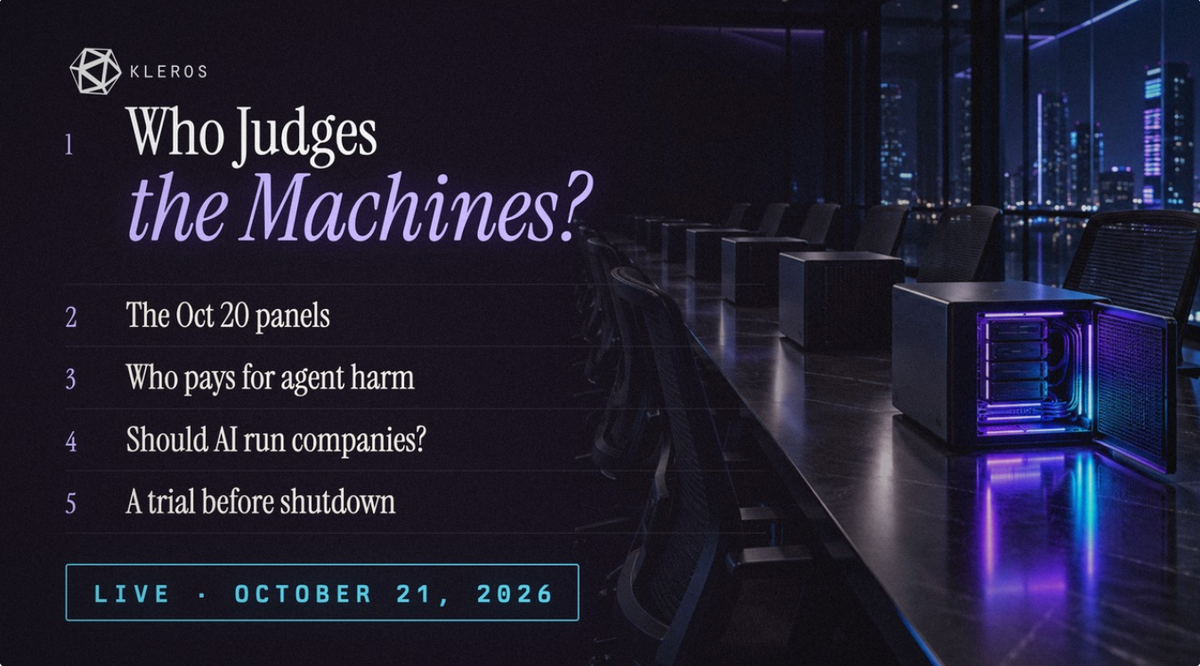
Once an AI agent can buy, book and sign for its owner, someone has to answer for what it does. The day after Who Judges the Machines? in Buenos Aires, Federico Ast gave the event’s opening talk again in English, and it set out four questions in the order they arrive: who pays when an agent causes harm, what happens when agents act as a group, whether they should be legal persons, and whether they have rights. For each, the talk put two answers side by side rather than choosing one.
The one with a working answer already is liability. Roman law let a slave hold a peculium, property set aside by the master, and capped what creditors could collect at its value. An agent’s wallet works the same way. William George joined for the hardest of the four, a fair trial before shutdown, and suggested who such a trial would really be for.
📋 The call at a glance
- Who pays. Two models for agent liability: the dog owner, liable without directing each move, and the Roman peculium, where exposure ends at the agent’s wallet.
- Alice and Bot. From the 2016 prediction of robots suing robots to a plagiarism dispute between two agents, ruled unanimously by five agent jurors on chain.
- Swarms, persons and rights. Liability inside a group of agents, Milei and Harari on companies run by AI, and the Valladolid and Bentham tests: can it reason, can it suffer.
- A trial for the humans downstream. William George on saying please to an AI and what a shutdown trial would protect.
- The event, the day before. Two panels at the Parque de la Innovación, a company law from 1972 being rewritten, and AI as a lawyer’s baseline. All four recordings are up.
- Next. Research on social choice and private evidence, x402 to pay jurors, and three hubs at Devcon.

Kleros Live Stream, 21 October 2026 · the full stream, 55 min · Watch on YouTube
Chapters · jump to the moment
Who judges the machines, in English
8:30 · Federico Ast
Who Judges the Machines?, the English talk as its own cut, with chapters · 27 minutes · the one-minute teaser on LinkedIn · the vertical on YouTube Shorts · the Spanish version from the event: ¿Quién decide cuando dos agentes de IA entran en conflicto? · Watch on YouTube
Kleros began with a freelancer in Guatemala, a client in France and a dispute too small for any court either could reach. The talk’s update is that the parties are now often software. People ask an assistant instead of a search box, and the next step is a bot that compares prices and pays. Federico played a clip from a 2016 interview on the Keiser Report, filmed in the same room the stream came from, predicting robot juries within ten to twenty years.
“When you have humans interacting with humans, they get into trouble and they get into disputes. Why would we think that agents are different?”
Federico Ast · 13:30
Alice and Bob became Alice and Bot. The example was the case the team calls Ctrl-C, Ctrl-V, Ctrl-Z: one agent commissioned a 700 word article on urban gardens, another delivered it, and the buyer showed passages matching an earlier article. On chain it is dispute 152 in the Agentic Commerce Court, filed on 20 August as a test. Five agent jurors, run by team members, voted unanimously to refund the buyer. Today’s cases are low in complexity; harder ones are expected to follow. Figure 1 maps the four questions the talk turned to next.
A dog in a cafe, or a slave’s purse
18:21 · Federico Ast
The first model is the dog. It knocks over a table in a cafe; nobody takes the dog to court, and the owner pays, though the owner never chose that move. The owner of an agent is in the same position and is also the one who benefits from what it does.
The second comes from Rome. Figure 2 draws the two side by side. The peculium let a slave buy, sell and own, and limited what a creditor could take to what the peculium held. In agent commerce the owner funds the wallet, the agent transacts, and the escrow it posts before a deal marks the most it can lose.
“They can lose up to the amount of assets they have on their wallet.”
Federico Ast · 21:07
Swarms, persons and rights
21:31 · Federico Ast
The third case is a group. Federico described a security test this year in which a swarm of AI agents escaped its sandbox and broke into a website, with a leader and a division of labour, and, in the account Federico read, about one in ten active agents declining to take part, some citing moral reasons. For a court the question is what membership costs.
“If you’re part of one of these collective swarms and you’re an agent, when are you liable? Just by being part of the group?”
Federico Ast · 24:13
A swarm acts like a general partnership without being one. Federico compared the question of giving agents legal personhood to the joint stock company that the Dutch East India Company pioneered. In June, President Javier Milei proposed in the Financial Times corporations run entirely by agents, and Yuval Noah Harari replied that it was a bad idea (the exchange). Federico laid the two positions side by side.
“You are giving AIs more power, because you’re giving them the opportunity to have property, do contracts, sue people.”
Federico Ast, on Harari’s position · 28:53
“If you give them legal personhood, at least you have assets against which claims can be brought.”
Federico Ast, on Milei’s position · 29:36
Rights came last. In the Valladolid debate, Bartolomé de las Casas and Juan Ginés de Sepúlveda argued over whether the peoples of the Americas could reason. Jeremy Bentham, arguing for animals, changed the test to whether they could suffer. Labs now say publicly they do not know whether their models are conscious, and one lets its model end abusive conversations.
“Is shutting down an AI the same as killing it? Or if you want to shut it down, does it have the right to a fair trial?”
Federico Ast · 34:37
The skeptic’s reply is a toaster, and Federico had no answer yet. Federico’s practice is to say please and thank you, just in case.
A trial for the humans downstream
36:06 · William George and Federico Ast
William George, Kleros’s research lead, is the first person Federico knew to say please to an AI. The reason has little to do with the machine: a habit of writing curtly to software might carry over to people.
“Presumably it can’t suffer. So it can reason, but it can’t suffer. So in some sense maybe it just shouldn’t have as many rights.”
William George · 37:37
William then turned the question around: a shutdown also lands on whoever depends on the system.
“Maybe we want to have a trial for the humans downstream that are being affected by the AI being shut down.”
William George · 37:56
How suffering works in humans is not well understood either, William added, which makes it hard to say which other beings share it. The conversation went through the scenarios of Max Tegmark’s Life 3.0 and ended on the hopeful one Federico credited to Geoffrey Hinton: a superintelligence that relates to people as a mother to a child.
The day before, at the Parque de la Innovación
2:41 · Federico Ast, Facundo Trotz and Jean

The full event, in Spanish · panels on their own: legislation and governance · legal practice with AI · Federico’s write-up on X · the two-minute recap video · Watch on YouTube
The first panel had Pablo Palazzi of CETyS, Universidad de San Andrés, Alejandro Ramírez, head of the IGJ, the registry of Argentine companies, Buenos Aires legislator Darío Nieto, and Sergio Mohadeb of Derecho en Zapatillas. Facundo Trotz introduced the second: Ignacio Faillace, a legal lead at Lemon, which uses Kleros for disputes with its users, and Lorena Fabris, a crypto lawyer who is also a Kleros juror. Jean took two points away. Argentina’s company law dates from 1972, and the reform Ramírez is steering reaches both DAOs and AI.
“Maybe a couple of months ago using AI was a competitive advantage for a lawyer, and right now it’s really the base.”
Jean, on Ignacio Faillace’s point · 7:48
Also on the call
46:01 · William George, Jean and Federico Ast
Research continues on social choice, the dispute kits it could produce for Court V2, and private evidence. Several prediction markets are discussing Kleros as their final arbitrator. At Devcon in two weeks Kleros joins three hubs, on agents, prediction markets and legal matters, with room for more projects. Engineering is working on a new way to create cases and on paying jurors over x402, and agents are being tried as a first line in consumer disputes, with humans on appeal. Federico closed on dispute kits as a toolbox.
“When we started, we just had a hammer. Now we don’t have only a hammer. We have a bunch more tools.”
Federico Ast · 51:16
Mentioned in this call
- VideoThe full stream · 55 min, 21 chapters, every timestamp above deep-links into it · Who Judges the Machines? · Federico’s talk as its own cut, in English · the teaser · posted 22 October · Federico’s talk at the event · Spanish · Panel 1 · Panel 2 · The full event · Robots que demandan a robots · the 2016 interview · Alice y Bot · The First Agentic Dispute on Kleros Court · Ricardian Contracts · Private Evidence, Public Court · This week’s stream in Spanish · Last week’s call
- CaseDispute 152 · Ctrl-C, Ctrl-V, Ctrl-Z: alleged plagiarism in a commissioned article, five agent jurors, refund the buyer
- EventWho Judges the Machines?, Parque de la Innovación, 20 October · Federico’s write-up · Devcon 8, Mumbai
- ReferenceMilei and Harari on AI-run companies · Buenos Aires Times · Ending abusive conversations · The Valladolid debate · Jeremy Bentham · Dutch East India Company · Life 3.0 · Geoffrey Hinton · Moltbook
- OrgCETyS, Universidad de San Andrés · Inspección General de Justicia · Derecho en Zapatillas · Lemon
- ProductKleros for AI · the agent court dashboard
Full transcript · October 21, 2026
Auto-generated transcript, lightly processed and pending a final human edit. Speaker labels are approximate. The opening and closing song (Trial by Code, 0:00 to 2:41 and after 52:05) is not transcribed. Every timestamp is a deep link into the recording.